Best Platform to Sell Online Courses in 2026: What to Know Before You Choose
The platform you use to sell your online course matters less than almost everyone in the online course industry wants you to believe.
Platforms have a vested interest in convincing you that their specific features, their community tools, their drip sequencing, their certificate generators, are the thing standing between you and a thriving course business. They're not.
The thing standing between most course creators and real revenue has nothing to do with the platform. It's the economics of how they're acquiring buyers, the structure of the funnel delivering people to the course page, and whether the math of the whole thing is built to actually work at scale.
That said, you do need a platform. And some choices are genuinely better than others depending on where you are in your business and what you're trying to build.
This article is going to cut through the noise, cover what actually matters when choosing a platform, and tell you what the people making real money from online courses understand that most first-time course creators don't.
What a Course Platform Actually Does
A course platform has one job: deliver your content to paying customers and handle the basic mechanics of the transaction.
It hosts your videos. It manages access control so only paying customers can see the material. It processes payments. It tracks student progress. In some cases it handles email sequences, upsells, and affiliate management.
That's it. That's the job.
The platform doesn't find your customers. It doesn't convince anyone to buy. It doesn't determine whether your offer is positioned correctly or priced right or specific enough to stand out in a crowded market.
A mediocre course on a great platform will underperform. A great course on a mediocre platform can still generate significant revenue if the funnel feeding it is built correctly.
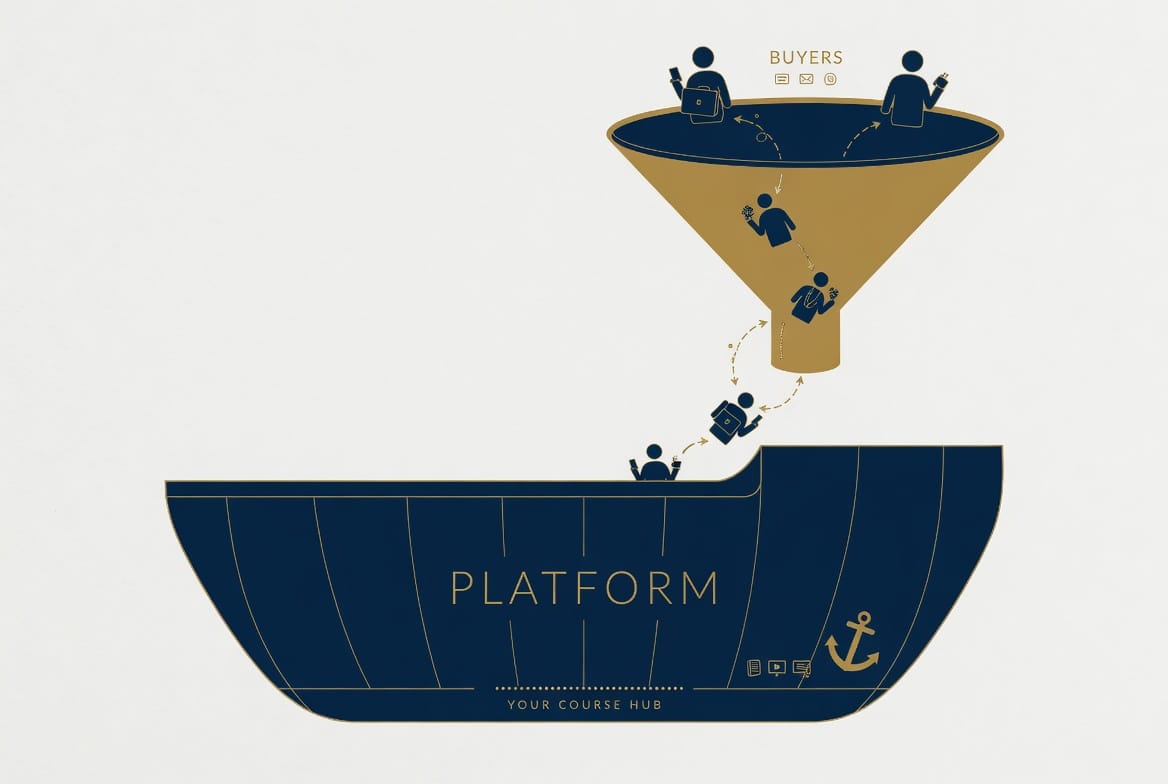
The reason this matters is that most course creators spend enormous energy evaluating platforms and almost no energy thinking about the funnel structure that will actually drive buyers to the course. They optimize the wrong variable.
The Two Fundamental Choices
Before getting into specific platforms, there's a more fundamental choice worth making clearly.
Do you want to host your course on a marketplace or on your own platform?
A marketplace like Udemy or Skillshare puts your course in front of their existing audience. You don't need to drive traffic. You don't need to build a list. You create the course, list it, and the platform markets it for you.
The tradeoff is significant. You don't own the customer relationship. Udemy controls the pricing, the discounting, and the communication with buyers. Your course gets bundled with thousands of others competing for the same eyeballs. Your income depends entirely on the platform's health and policies.
Your own platform, whether that's Teachable, Thinkific, Kajabi, Systeme.io, or something similar, gives you full control. You own the customer relationship. You control pricing. You can communicate with buyers directly. You build a list that compounds over time.
The tradeoff is that you need to drive your own traffic.
For anyone building a serious course business, your own platform is almost always the right answer. The customer relationship is the asset. Giving that to a marketplace means you're building on rented land.
What Actually Matters When Choosing a Platform
Once you've decided to host on your own platform, here's what actually matters in the decision.
Does it handle the checkout flow cleanly?
Your conversion rate at checkout is one of the most important numbers in your business. A clunky, slow, or confusing checkout experience loses buyers who were ready to purchase. Whatever platform you choose needs a clean, fast, mobile-optimized checkout that doesn't create friction between the buyer's decision and the completed transaction.
Does it support order bumps and upsells natively?
This is the feature most first-time course creators overlook and it's one of the most financially significant. An order bump on the checkout page, a simple checkbox add-on before the payment goes through, can add $5 to $15 to your average order value with no additional traffic required. An upsell immediately after purchase can add significantly more.
These two elements are often the difference between a paid traffic campaign that loses money and one that covers its own costs. If a platform doesn't support them natively, you're either leaving money on the table or paying for a third-party tool to add them in.
Is it simple enough that you'll actually use it?
This sounds obvious and it matters enormously. Platforms that are technically powerful but practically complicated create a constant friction between you and getting things done. The best platform for your business is one you'll ship content on consistently, not the one with the most features you'll never learn to use.
What does it cost relative to where you are right now?
Some platforms charge a monthly fee regardless of whether you're making money. Others take a percentage of revenue. Others do both. The right choice depends on your current revenue and trajectory.
If you're just starting out and not yet making consistent revenue, a high monthly fee platform is a cost you're paying before the business has proven itself. A lower monthly fee or revenue-share model makes more sense until you're generating enough to justify the upgrade.
The Platforms Worth Knowing About
System.io
Systeme.io has become one of the most compelling options for course creators who are also running funnels and paid traffic. It handles course hosting, email marketing, funnel building, order bumps, and upsells all under one roof. The free plan is genuinely functional. The paid plans are significantly cheaper than most competitors. If you're building the type of front-end funnel described throughout this series, Systeme.io is worth serious consideration because it handles all the connected pieces without requiring you to stitch together multiple tools.
Teachable
Teachable is one of the most established platforms in the space and has a clean, student-friendly interface. It handles the basics well. The main limitation for course creators running paid traffic campaigns is that the native checkout customization and upsell functionality is less robust than some alternatives, particularly at the lower price tiers. It works well for creators relying primarily on organic traffic and launches.
Thinkific
Thinkific is strong on the course delivery side and has improved its e-commerce functionality over time. Like Teachable, it's a solid choice for course creators who aren't heavily focused on funnel optimization. The free plan allows you to test before committing to a paid tier.
Kajabi
Kajabi is the all-in-one option that handles courses, email marketing, websites, funnels, and communities. It's the most expensive option by a significant margin. For creators generating substantial revenue who want everything in one place and are willing to pay for that convenience, it makes sense. For anyone just starting out or running a lean operation, the monthly cost is hard to justify before the business has scaled to the point where it can absorb it easily.
Podia
Podia is clean, simple, and handles digital downloads and courses without much friction. It's a reasonable option for creators who want simplicity over feature depth. The checkout and upsell functionality is limited compared to Systeme.io.
The Feature Nobody Talks About Enough
Here's what separates course creators who build real businesses from ones who stay stuck at modest revenue despite having good content.
The ability to move buyers from the front end to the back end automatically.
A course platform that only hosts your course content is a container. What transforms a container into a business is the post-purchase infrastructure that takes someone who just bought a $27 product and moves them, naturally and without pressure, toward a $197 course or a $500 coaching program.
This requires a few things working together. A thank you page that introduces the next offer immediately after purchase when buying momentum is at its peak. A post-purchase email sequence that delivers value, builds the relationship, and presents the back-end offer as the natural next step for someone who wants to go further. Clean integration between the course platform and the email marketing system so buyers are tagged and sequenced correctly without manual work.
Some platforms handle all of this natively. Others require integration with external email tools. A few make it unnecessarily complicated.
Whatever platform you choose, map out how the buyer journey works from the moment they complete their first purchase to the moment they're presented with the next offer. If that path is clear and simple, the platform is doing its job. If it requires workarounds and manual intervention, you'll lose buyers who would have converted with a cleaner experience.
The Decision Most People Get Backwards
Most course creators choose their platform first and then figure out their funnel structure afterward.
This is backwards.
Your funnel structure determines what your platform needs to do. If you know you're going to run paid traffic to a low-ticket front-end product with an order bump and upsell, you need a platform that handles those elements cleanly. If you know you're going to rely primarily on launches to a warm list, your requirements are different.
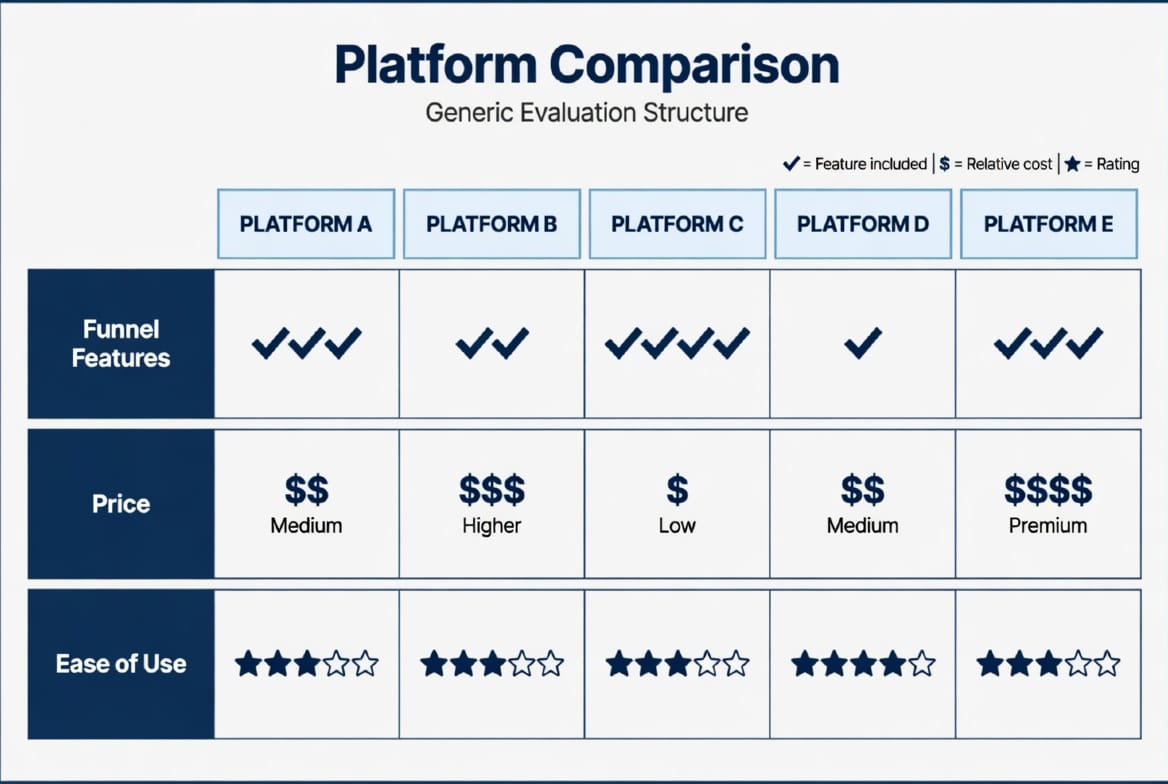
Map the buyer journey you intend to create before evaluating platforms. Then evaluate platforms against that specific journey rather than against a generic feature comparison.
Priya Sharma chose her first platform based on a recommendation she found in a Facebook group. It was a perfectly good platform. But it didn't natively support order bumps, and adding them required a third-party integration that took her several weeks to set up correctly. Those weeks cost her front-end revenue she never recovered.
When she rebuilt her funnel eight months later with a platform that handled the full checkout flow natively, her average order value improved immediately just from removing the friction.
The platform didn't change her content. It changed the mechanics of the transaction. And the mechanics of the transaction determined whether the math of the whole business worked.
What the Platform Decision Actually Costs You
The platform decision has two costs that most people only count one of.
The monthly subscription fee is the visible cost. It's the one that shows up on your credit card statement and feels concrete.
The invisible cost is what happens when your platform limits your ability to execute the funnel structure that makes your economics work.
A platform that doesn't support order bumps costs you every order bump you could have captured. A platform with a slow or clunky checkout costs you every buyer who got frustrated and left before completing the purchase. A platform that doesn't integrate cleanly with your email marketing tool costs you every buyer who should have received a post-purchase sequence and didn't.
These are not small numbers. Order bumps alone can add 30 to 40 percent to your front-end revenue. That's the difference between a paid traffic campaign that breaks even and one that's profitable.
Choose the platform that lets you execute the funnel you need. Not the cheapest option. Not the most feature-rich option. The one that handles the specific mechanics of the buyer journey you're building.
The Bottom Line
The best platform to sell online courses is the one that supports the full buyer journey you need to execute without creating unnecessary friction, at a price point that makes sense for where your business is right now.
For most course creators building the type of front-end funnel described throughout this series, the platforms that handle course delivery, order bumps, upsells, and post-purchase sequencing under one roof are worth the additional cost compared to platforms that handle only the delivery side.
The platform is the foundation. The funnel is the business. Get the funnel structure right first, then choose the platform that lets you execute it cleanly.
How to build that funnel structure, from the front-end offer through the value stack and the post-purchase sequence, is exactly what Get Paid to Get Leads covers.