Facebook Ads for Course Creators
Most course creators who try Facebook ads lose money the first time.
Sometimes the second time too.
They set up the campaign, run it for two or three weeks, watch the money leave the ad account, and quietly conclude that Facebook ads don't work for their type of business. They go back to organic content and file paid traffic under "things other people can make work but I can't."
Almost every time, that conclusion is wrong.
The ads didn't fail. The funnel sitting behind the ads failed. And those are two completely different problems with two completely different solutions.
Facebook ads work for course creators. They work extremely well when the math behind the campaign is right. When it isn't, it doesn't matter how good the targeting is or how well-written the ad copy is or how precisely you've identified your audience. The campaign will lose money and keep losing money until the underlying structure changes.
This article is going to walk through what that structure looks like, why most course creator campaigns fail before they have a real chance, and what the math needs to look like for Facebook ads to be a viable growth channel for your specific business.
Why Facebook Ads Fail for Most Course Creators
The standard course creator Facebook ad campaign looks like this.
You create an ad. You target people who are interested in your topic. You send them to a free lead magnet or directly to your course sales page. You run the campaign for two to three weeks. You evaluate the results.
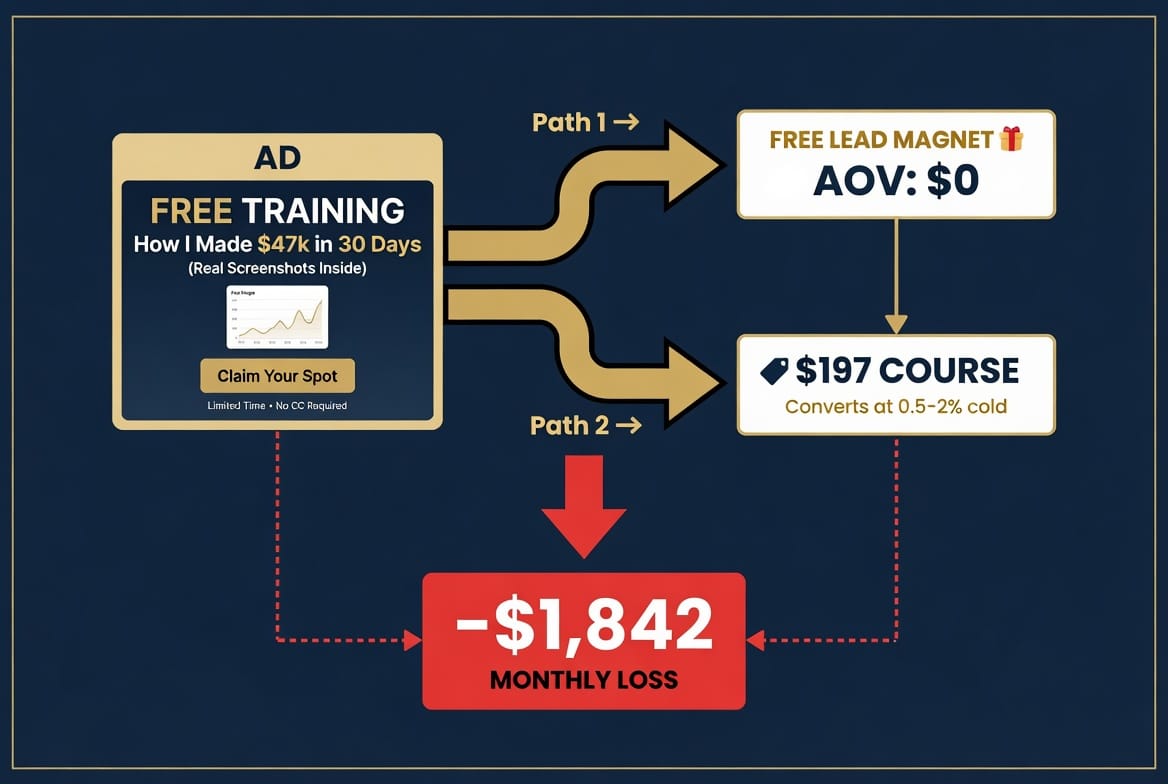
If you sent them to a free lead magnet, you probably got leads at a reasonable cost per lead and almost no sales from those leads in the campaign window. If you sent them directly to a course sales page, you probably got very few sales at a cost per acquisition that made the economics look terrible.
Either way the campaign looks like a failure and the conclusion is that Facebook ads don't work.
Here's what actually happened in both cases.
The free lead magnet campaign failed because it had no front-end revenue. Every dollar you put into the ad account stayed spent. There was nothing coming back out on the front end to offset the acquisition cost. The only way that campaign could ever be profitable was if your email nurture sequence converted enough of those free leads into buyers over the following weeks and months to justify what you spent getting them.
For most course creators running this model, it doesn't happen fast enough or at a high enough rate to make the math work.
The direct-to-sales-page campaign failed because cold traffic won't pay $197 or $497 to someone they met ten minutes ago at a meaningful conversion rate. The trust required to justify that purchase doesn't exist at the moment of first contact. Your conversion rate on cold traffic to a mid-to-high ticket course is going to be somewhere between 0.5 and 2 percent on a good day. At those conversion rates the cost per acquisition is almost always higher than the revenue generated.
Neither campaign failed because of Facebook. Both failed because of what was sitting behind the ad.
The Funnel Structure That Makes Facebook Ads Work
Facebook ads become viable for course creators when the funnel behind the ad is structured to recover the cost of the traffic on the front end.
Not on the back end weeks later. On the front end, in the same transaction window as the initial click.
That requires a specific funnel structure. A low-ticket front-end product priced between $7 and $47 that solves one specific immediate problem. An order bump on the checkout page that adds a complementary resource at $17 to $27. An upsell immediately after purchase that delivers a deeper version of the solution at $37 to $97.
Together those three elements produce an average order value that can cover the cost per acquisition on Facebook traffic in most course creator niches.
Here's what that math looks like in practice.
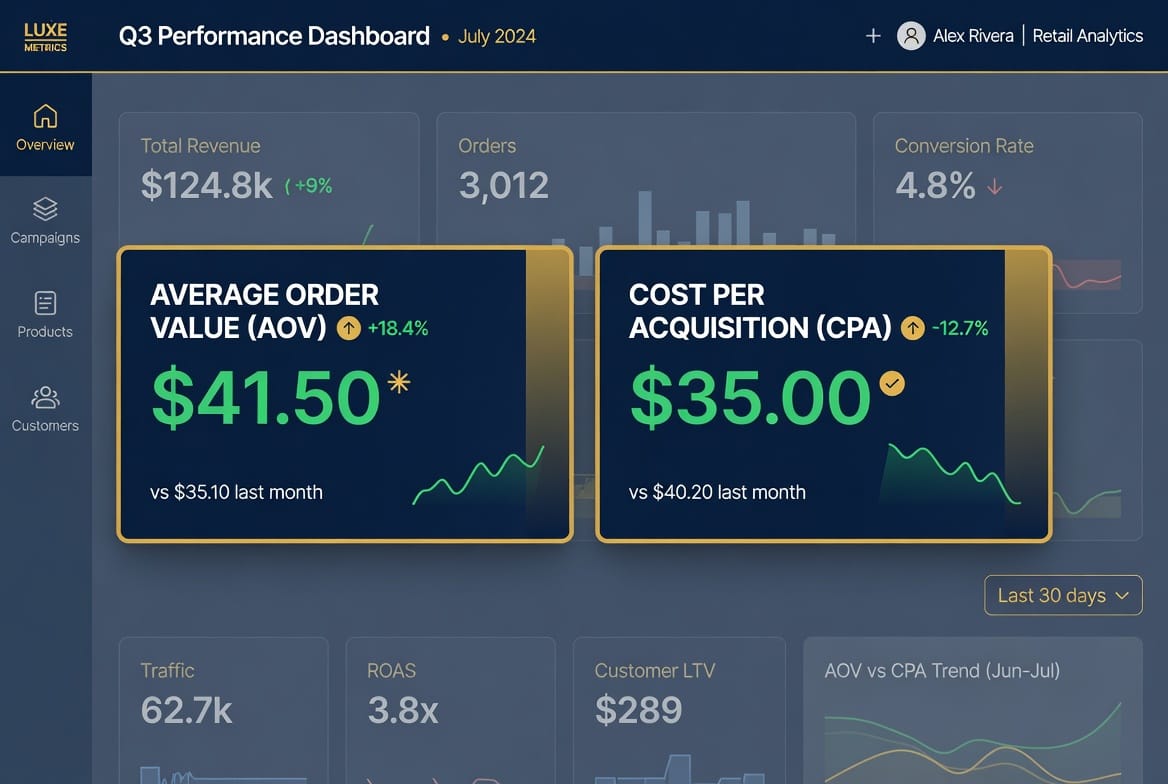
Front-end product at $27. Order bump at $17 converting at 30 percent adds $5.10 to the average order. Upsell at $47 converting at 20 percent adds $9.40 to the average order. Total average order value: $41.50.
If your cost per acquisition on Facebook is $35, your front end is generating $6.50 per buyer before your course or coaching program ever enters the picture.
That's the structural shift that makes Facebook ads work for course creators. Not a better audience. Not better creative. A funnel that generates revenue on the front end instead of one that spends money on the front end and hopes the back end saves it.
How Facebook's Algorithm Actually Works
Understanding how Meta's algorithm finds your buyers changes how you think about campaign setup completely.
Most course creators spend significant time and energy on audience targeting. Interests, behaviors, demographics, lookalike audiences. They treat the targeting as the primary variable that determines campaign performance.
It isn't. Not anymore.
Meta's algorithm has become sophisticated enough that the ad creative is the primary targeting mechanism. The algorithm uses the behavioral signals of the people who respond to your ad to find more people who match that profile. The first buyers who convert teach the algorithm what your buyer looks like. It then goes and finds more people who look like them.
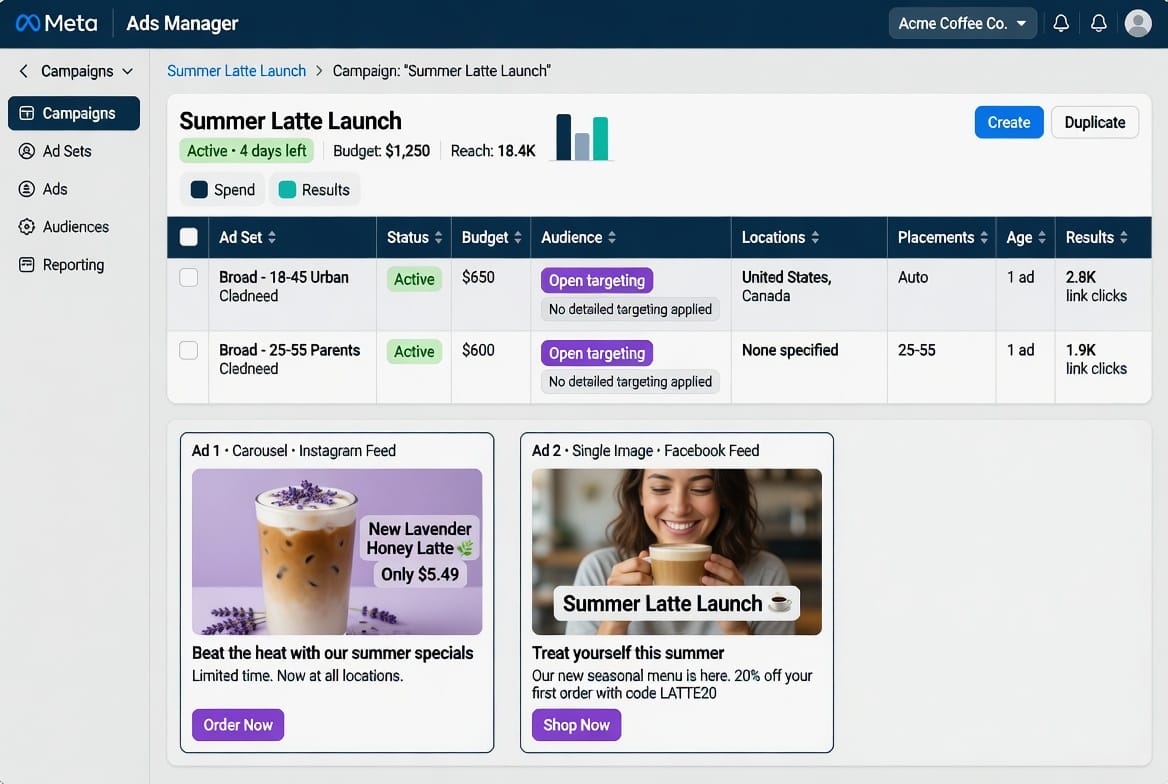
What this means practically is that overly restrictive targeting often hurts performance. The algorithm needs room to work. Giving it a tightly defined audience limits its ability to find the people within that audience who are most likely to buy.
The campaign structure that consistently outperforms for course creators running low-ticket front-end funnels is simpler than most people expect.
One Advantage+ campaign. Open targeting with no interest restrictions. Two ads running simultaneously with two different creative angles. Daily budget set at three to five times the price of the front-end product. Give it seven to ten days before making any decisions based on the data.
The algorithm does most of the heavy lifting. Your job is to give it a strong enough ad to work with and enough budget to find the right people.
What Makes a Facebook Ad Work for a Course Creator
The ad itself has one job: stop the right person mid-scroll and give them a reason to click.
That sounds simple. It's where most course creator campaigns fall apart before the funnel ever has a chance to perform.
The most common mistake is leading with the course. Talking about the modules, the bonuses, the transformation, the methodology. All of that is relevant to someone who is already evaluating whether to buy. It's irrelevant to someone who is scrolling their Facebook feed and hasn't yet decided they have a problem worth solving.
The ad needs to meet the person where they are, not where you want them to be.
The hooks that consistently perform for course creators running low-ticket front-end funnels have a few things in common.
They name a specific problem in language the ideal buyer uses to describe that problem to themselves. Not the clinical or professional language you might use to describe it. The words they actually say in their head when they're frustrated.
They make a specific, believable promise that addresses that problem. Not "transform your life" or "take your business to the next level." A concrete, tangible outcome that the right person reads and thinks "I would pay money for that."
They create enough curiosity or urgency that the person who recognized themselves in the hook is compelled to click rather than scroll past.
The best performing ad Matthew Coast has run for Get Paid to Get Leads opens with this: "A free lead is worth about $1. A buyer is worth $10 to $100. You already know which list you want to be building."
Three sentences. A specific data point. A contrast. An implied question the viewer answers in their own head before the ad continues. No mention of the product. No pitch. Just a hook that speaks directly to the person who already knows they have a list quality problem and is looking for someone who understands it.
The Two Numbers That Tell You Everything
Once your campaign is running, most of the data in your ads manager is noise.
Not useless noise. But noise that will distract you from the two numbers that actually tell you whether the campaign is working.
Number one is cost per acquisition. What are you spending on average to generate one buyer.
Number two is average order value. What is the average buyer spending when they go through your funnel.
Those two numbers in relation to each other tell you the only thing that matters in the early stages of a campaign: is the math working?
If your AOV is above your CPA, the front end is covering the cost of the traffic. The campaign is viable. Optimize and scale.
If your AOV is below your CPA by a small amount, something specific is underperforming. Usually the order bump conversion rate or the landing page conversion rate. Both are fixable without rebuilding the campaign.
If your AOV is dramatically below your CPA, the issue is more fundamental. Either the offer isn't specific enough, the price point isn't right, or the ad is attracting the wrong type of traffic. That requires going back before the campaign rather than optimizing within it.
Everything else in your ads manager, click-through rates, cost per click, reach, frequency, these are inputs that affect your CPA. They're worth understanding when you're diagnosing a problem. They're not worth obsessing over when the campaign is working.
Watch AOV and CPA. Let everything else be secondary.
The Budget Question Most Course Creators Get Wrong
The most common question course creators ask about Facebook ads is how much they need to spend to see results.
The most common answer they get is some version of "it depends" which is accurate and not very useful.
Here's something more specific.
The testing budget for a low-ticket front-end funnel should be set at three to five times your front-end product price per day. For a $27 product that's $81 to $135 per day. For a $47 product that's $141 to $235 per day.
That budget level gives Meta's algorithm enough daily spend to optimize without burning through budget faster than you can evaluate what's happening. It's also calibrated to your front-end price so that a handful of daily conversions will tell you pretty quickly whether the math is working.
Run that budget for seven to ten days before making any decisions. The first two to three days of a new campaign are noisy. The algorithm is learning. Conversion rates fluctuate. Making changes based on day two data is one of the most common ways course creators destroy campaigns that would have found their footing with a little more time.
By day seven you have enough data to make a real assessment. Is your CPA below your AOV? Is your landing page converting at 2 percent or better? Are buyers taking the order bump at a reasonable rate?
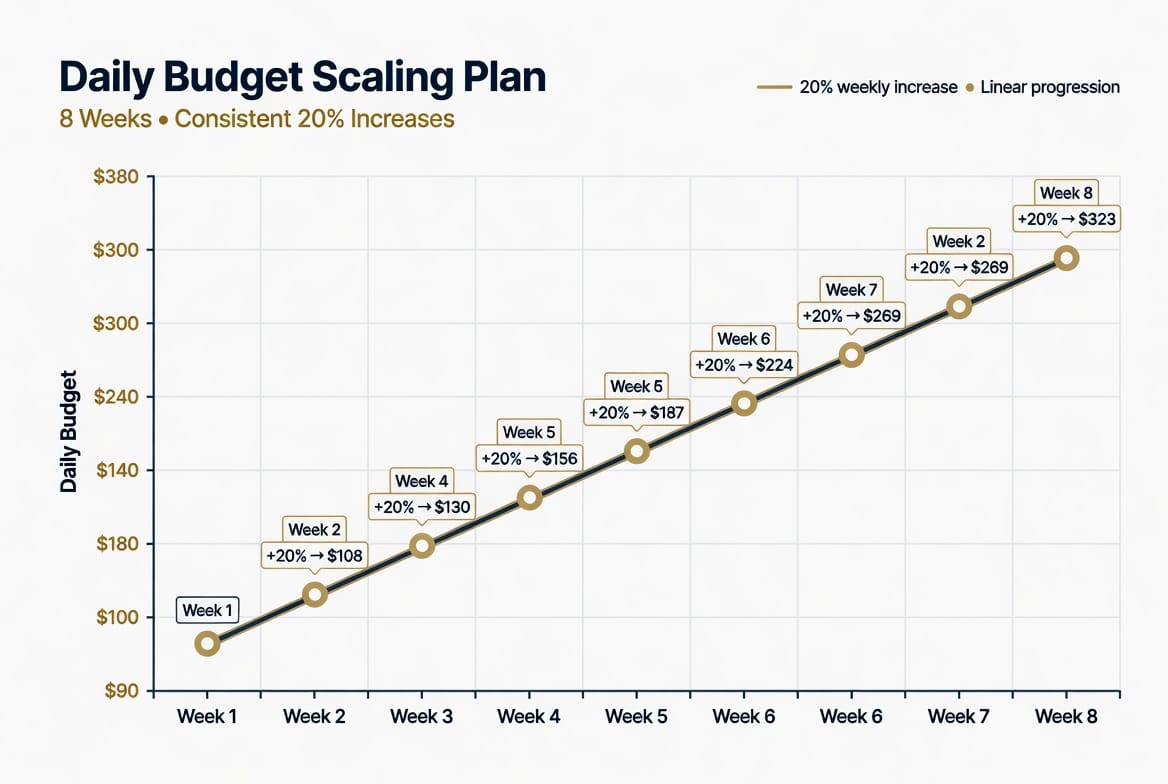
If the answers are yes, you have a working campaign. Scale it slowly, 20 percent budget increases every 48 hours, and watch that the AOV to CPA relationship holds at the higher spend level.
If the answers are no, you have a diagnostic process. Which specific number is off. What's the most likely cause. What's the smallest change that addresses it directly.
That process, applied consistently and without panic, is how course creators go from losing money on Facebook ads to building a self-funding buyer acquisition machine.
What Scaling Actually Looks Like
Most course creators who get a Facebook campaign working make one of two mistakes when they try to scale it.
They increase the budget too aggressively, forcing Meta's algorithm to reset its optimization and often causing performance to drop even in a campaign that was working well.
Or they start changing creative, targeting, and offer elements simultaneously, making it impossible to know which change caused any subsequent shift in performance.
Scaling a Facebook campaign is a discipline of patience and small moves.
When the campaign is green, meaning your ROAS is at or above break-even, you increase the daily budget by 20 percent and wait 48 hours before evaluating again. Not 50 percent. Not double. 20 percent. Small enough that the algorithm can recalibrate without resetting. Large enough to produce meaningful growth over time.
When performance dips below break-even for a single day or two, you hold the budget steady and give it 48 to 72 hours to recover. One bad day doesn't mean the campaign is broken. Overreacting to short-term variance is one of the most reliable ways to kill a campaign that would have recovered on its own.
When performance has been consistently below break-even for three or more days, you pause the underperforming ad and introduce a new creative angle to replace it. You don't reduce the budget, you don't change the targeting, you replace the specific element that's most likely causing the problem.
Marcus Thompson scaled his Facebook campaign from $90 a day to $380 a day over eight weeks using exactly this process. His ROAS stayed between 1.2 and 1.7 the entire time. His buyer list grew by 1,400 people. His back-end coaching program had a waiting list for the first time in three years.
That's what disciplined scaling looks like. Not a dramatic overnight transformation. A steady, controlled process of increasing spend while keeping the math intact.
The Validation Step Most Course Creators Skip
Before spending real money scaling a Facebook campaign, there's a step that dramatically increases the likelihood the campaign will work.
Validating that cold strangers will pay for your specific offer at your specific price point before you invest in the full funnel build.
Most course creators skip this. They build the full funnel, write the ads, set the budget, and find out whether the offer converts when real money is already committed.
A five-day validation test with a minimal version of the offer, run to cold traffic on a small daily budget, tells you everything you need to know before you make that commitment. Does the offer convert at a viable rate on cold traffic? Will real strangers with no prior relationship to you pay this price for this solution?
If the answer is yes, build the full funnel with confidence. If the answer is no, you've bought that information for a few hundred dollars instead of discovering it after months of build time and a failed launch.
The validation step isn't glamorous. It doesn't make for a good story about launching a course to massive immediate success. But it's the thing that turns Facebook ads from an expensive experiment into a predictable system for acquiring buyers.
And a predictable system for acquiring buyers is what separates the course creator business that scales from the one that launches periodically, makes some sales, and stays stuck below the ceiling that better Facebook ads alone can never push through.
The complete framework for building that system, including how to structure the offer, validate the demand, set up the campaign, and scale it without it consuming your life, is exactly what Get Paid to Get Leads covers.