Facebook Ads for Small Business: What Actually Works and What Wastes Your Money
Most small business owners who try Facebook ads have the same experience.
They spend a few hundred dollars. Maybe a thousand. They get some clicks, a handful of leads, and almost no sales. They conclude that Facebook ads don't work for small businesses and go back to whatever they were doing before.
The conclusion is almost always wrong.
Facebook ads work for small businesses. They work extremely well when the infrastructure behind the ad is set up correctly. When it isn't, it doesn't matter how good the targeting is or how much you spend. The campaign will keep losing money until the underlying problem gets fixed.
The problem is almost never the ad. It's almost always the funnel.
This article is going to walk through what actually works for small businesses running Facebook ads, why most campaigns fail before they have a real chance, and what the math needs to look like for paid traffic to make sense for a business running on a real budget with real constraints.
Why Facebook Ads Are Different for Small Businesses
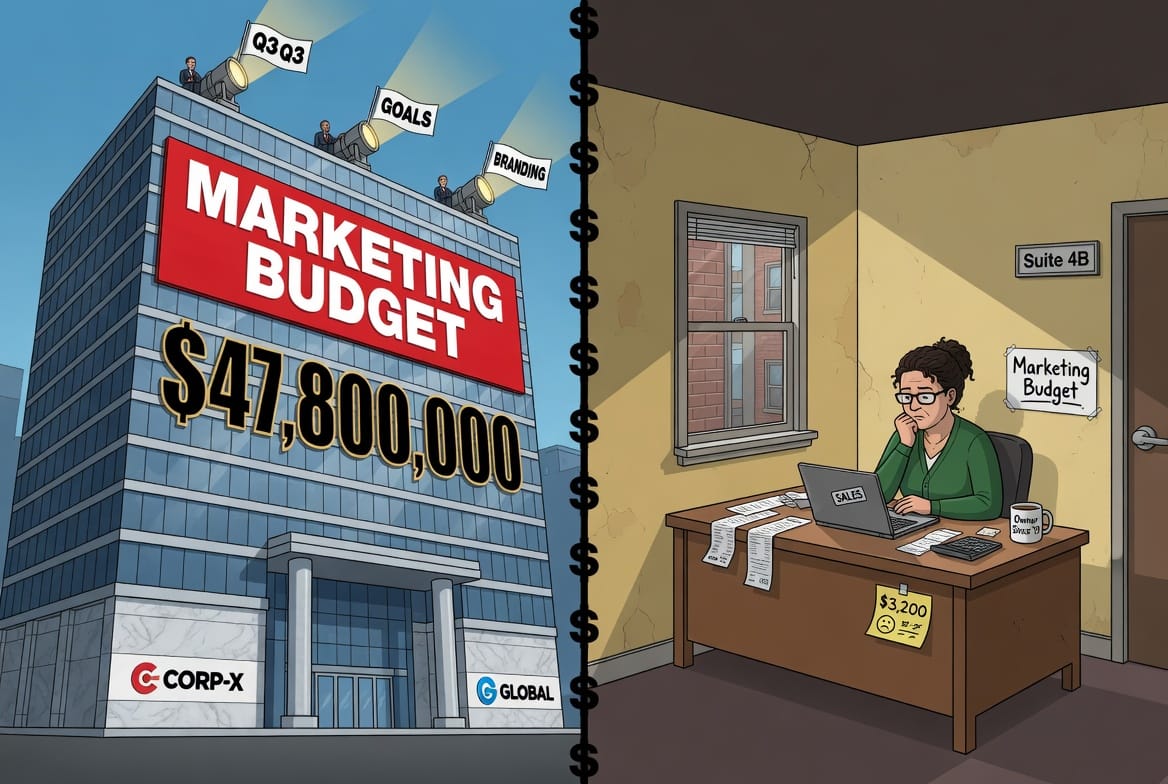
Large companies running Facebook ads operate in a fundamentally different environment than small businesses.
A large company has a marketing budget that exists as a cost center. They can run campaigns that lose money for months while brand awareness builds and the back end eventually converts. They have teams to manage creative, analytics, and optimization. They can absorb bad months without it affecting payroll.
A small business doesn't have any of that.
When you're running a business where every dollar matters, a $500 campaign that returns nothing isn't a learning experience that gets filed away in a quarterly report. It's $500 you personally earned that's now gone. That changes everything about how you make decisions, how long you give campaigns to run, and how much risk you can absorb while you figure out what works.
The result is that most small business owners approach Facebook ads the way large companies do but without the budget, the team, or the runway to make that approach work. They send traffic to free lead magnets or directly to their offer page, watch the money leave the account, and walk away convinced the platform doesn't work for them.
The platform works. The approach doesn't.
The One Structural Problem Behind Most Failed Campaigns
If you've run Facebook ads before and lost money, there's a very high probability the problem came from one specific place.
You were sending paid traffic to something that had no mechanism for returning money on the front end.
Here's what that means in plain terms.
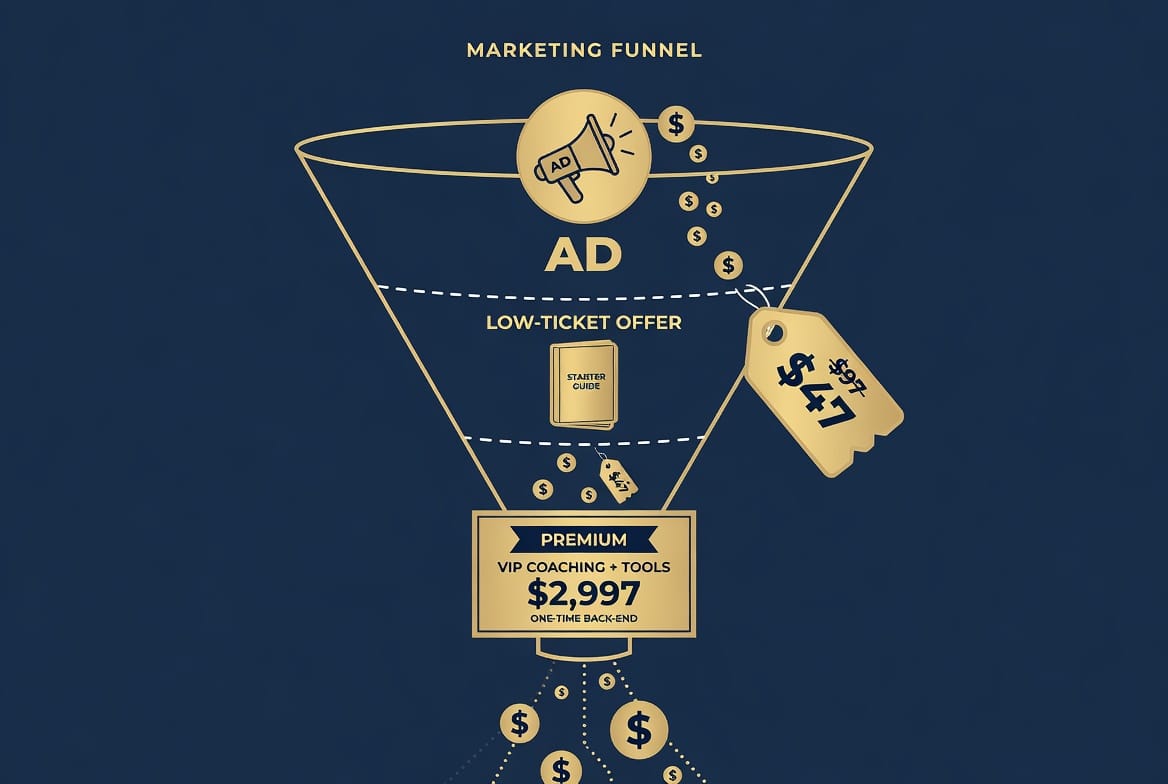
When you run traffic to a free lead magnet, every dollar you spend on ads stays spent. Someone clicks your ad, downloads your free guide, lands on your list. Nothing comes back in. The only way that campaign ever becomes profitable is if your email nurture sequence converts enough of those free leads into buyers over the following weeks and months to justify what you spent acquiring them.
For most small businesses running real budgets with real time constraints, that never happens fast enough.
When you run traffic directly to a product or service page, you're asking cold traffic to make a purchase decision from someone they've never heard of before. Cold traffic conversion rates on direct offers are low, typically 0.5 to 2 percent on a good day. At those rates, the cost per customer is almost always higher than the margin on the sale.
Both models fail for the same reason. There's no mechanism on the front end to recover the cost of the traffic before the back end ever enters the picture.
The fix isn't better ads. It isn't smarter targeting. It's building a front end that generates revenue from the traffic in the same transaction window as the initial click.
What a Self-Funding Campaign Actually Looks Like
The model that works for small businesses running Facebook ads is built around one core idea.
The front end of your funnel needs to cover its own costs.
That means when someone clicks your ad and buys something, the revenue from that transaction should be close to or greater than what you paid to get them there. When that math works, every customer costs you nothing net to acquire. Your ad spend comes back out as front-end revenue, and every buyer on your list is essentially free.
For coaches, consultants, and course creators, this usually means a low-ticket front-end product. Something priced between $7 and $47 that solves one specific, immediate problem your ideal customer is already trying to solve. Not your flagship program. Not a watered-down version of your main offer. One problem, one solution, one simple transaction.
For other small businesses, the principle is the same even if the specific structure looks different. The question is always: is there something on the front end of this funnel that generates enough revenue to offset the cost of the traffic finding it?
When the answer is yes, Facebook ads become a growth lever instead of an expense.
When the answer is no, they become a drain regardless of how well you optimize the campaign.
The Math Every Small Business Owner Needs to Run
Before spending a dollar on Facebook ads, there are three numbers you need to know.
The first is your average order value. What does the average customer spend when they go through your funnel, including any add-ons or upsells behind the initial purchase?
The second is your target cost per acquisition. What can you afford to spend on ads to get one customer while still being profitable? This number depends entirely on your margins and your average order value.
The third is your ROAS. Return on ad spend. Divide your total funnel revenue by your total ad spend. A ROAS of 1.0 means you're breaking even. Above 1.0 means the front end is profitable. Below 1.0 means you're losing money on the front end and need your back end to save you.
The goal for most small businesses starting with Facebook ads is to get to ROAS 1.0 on the front end before anything else. Breaking even on the front end means your buyers are free. Every dollar you put into the ad account comes back out as revenue. Every buyer who lands on your list cost you nothing net to acquire.
That's the starting point that makes scale possible. Not profit on the front end, not immediately. Break even first, then optimize toward profitability as the campaign finds its footing.
Marcus Thompson, a business coach who had tried and failed with Facebook ads twice before, restructured his funnel around this math. His front-end product was $27. An order bump at $17 converting at 31 percent and an upsell at $47 converting at 22 percent pushed his average order value to $42.61. His cost per acquisition was $31. His front end was generating $11.61 per buyer before his coaching program ever entered the picture.
That's not a massive margin. But it's a positive one. And a positive margin on the front end means the back end is pure profit.
How Much Do Small Businesses Actually Need to Spend?
This is the question most people ask first and it's usually the wrong question to start with.
The right question is: how much do I need to spend to get enough data to know whether this is working?
The answer to that question is more specific. A meaningful Facebook ads test for a small business running a low-ticket front-end funnel requires a daily budget of three to five times the price of the front-end product. For a $27 product, that's $81 to $135 per day. Run that for seven to ten days before making any decisions.
That puts the cost of a real test somewhere between $567 and $1,350.
That's not a small amount of money for a business operating on a tight budget. But it's the minimum that gives Meta's algorithm enough data to optimize and gives you enough information to make a real decision about whether the campaign is working.
Running a campaign on $10 or $20 a day produces data so slowly that you can't distinguish between a campaign that needs time to find its audience and one that fundamentally doesn't work. You end up making changes based on noise rather than signal and the campaign never has a chance to perform.
If $1,000 isn't available for a test, the answer isn't to run the test at a lower budget. The answer is to validate the offer first at a minimal cost to confirm demand exists before committing to the full test.

What Small Businesses Get Wrong About Targeting
One of the most common mistakes small businesses make with Facebook ads is spending too much time and energy on audience targeting.
They build detailed interest stacks. They layer in behavioral filters. They try to narrow the audience down to exactly the type of person they think will buy.
This approach made more sense five years ago. It makes less sense now.
Meta's algorithm has become sophisticated enough that the ad creative is the primary targeting mechanism. The algorithm uses the behavioral signals of the people who respond to your ad to find more people who match that profile. The first buyers who convert teach the algorithm what your buyer looks like. It goes and finds more people like them.
What this means practically is that overly restrictive targeting often hurts performance. You're limiting the algorithm's ability to find the right people within your audience.
The campaign structure that consistently outperforms for small businesses testing a new offer is simpler than most people expect. One Advantage+ campaign with open targeting and no interest restrictions. Two ads running simultaneously with two different creative angles. Let the algorithm do the work of finding who responds.
This feels counterintuitive because it removes the sense of control that comes with detailed targeting. But the data consistently shows that open targeting with strong creative outperforms narrow targeting with the same creative in most small business contexts.
What to Watch and What to Ignore
When your campaign is running, most of the data in your ads manager is noise.
Click-through rate, cost per click, reach, frequency, these numbers affect your outcome but they're not the outcome itself. Obsessing over them leads to changes made based on inputs rather than results.
Watch two numbers above everything else.
Cost per acquisition and average order value.
If your AOV is above your CPA, the math is working. Optimize and scale slowly.
If your AOV is below your CPA by a small margin, one specific thing is usually underperforming. Either the landing page conversion rate or the order bump conversion rate. Both are fixable without starting over.
If your AOV is dramatically below your CPA, the issue is more fundamental. The offer isn't specific enough, the price point is wrong, or the ad is attracting the wrong type of traffic. That requires going back before the campaign rather than optimizing within it.
Give the campaign seven to ten days before making any meaningful changes. The first few days of a new campaign are noisy while the algorithm learns. Making changes based on day one or day two data kills campaigns that would have found their footing with more time.
The Small Business Advantage Most People Don't See
Here's something worth understanding that rarely gets talked about in conversations about Facebook ads for small businesses.
Small businesses actually have a structural advantage over large companies in one specific area.
Speed and specificity.
A large company running Facebook ads is usually selling to a broad audience with a general message. Their creative goes through approval processes. Their campaigns get managed by agencies or marketing departments with dozens of competing priorities.
A small business owner who knows their customer intimately can write ad copy that speaks directly to a specific problem in language their ideal customer uses to describe it to themselves. They can test a new angle in an afternoon. They can respond to what the data is telling them in real time.
That specificity is what makes the creative work. And the creative, not the targeting, is what makes the campaign work.
The small business owner who understands the economics of a self-funding funnel and writes ad creative that speaks precisely to their ideal customer's most acute problem is not at a disadvantage to large companies on this platform.
They're at an advantage.
The System Behind This
Everything covered in this article, the front-end funnel structure, the math of AOV and CPA, the campaign setup, the scaling process, comes from one connected system.
A low-ticket front-end product that acquires buyers instead of leads. A value stack that pushes average order value above the cost of the traffic. A post-purchase sequence that moves buyers toward the back end. An ad setup that gives the algorithm room to find the right people. A daily process for reading the numbers and making decisions without overreacting to noise.
Each piece depends on the others. A great front-end offer without the value stack won't cover ad costs. A great value stack without the right ad won't attract the right buyers. The system works when all the pieces are in place.
That complete system, including how to build each piece and make the math work from the first week of running traffic, is exactly what Get Paid to Get Leads covers.