How a $27 Product Pre-Qualifies Your Leads Before They Ever Book a Time With You
David Chen made one change to his lead generation system in the spring of his third year in business.
He stopped sending people directly to his discovery call booking page.
Instead he put a $27 product in front of them first. A specific, focused resource that addressed the exact problem his ideal consulting clients were already trying to solve. Nobody was pressured to buy it. Nobody was told it was a prerequisite for working with him. It was simply the first thing they encountered when they found him.
The people who bought it went into a short email sequence. The sequence delivered value, built the relationship, and at the end introduced the option to book a call with David for anyone who wanted to go further.
His calendar didn't fill up as fast as it had with cold outreach.
But 34 percent of the calls he took closed into paying clients. Up from 11 percent.
He was taking fewer calls and closing more business. The $27 product hadn't just changed his revenue. It had changed his entire experience of running the business.
Here's exactly what that product was doing that his cold outreach never could.
What a Purchase Actually Signals
When someone pays you $27, the transaction itself is almost irrelevant.
The signal behind the transaction is everything.
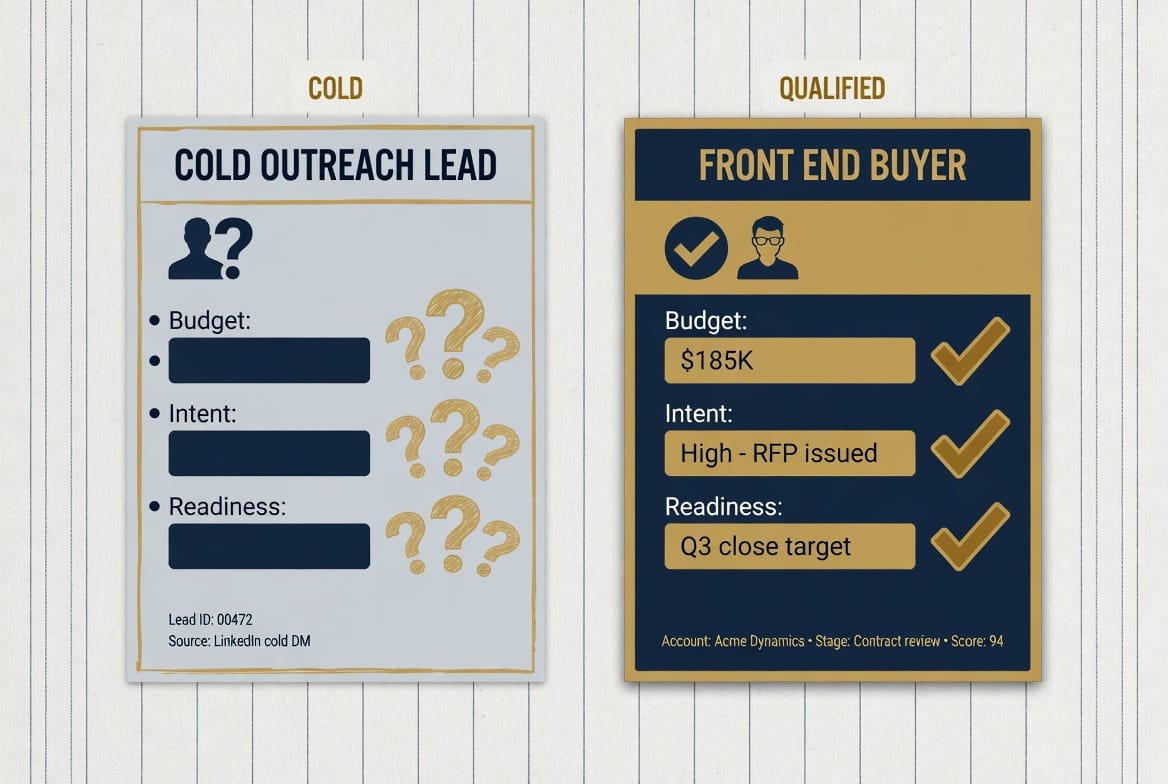
That person has just told you, with their actual behavior rather than their stated intentions, four specific things about themselves.
They have a real problem they're actively trying to solve, not just vaguely interested in. They are the kind of person who invests money in solutions rather than waiting for free information to magically fix things. They have enough trust in you specifically to hand over their credit card details. And they are paying attention right now, in this moment, to this category of problem.
No qualifying question on a booking form extracts that information reliably. People can say anything on a form. A purchase is a behavior. Behaviors are far more predictive of future behaviors than self-reported intentions.
The $27 buyer who shows up on David's calendar has already demonstrated all four of those things before he ever says hello. The cold outreach prospect who shows up on his calendar has demonstrated none of them.
That's the gap between an 11 percent close rate and a 34 percent close rate.
The Filtering That Happens Without You Doing Anything
The thing David appreciated most about the front-end product wasn't the revenue it generated.
It was the filtering that happened automatically without him having to do anything.
In his cold outreach days, the filtering burden fell entirely on him. He was the one trying to figure out, through conversation, whether the person across from him was a real prospect or a time sink. He was investing his energy in that filtering process on every single call, often getting it wrong, and paying the price in wasted hours and deflated motivation.
The front-end product transferred that burden to the prospect.
The act of paying $27 was the filter. Anyone who wasn't serious enough about their problem to invest $27 in a solution self-selected out before they ever reached his calendar. Anyone who did pay had already demonstrated the seriousness that David had previously been trying to assess through conversation.
He didn't have to qualify them. They had already qualified themselves.
And the qualification was reliable in a way that a conversation never fully can be. You can talk your way past a qualifying question. You can't fake a credit card transaction.
What the $27 Product Actually Does to the Relationship
Beyond the filtering, the front-end product does something else that cold outreach can't replicate.
It establishes the relationship on completely different terms.
When a cold prospect books a discovery call, they arrive as an evaluator. They're there to assess whether you're worth their money. The dynamic is inherently adversarial in a low-grade way. They're skeptical. You're selling. Both parties know it.
When a front-end buyer books a call, they arrive as someone who has already made a positive decision about you. They paid. They consumed the product. They got value from it. They want more.
The dynamic is completely different. They're not evaluating whether to trust you. They already trust you. The call is about whether the specific offer you have is the right fit for where they are right now.
David described the difference this way: "Cold outreach calls feel like job interviews where I have to convince someone to give me a chance. Calls from funnel buyers feel like conversations with someone who already hired me and wants to know what the next engagement looks like."
That shift in dynamic doesn't come from better sales training or a stronger close. It comes entirely from the quality of the relationship that exists before the call starts.

The Email Sequence That Bridges the Gap
The $27 product alone doesn't produce a calendar full of qualified calls. The sequence that follows it does most of the heavy lifting.
When someone buys the front-end product they enter a short post-purchase email sequence. The sequence has one job: move the buyer from someone who paid $27 for a specific resource to someone who is seriously considering a deeper engagement.
It does this without pressure and without hard selling. The first couple of emails deliver additional value related to what they just bought. They establish David as someone who over-delivers rather than someone who is immediately trying to sell them something else. They build the relationship.
The middle emails deepen the connection. They share a relevant story. They demonstrate an understanding of the specific frustration this type of client experiences. They make the buyer feel genuinely seen rather than processed.
The final emails introduce the back-end offer as the natural next step for someone who wants to go further. Not as a pitch. As an invitation for the right person. The framing is: here's what working together looks like, here's who it's right for, here's how to find out if that's you.
The people who book calls through that sequence have been through a relationship-building process that a cold outreach message can never replicate. They know David. They trust David. They have already consumed his thinking on their problem and decided it resonates.
By the time they click the booking link they have already made a preliminary decision to work with him. The call is confirmation, not persuasion.
What the Numbers Look Like at Scale
David's cold outreach close rate was 11 percent. His funnel buyer close rate is 34 percent.
That difference compounds significantly at scale.
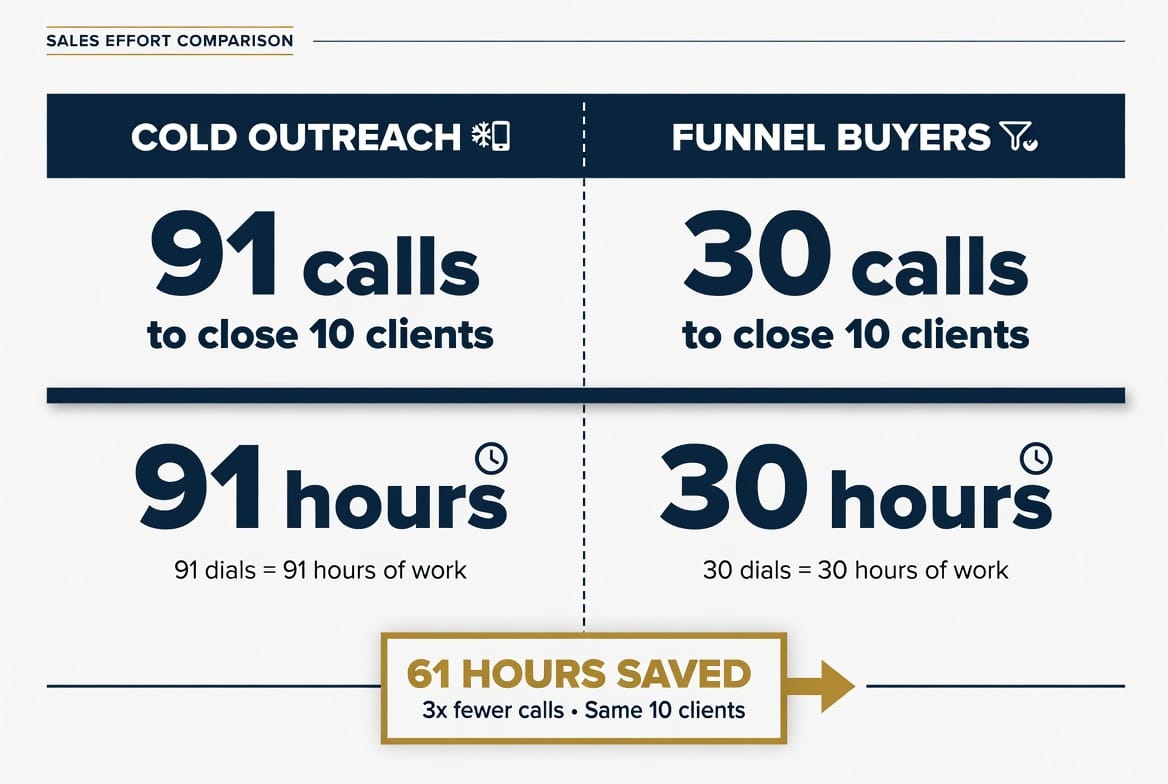
To close 10 new clients from cold outreach at an 11 percent close rate, David needed 91 discovery calls. At roughly an hour each including prep and follow-up, that's 91 hours of his time to close 10 clients.
To close 10 new clients from funnel buyers at a 34 percent close rate, he needs 30 discovery calls. Same 10 clients. 30 hours instead of 91.
He's getting back 61 hours for every 10 clients he closes. At his billing rate those 61 hours are worth over $18,000.
The front-end product isn't just improving his close rate. It's returning him the most valuable resource in his business: time he can spend doing actual work rather than sitting on calls with people who were never going to hire him.
The Shift in How the Business Feels
Numbers aside, David describes the change in how the business feels day to day as the most significant difference.
The calendar dread is gone. The low-grade exhaustion from back-to-back calls that go nowhere has been replaced by a different kind of calendar: fewer calls, better conversations, higher percentage of them resulting in something.
He books two to three discovery calls a week now instead of eight to ten. He closes one to two of them. His monthly revenue is higher than it was when he was booking eight to ten calls a week from cold outreach because the close rate is three times better and the clients he closes are more aligned with what he does.
He describes his Wednesday afternoons differently now. "I used to dread them. Now I look forward to them. The people I'm talking to actually want to be there."
That's not a small thing. The day-to-day experience of running a business matters. A business that produces good revenue but requires you to spend your days in demoralizing conversations is not a business you can sustain indefinitely.
The $27 product didn't just fix the math. It fixed the experience.
How to build the front-end product, structure the funnel around it, and make the ad math work so the system pays for itself while filling your calendar with pre-qualified buyers...