How I Make 7 Figures Selling Online Courses
I want to start with something most people in my position won't tell you.
The version of this business that makes seven figures a year looks almost nothing like the version I was running in year two. And the gap between those two versions has almost nothing to do with the courses themselves.
The courses were fine in year two. The content was solid. The transformation was real. The people who bought them got results.
The problem was the architecture sitting underneath them. How I was finding buyers, what it was costing me to find them, and whether the math of the whole thing made sense at any real scale.
It didn't. Not yet.
I spent a long time building a business that worked on paper and struggled in practice. Good products, growing audience, decent revenue, and a persistent feeling that the ceiling was always just a little lower than it should have been.
What changed wasn't the courses. What changed was how I thought about the economics of selling them.
Here's what that looks like now and how I got there.
Where It Started
I've been doing direct response marketing since 2013.
I built my first real business in the women's dating and relationship space. Over time that business became what it is today: a seven-figure-a-year brand with a large buyer list, a suite of products at multiple price points, and a paid traffic operation that acquires new buyers every single day without me having to manually generate leads or run live events to keep the revenue flowing.
I didn't build it that way from the beginning. I built it through a long series of tests, failures, pivots, and occasional expensive lessons about what actually works when real money is on the line.
The model I run today is the result of over a decade of figuring out what separates online course businesses that scale from ones that plateau regardless of how good the content is.
The short answer, the one that took me embarrassingly long to fully internalize, is this: the content is rarely the problem. The economics almost always are.
The Mistake Almost Everyone Makes
When most people think about selling online courses they think about the course first.
What should I teach? How many modules? What's the right price? How do I make it better than what's already out there?
These are reasonable questions. They're just not the most important questions. Not even close.
The most important question, the one that determines whether the business scales or stagnates, is this: how am I going to acquire buyers profitably?
Not leads. Buyers.
There's a difference that took me longer than it should have to fully appreciate.
For the first few years of my business I was doing what most course creators do. Building a free list. Giving away content. Growing an audience. Launching periodically to that audience and hoping the launch revenue justified the months of effort that preceded it.
It worked. Inconsistently. Unpredictably. With a ceiling that kept revealing itself every time I tried to push past it.
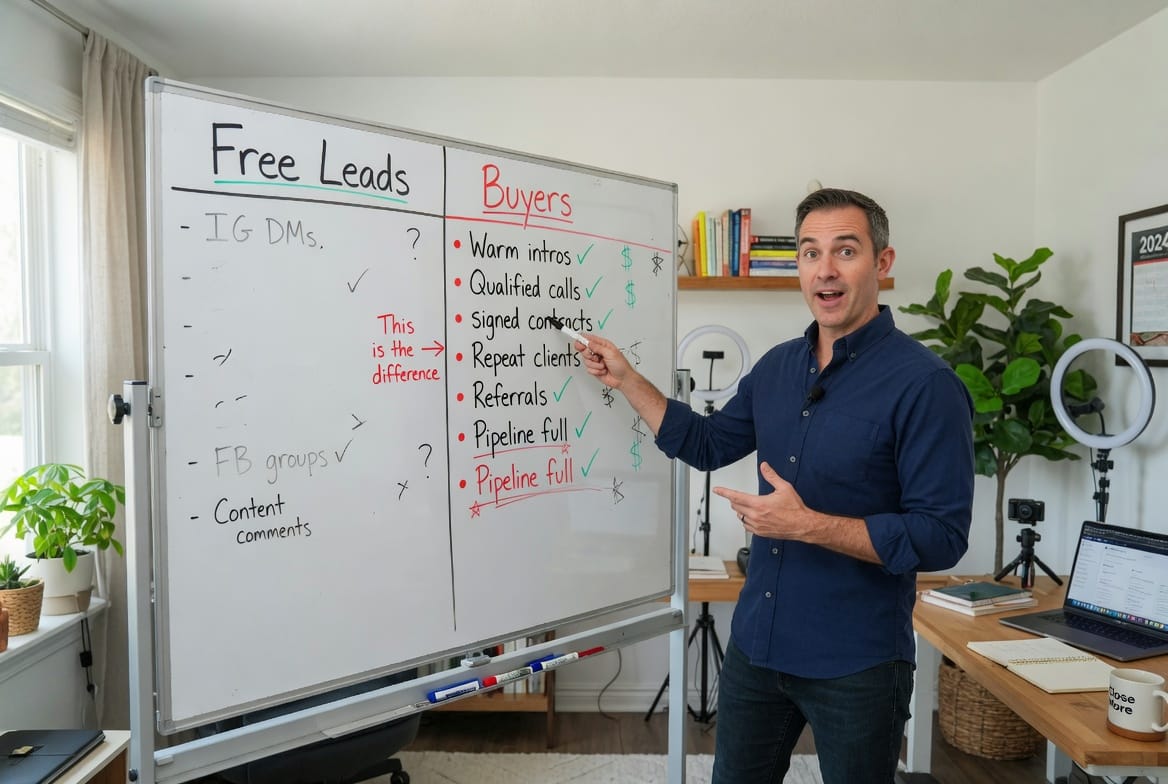
The ceiling wasn't a content problem. It was a math problem. And the math problem had a specific source: I was building my audience with free leads instead of buyers, and free leads and buyers are fundamentally different people who behave in fundamentally different ways.
The Number That Changed How I Thought About Everything
At one point I had 300,000 people on my email list.
Not cold names. Not dead accounts. Active, engaged subscribers who had opted in, were opening emails, and were clicking links. By any traditional measure it looked like a thriving, healthy business.
Then I ran an experiment. I shut off every free lead magnet for six months. I wanted to see what those 300,000 people would actually do on their own without a new free thing arriving every month to keep them engaged.
What I found was uncomfortable.
The revenue those free leads generated wasn't enough to cover the cost of maintaining them on the list. Not even close. I was spending thousands of dollars a month on platform fees, tools, and content creation to maintain a list that wasn't generating enough to justify the expense.
So I did something most people thought was insane. I deleted everyone who had never bought anything.
Three hundred thousand people down to fifty thousand.
Revenue went up.
Not slightly. Meaningfully. Because the fifty thousand buyers I kept were generating more revenue per person than the two hundred and fifty thousand free subscribers I had cut by a factor of somewhere between ten and one hundred to one.
A buyer is a completely different person than a free subscriber. They have already proven, with their actual behavior, that they will spend money on solutions to their problems. That single behavioral signal predicts everything else about how they interact with your business.
That experiment is the foundation of everything I do now.
What the Model Actually Looks Like
The seven-figure version of this business runs on a specific structure.
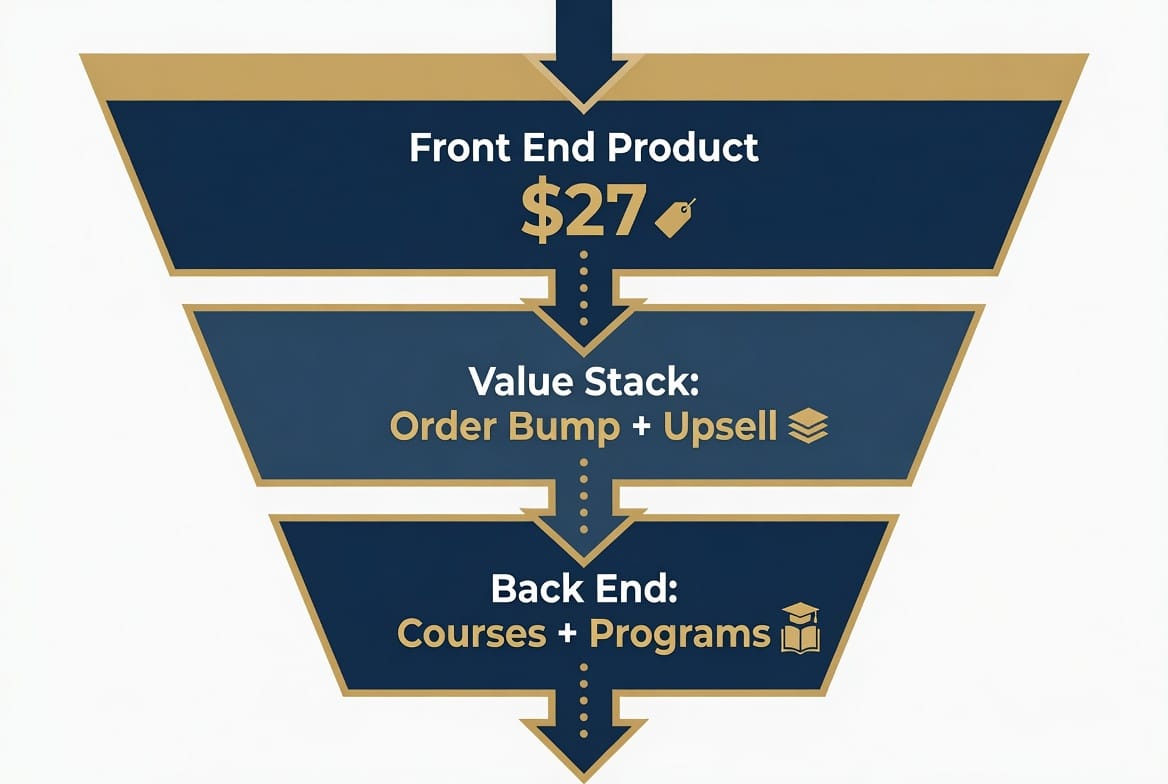
At the front of the funnel is a low-ticket product. Something priced between $7 and $47 that solves one specific, immediate problem. Not a broad overview of everything I know. One problem, one solution, one product. The job of this product is to acquire a buyer at a cost the math can support.
Behind that front-end product is a value stack. An order bump on the checkout page. An upsell behind the purchase. Together these push the average order value high enough that the front end covers the cost of the paid traffic feeding it. When the front end breaks even or better on ad spend, every buyer on the list cost nothing net to acquire.
Behind the value stack is the back end. The courses, the programs, the higher-ticket offers that deliver the deeper transformation. This is where the real margin lives. But it only works the way it's supposed to work when the people arriving at it are buyers who came through the front end already warm, already trusting, already having had a positive transaction with me.
The back end is the destination. The front end is what makes the journey to it economical.
The Math Behind Why This Works at Scale
The reason this model scales where other models don't comes down to one equation.
Average order value minus cost per acquisition.
If my AOV is higher than my CPA, my front end is profitable before my back end ever enters the picture. I can spend more on ads. More ads means more buyers. More buyers means more back-end revenue. The business compounds.
If my AOV is lower than my CPA, I'm losing money on every buyer I acquire and depending on the back end to save me. Sometimes it does. At scale it usually doesn't reliably enough to build on.
The free list model I was running in year two had an AOV of zero on the front end. Every dollar I spent on ads to grow the list stayed spent with no mechanism to recover it until the back end converted weeks or months later. That's not a scalable model. That's a bet.
The low-ticket front-end model I run now has an AOV that covers the CPA on most campaigns before I've sent a single back-end email. The list of buyers that builds from that traffic is worth dramatically more per person than any free list I ever built.
The math isn't complicated. It just took me longer than it should have to build a funnel structure around it.
What Paid Traffic Actually Does for a Business Like This
A lot of course creators are afraid of paid traffic. Usually because they tried it once, lost money, and concluded it didn't work for them.
I understand that experience completely. I've had versions of it myself.
What I've learned is that paid traffic almost never fails because of the traffic itself. It fails because the funnel sitting behind the traffic wasn't built to cover its own costs.
Sending paid traffic to a free lead magnet means spending money with no mechanism to recover it on the front end. The campaign runs, the money goes out, and the only path to profitability is a back-end conversion that may or may not happen on a timeline the budget can support.
Sending paid traffic to a properly structured low-ticket funnel is a fundamentally different experience. The front end generates revenue. The AOV covers the CPA. The list fills with buyers rather than free leads. The back end compounds from a base of people who have already proven they'll spend money.
My business acquires new buyers every single day through paid traffic on Meta. The front-end funnel covers the cost of that traffic. The buyers it produces move through the back end over time, purchasing courses and programs and higher-ticket offers at rates that free leads never matched.
I don't run launches anymore as the primary driver of revenue. I don't need a weekly live event to keep income flowing. I don't have to post content every day to maintain a pipeline. The funnel runs. The buyers come in. The back end compounds.
That's what paid traffic looks like when the math is right.

The Part Nobody Talks About
Here's something I don't see discussed enough in conversations about building a seven-figure course business.
The product quality matters. Obviously. Deliver a bad experience and the back end won't convert, refunds will eat your margins, and word of mouth will work against you.
But product quality is table stakes. It's the minimum required to stay in business. It's not the thing that separates the businesses that scale from the ones that plateau.
What separates them is the economics of customer acquisition.
I've watched course creators with genuinely exceptional content struggle to break six figures because their acquisition model was bleeding money. And I've watched people with decent but not extraordinary content build seven-figure businesses because they understood the math and built a funnel structure that made the numbers work.
The content gets you in the game. The acquisition economics determine how far you go.
If you're building a course business right now and you're focused primarily on making the content better while running a free list and periodic launches, you're optimizing the right thing for the wrong stage of the problem.
The content is probably fine. The economics are where the work is.
What I'd Tell Someone Starting From Scratch
If I were starting over today with everything I know, the sequence would look like this.
First, identify the one specific problem my ideal buyer is most acutely trying to solve right now. Not a broad topic. Not a comprehensive curriculum. One problem with one clear solution.
Second, validate that real strangers will pay real money for that solution before investing significant time building it. A five-day paid traffic test to a simple page tells you more about real demand than months of audience research ever could.
Third, build the simplest possible version of the solution at a price point the math can support. Something that generates enough front-end revenue to cover the cost of the traffic finding it.
Fourth, add the order bump and upsell that push the average order value above the cost per acquisition. This is the step most people skip and it's the step that determines whether paid traffic is viable or not.
Fifth, build the back-end offer that serves the buyers who want to go further. This is where the existing course lives for most people reading this. Not as the front door but as the natural next step for someone who has already bought once and wants more.
That sequence, done in that order, produces a business with a completely different economic profile than the launch-dependent, free-list model most course creators are running.
It's the model my business runs on now. It's what the seven-figure version of this looks like from the inside.
The complete framework for building it, including how to structure the offer, validate the demand, make the ad math work, and scale without it consuming your life, is exactly what Get Paid to Get Leads lays out from the first page to the last.