How Much Do Facebook Ads Cost? The Honest Answer for Small Business Owners
If you search for how much Facebook ads cost, you'll find a lot of averages.
Average cost per click: $0.50 to $2.00. Average cost per thousand impressions: $5 to $15. Average cost per lead: $5 to $50.
These numbers are real. They're also almost completely useless for making decisions about whether Facebook ads make sense for your specific business.
Here's why.
The cost of a Facebook ad tells you nothing meaningful on its own. A $0.50 click that never converts is more expensive than a $2.00 click that becomes a $500 customer. A $15 cost per lead on a free lead magnet is money you'll never see again. A $35 cost per buyer on a $47 average order value is a profitable campaign.
The question isn't how much Facebook ads cost. The question is whether what comes back out of your funnel covers what you put in.
That's a completely different conversation and it's the one this article is going to have.
What Determines What You Actually Pay
Facebook ad costs aren't fixed. They fluctuate based on several variables, some of which you control and some you don't.
The variables you don't control are seasonality and competition. Ad costs on Meta spike during Q4 as major retailers pour budget into the platform for the holiday shopping period. They tend to be lower in January and February when fewer advertisers are competing for the same attention. Your industry matters too. Financial services, insurance, and software companies pay more per click than most because the lifetime value of their customers justifies higher acquisition costs and they bid accordingly.
The variables you do control are more important.
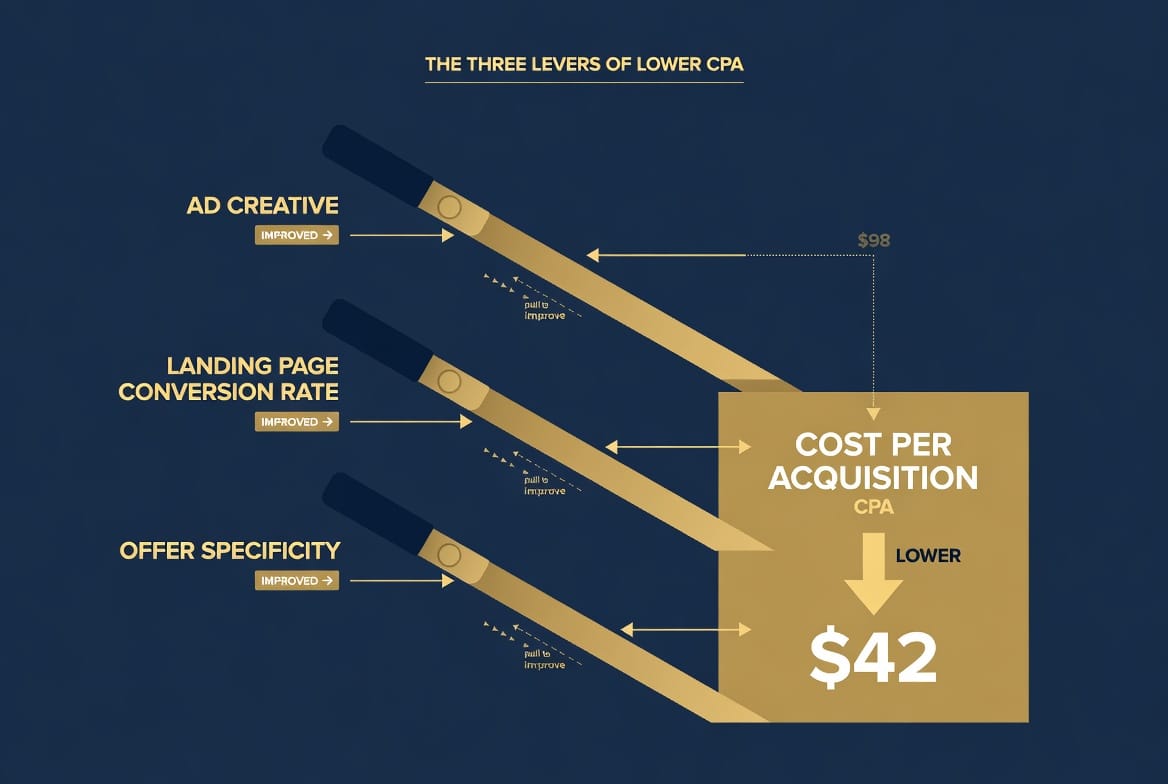
Your ad creative is the most significant lever you have over your costs. A strong creative that stops the right person mid-scroll and compels them to click produces a high click-through rate. A high click-through rate signals to Meta's algorithm that your ad is relevant and valuable to the audience seeing it. Meta rewards relevance with lower costs. A weak creative produces low engagement and higher costs for the same impression volume.
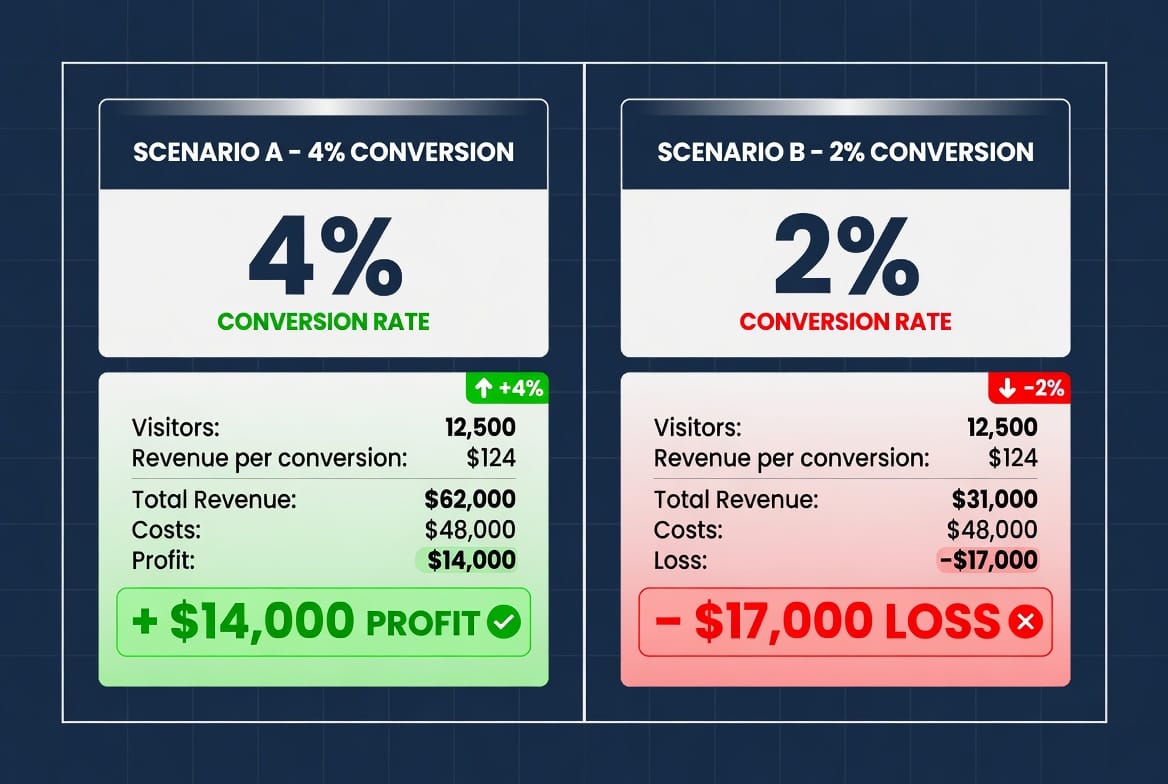
Your landing page conversion rate matters almost as much. If 4 percent of people who land on your page buy something versus 2 percent, your cost per buyer drops in half without changing anything about the ad itself.
Your offer specificity affects both of those things. A vague, broad offer produces lower click-through rates and lower conversion rates because it doesn't connect with enough precision to any specific person's specific problem. A specific offer that names a real problem in language real people use to describe it performs better at every stage.
The Number That Actually Matters
Forget cost per click. Forget cost per impression.
The only number that determines whether your Facebook ad campaign is viable is cost per acquisition relative to average order value.
Your cost per acquisition is what you spend on average to turn one person from ad viewer into paying customer. Your average order value is what that customer spends in a single transaction going through your funnel.
If your AOV is above your CPA, your front end is covering the cost of the traffic. You're acquiring buyers at a net cost of zero or better. The business can scale.
If your AOV is below your CPA, you're losing money on every customer you acquire before your back end ever comes into the picture. You're hoping email sequences and future offers will eventually make up the difference. Sometimes they do. Consistently, at scale, they usually don't.
This is why the cost of Facebook ads isn't really a question about the platform. It's a question about whether your funnel is structured to recover the cost of the traffic that's feeding it.
Most campaigns that "fail" because Facebook ads are "too expensive" are actually campaigns where the funnel structure had no mechanism for generating front-end revenue. The cost wasn't the problem. The architecture was.
Real Numbers From Real Funnels
Here's what the math looks like when a funnel is built correctly.
A $27 front-end product. An order bump priced at $17 that converts at 30 percent. A upsell priced at $47 that converts at 20 percent.
Average order value: $27 plus $5.10 from the order bump plus $9.40 from the upsell equals $41.50.
If your cost per acquisition on Meta ads is $35, you're generating $6.50 per buyer before your back end ever enters the picture. Your ads are paying for themselves. Every buyer on your list cost you nothing net to acquire.
Now here's what the same campaign costs at different conversion rates.
If your landing page converts at 4 percent on cold traffic and your ad costs $1.20 per click, you need 25 clicks to get one buyer. That's $30 in ad spend per buyer. Against a $41.50 AOV, you're up $11.50 per buyer.
If your landing page converts at 2 percent, you need 50 clicks to get one buyer. That's $60 in ad spend per buyer. Against the same $41.50 AOV, you're losing $18.50 per buyer.
Same ad. Same product. Same price. The landing page conversion rate doubled the cost per acquisition and turned a profitable campaign into a losing one.
This is why cost per click is the wrong number to optimize. Two campaigns with identical cost per click can produce dramatically different cost per acquisition depending on what happens after the click.
Large Call to Action Headline
The number most small business owners want to know before they start is how much they need to spend to find out if Facebook ads will work for them.
The honest answer is that a meaningful test for a low-ticket front-end funnel requires somewhere between $500 and $1,500.
That range comes from a specific logic. You need a daily budget of three to five times your front-end product price to give Meta's algorithm enough daily spend to optimize. For a $27 product that's $81 to $135 per day. You need to run that budget for seven to ten days before making any real decisions, because the first few days of any new campaign are noisy while the algorithm learns.
That math produces a test cost of $567 to $1,350.
If that number is higher than you can currently commit, the answer isn't to run the test at $10 a day. At $10 a day the data comes in too slowly to distinguish between a campaign that needs more time and one that fundamentally doesn't work. You end up making decisions based on incomplete information and the campaign never gets a fair test.
The better approach if budget is tight is to validate demand before running the full test. A five-day validation run at $150 to $200 total tells you whether real strangers will pay for your specific offer at your specific price point before you commit to the full test budget. If the validation produces conversions, run the full test. If it doesn't, you've learned something important for $200 instead of $1,500.
Why Your Ad Costs Will Change Over Time
One thing most people don't anticipate when they start running Facebook ads is how much the cost per acquisition fluctuates in the early weeks.
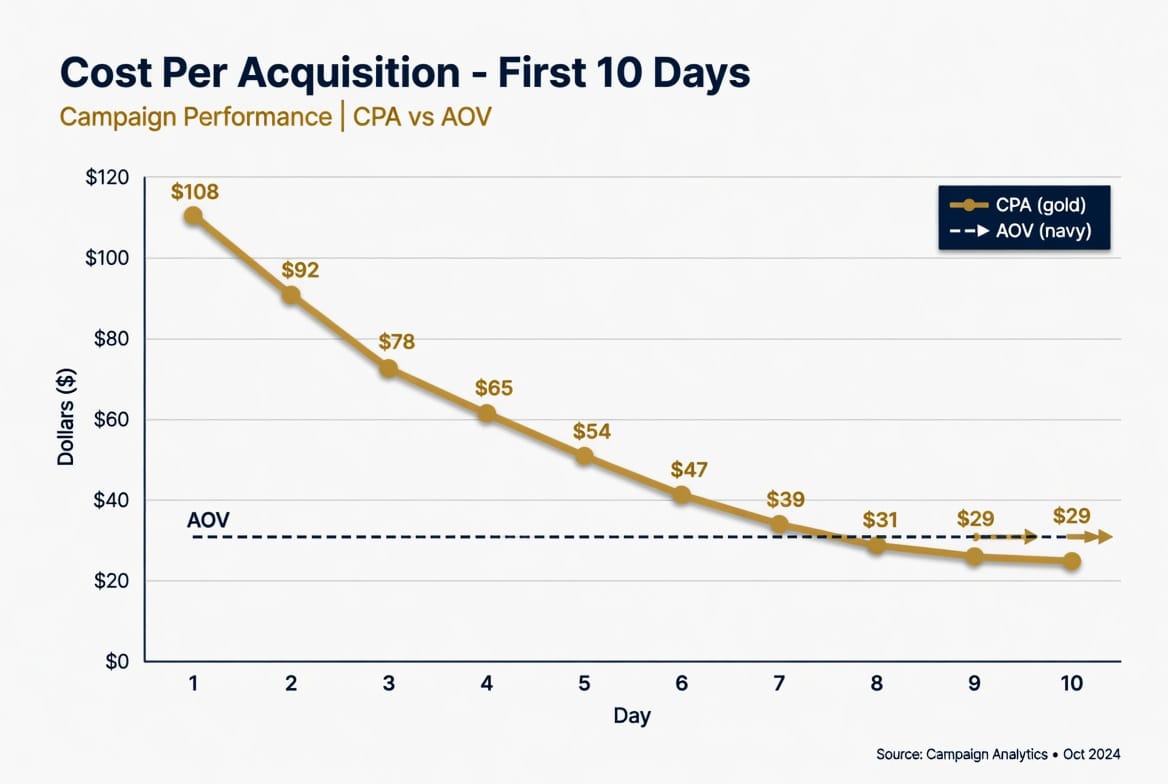
The first few days of a new campaign are almost always the most expensive. Meta's algorithm doesn't yet know who your buyers are. It's showing the ad broadly while it collects data on who responds. Cost per acquisition in this period is often significantly higher than it will be once the algorithm has found its footing.
This is the period where most small businesses pull the campaign. They see $50 or $80 cost per acquisition in the first three days and shut everything off before the algorithm has had time to optimize.
If your AOV is $41.50 and you're paying $80 per acquisition on day two, that's a losing campaign. But day two data from a cold campaign doesn't tell you what the campaign will look like on day ten after the algorithm has learned who your buyers are and started finding more of them.
Give the campaign seven days of data before making any decisions. If by day seven the cost per acquisition is still dramatically above your AOV, there's a real problem worth addressing. If it's trending toward your AOV or already there, you have a campaign worth continuing.
The Hidden Cost Most People Miss
When people calculate whether Facebook ads are worth it, they usually only count the ad spend.
They don't count the cost of free leads.
If you're currently building your audience through free lead magnets, you're paying for those leads even if no money is leaving your ad account.
You're paying in platform fees to maintain them on your email list. You're paying in time to create the content that keeps them engaged. You're paying in opportunity cost for every hour spent writing emails to people who downloaded a free guide and will likely never buy anything.
A free subscriber in the coaching and course creator space generates somewhere between 10 and 40 cents per month in revenue on average. A buyer generates $1 to $3 per month or more.
The real cost of Facebook ads isn't what you see in the ads manager. It's what you pay per buyer acquired relative to what each buyer generates over their lifetime on your list.
When you frame the question that way, a $35 cost per acquisition for a buyer who generates $2 per month over the next 24 months is a $48 return on a $35 investment, a 37 percent return before the back end ever does anything.
The free lead magnet that costs nothing to acquire generates $0.25 per month for the same 24 months. That's $6 from someone who cost you real time and real money even without paying for ads.
The math, when you run it honestly, often points in a direction that surprises people.
Making It Work
The businesses that make Facebook ads work at a small business scale share a few things in common.
They understand that the cost of the ad is not the question. The economics of the funnel is the question.
They build a front end designed to recover the cost of the traffic before the back end enters the picture.
They give campaigns enough time and budget to produce meaningful data before making changes.
They watch cost per acquisition and average order value and mostly ignore everything else.
And they understand that the goal in the early stages isn't profitability on the front end. It's break-even. Break-even means buyers are free. Free buyers compound into back-end revenue. Back-end revenue funds more ad spend. The business grows.
The complete framework for building a funnel that makes this math work, from the front-end product through the value stack, the back-end offer, and the ad campaign setup, is what Get Paid to Get Leads covers.