How to Build a LEGIT Online Course
There are a lot of online courses about how to build online courses.
Most of them will teach you how to record modules, set up a membership site, design slides, and create a launch sequence. Some of them are genuinely useful for those specific things.
Almost none of them will tell you the thing that actually determines whether your course makes money or disappears into the graveyard of digital products that never found an audience.
That thing is not the content. It's not the production quality. It's not the platform you host it on or the email sequence you write to sell it.
It's whether real people will pay real money for what you're building before you spend months building it.
That single question, answered honestly and early, is the difference between a course that generates consistent revenue and one that makes nine sales on launch day and sits untouched in a membership site for the next two years.
I've built courses that did both. Here's what I've learned about what separates them.
What Makes a Course "Legit"
Before we get into the how, it's worth being clear about what we're actually talking about when we say a legitimate online course.
A legitimate course isn't defined by its production quality. Some of the highest-converting courses I've seen were recorded in a spare bedroom on a basic camera with no fancy graphics or editing. Some of the most beautifully produced courses I've encountered have never made their creators more than a few hundred dollars.
A legitimate course isn't defined by its length or comprehensiveness. Longer is not better. More modules is not more valuable. A course that solves one specific problem completely is worth more to the right person than a sprawling curriculum that tries to cover everything.
A legitimate course is defined by one thing: it delivers a real transformation for a real person who had a real problem and paid real money to solve it.
Everything else, the production, the platform, the bonuses, the community, these are secondary. The primary question is whether someone's life or business is meaningfully different after going through your course than it was before.
If the answer is yes, you have a legitimate course. If the answer is no, better slides won't fix it.

The Problem With Starting With the Content
Most people who decide to build an online course start in the same place.
They open a Google Doc or a Notion page and start outlining the curriculum. What should Module 1 cover? How many lessons per module? What order should the content go in?
This is completely backwards and it's the reason so many courses underperform despite being genuinely good.
Starting with the content assumes you already know what the market will pay for. It assumes your instinct about what people need is accurate enough to stake months of your time on. It assumes the transformation you want to deliver is the transformation people are actually looking to buy.
Sometimes those assumptions are right. More often they're partially right in ways that don't show up until launch day when the sales numbers come in and you realize the market wanted something slightly different than what you built.
The legitimate way to build a course starts somewhere else entirely.
It starts with a specific problem that specific people are already actively trying to solve and already spending money on solving. Not a problem you think they should care about. A problem they're already searching for answers to, already buying books and hiring coaches and consuming content about, already feeling the daily friction of not having solved.
Find that problem first. Validate that real people will pay for a solution. Then build.
That sequence sounds obvious when you say it out loud. The majority of course creators do it in the opposite order.
What Validation Actually Means
Validation is one of the most misunderstood concepts in online course creation.
Most people think validation means asking your audience if they'd be interested in a course on a particular topic. They post a poll. They send a survey. They ask in their Facebook group. They get enthusiastic responses and take that as confirmation that the demand is real.
It isn't. Not even close.
Interest and purchase intent are completely different things. Your audience will tell you they're interested in almost anything you ask about if they like you and want to be supportive. What they tell you in a survey bears almost no relationship to what they'll actually do when you present them with a price tag and a buy button.
Real validation is a transaction.
It's finding out whether a real person who doesn't know you will hand over their credit card for a specific solution to a specific problem at a specific price point. No relationship to draw on. No goodwill. No desire to be supportive. Just a cold stranger making a pure buying decision based on whether your offer addresses something they genuinely need.
That information, gathered before you build anything significant, is worth more than any amount of audience research or survey data.
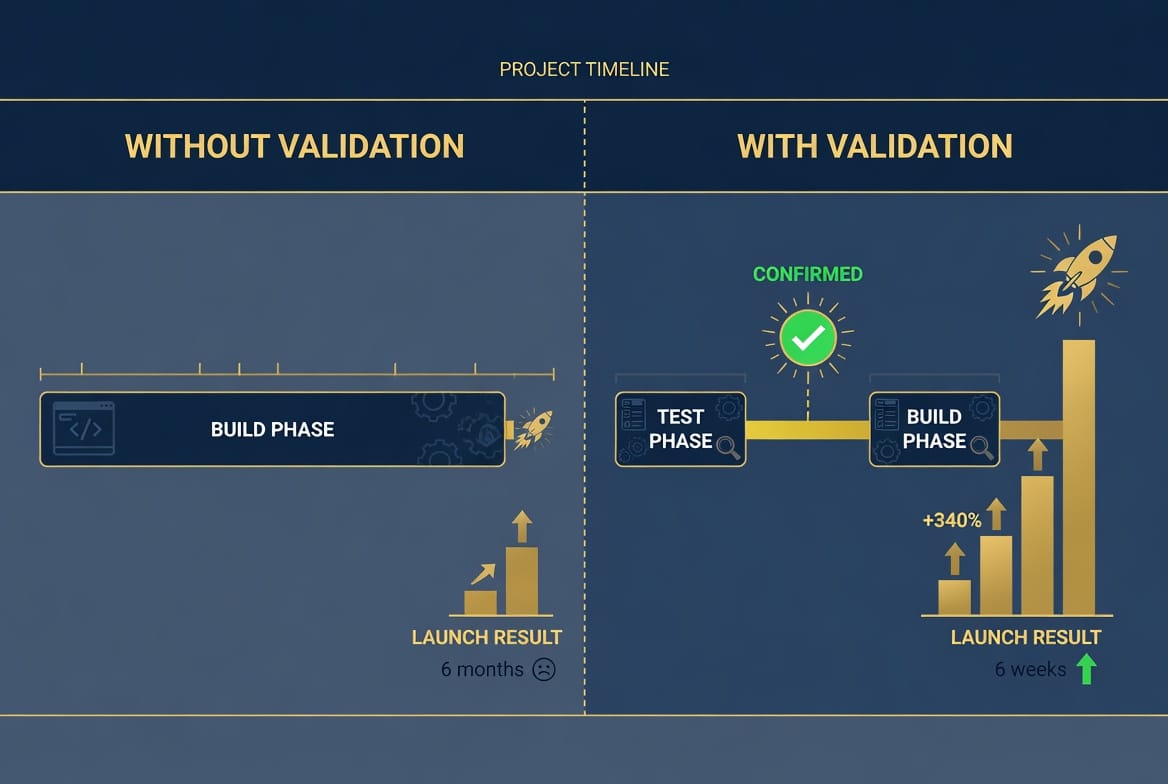
Priya Sharma spent four months building a course before she had that information. She launched it and made nine sales. When she finally ran a proper validation test on a small low-ticket offer before her second course build, she confirmed real demand in five days and spent her build time creating something she already knew the market would pay for.
The difference between those two experiences wasn't talent or effort or content quality. It was sequence.
The Course That Sells Versus the Course That Should Sell
Here's a distinction worth sitting with.
There's the course you think people need. And there's the course people will actually pay for.
Those two things overlap more than you'd expect, but the overlap is never complete. The gap between them is where most course failures live.
The course you think people need is usually comprehensive. It covers everything. It addresses the root cause of the problem, not just the symptoms. It delivers a deep and lasting transformation. It's the course you wish you'd had when you were struggling with the problem yourself.
The course people will actually pay for is usually specific. It addresses the most acute, immediately painful symptom of the problem. It promises a clear, tangible outcome in a defined timeframe. It feels like a solution to what they're experiencing right now, not a solution to the underlying pattern they don't yet fully recognize.
People buy painkillers before they buy vitamins. They buy the solution to the problem they're aware of before they buy the solution to the problem they haven't yet identified.
The most legitimate online course you can build is one that bridges those two things. It starts where the buyer is, addressing the immediate pain they're already feeling, and takes them somewhere they didn't know they needed to go. It delivers the transformation they asked for and the one they didn't know to ask for.
That's a much harder design challenge than simply outlining everything you know about a topic. But it's the challenge that produces courses people finish, get results from, and tell other people about.
The Price Point Question Everyone Gets Wrong
Most course creators price their courses based on what other courses in their space cost.
They look at what competitors are charging, pick a number that feels competitive, and build backward from there. This is a reasonable instinct and a mediocre strategy.
Price is a signal. And the signal it sends isn't just about perceived value, though that matters. It's about who it attracts and what they do after they buy.
A $197 course attracts a different buyer than a $27 course. Not necessarily a better buyer in absolute terms, but a buyer who arrives with different expectations, different levels of prior commitment to solving the problem, and different likelihood of completing the course and getting results.
Here's what most people don't think about clearly enough: your completion rate and your results rate are part of your product. They're what your testimonials come from. They're what your word of mouth is built on. They're what your refund rate reflects.
A course priced too high for the transformation it delivers produces buyers who feel let down. A course priced appropriately for where it sits in the buyer's journey produces buyers who feel like they got more than they paid for.
The question isn't what the market will bear. The question is what price point attracts the kind of buyer who will actually complete the course, get the result, and become the testimonial and referral engine that makes the next launch easier than the last one.

What Goes in the Course and What Doesn't
Once you know what problem you're solving, who you're solving it for, and what price point makes sense, the content question becomes much easier to answer.
Because now you have a filter.
Everything that moves the buyer from where they are now to the specific promised outcome stays in. Everything else comes out.
This is harder than it sounds. Most subject matter experts know significantly more about their topic than belongs in any single course. The temptation to include more, to cover edge cases, to add the advanced material, to share the nuance and depth that reflects your real expertise, is almost irresistible.
Resist it.
A course that delivers one complete transformation is worth more to the buyer than a course that delivers half of three transformations. Overwhelm is one of the primary reasons people don't complete courses. Every additional module that isn't directly on the critical path from problem to solution is another opportunity for the buyer to fall off.
The most legitimate courses I've seen and built are ruthlessly focused. They include everything necessary and nothing optional. The buyer who completes the last module has arrived at the promised outcome. Not approximately. Not mostly. Actually.
That focus is what produces the completion rates and the results that make the testimonials that make the next launch easier than the last one.
The Platform Question Is the Last Question
One of the most common questions I hear from people building their first online course is which platform they should use.
It's usually one of the first questions they ask. It should be one of the last.
The platform is a delivery mechanism. It doesn't determine whether your course is any good. It doesn't determine whether people will buy it. It doesn't determine whether buyers will complete it and get results.
What it does is give your buyers a place to access the content you've already confirmed people will pay for, that you've already built to deliver a specific transformation, at a price point you've already validated makes sense.
Make those decisions first. Then pick a platform that handles the delivery simply and reliably without adding unnecessary friction for the buyer.
The best platform is the one you'll actually use consistently without it becoming a technical distraction from the work of creating good content and building a system to get it in front of the right people.
The Part That Determines Whether Any of This Makes Money
You can build a completely legitimate course. Properly validated, ruthlessly focused, correctly priced, well delivered. And still struggle to make it profitable if the system around it isn't built to acquire buyers at a cost the math can support.
The course is the product. The funnel is what sells it.
Most course creators treat these two things as the same problem. They aren't. Building a great course and building a profitable course business are related challenges but they require different thinking and different infrastructure.
The businesses that make real money from online courses, consistently, at scale, without depending on periodic launches or constant content creation to keep revenue flowing, have solved both problems.
They've built a course that delivers a genuine transformation. And they've built a funnel structure that acquires buyers at a cost that makes the economics work whether they're actively promoting or not.
The courses I've built that generate consistent seven-figure revenue aren't just better courses than the ones that underperformed. They're sitting inside a better system. A front-end funnel that covers its own acquisition costs, builds a list of buyers who arrive at the course already warm, and runs whether I'm actively working on the business or not.
The content gets you in the game. The system is what scales it.
How to build that system around the course you're creating or the course you've already built is exactly what Get Paid to Get Leads covers.