How to Build a Self-Funding Funnel That Can Replace a Salary Without Quitting Your Job First
Jennifer Walsh quit her job on a Thursday afternoon in March.
Not because she had to. Not because she got fired or burned out or had some dramatic falling out with her employer. She quit because her coaching business had been generating more than her salary for four consecutive months and continuing to show up to a job she no longer needed felt like a choice she was making for no good reason.
She had not quit before that point. Not when the funnel first broke even. Not when it hit $3,000 a month. Not even when it crossed her salary for the first time. She kept the job until the number had been consistent long enough that leaving felt like a logical step rather than a leap of faith.
That patience, staying employed while the funnel proved itself month after month, is a big part of why the transition worked so cleanly.
Most people get this wrong in one of two directions. They quit too early, before the funnel has produced enough consistent revenue to replace a salary with any real confidence. Or they stay too long, using the safety of the day job as a reason to never fully commit to making the business work.
Jennifer threaded that needle by having a specific number in mind and refusing to move until she hit it four times in a row.
Here's what that process actually looked like.
The Number That Actually Matters
Most side-hustle business owners think about replacing their salary in terms of matching their gross income. If I make $65,000 a year, I need my business to make $65,000 a year.
That's the wrong number to target.
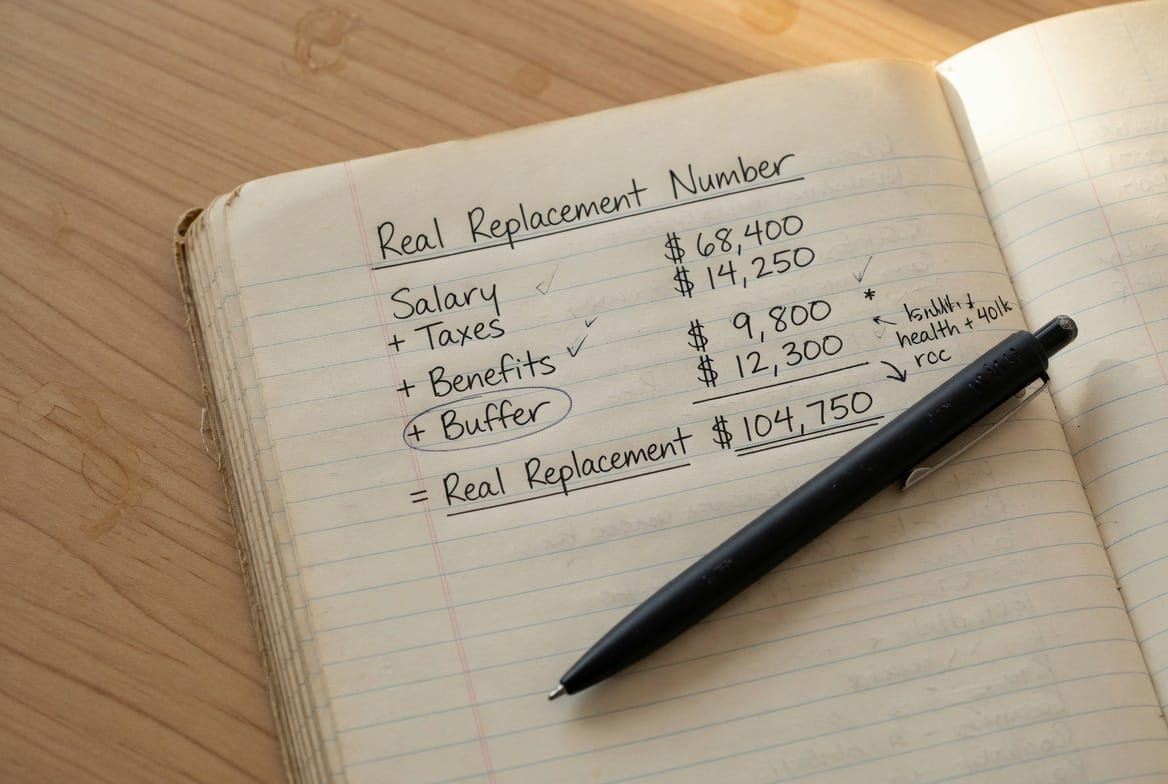
Your salary comes with benefits, retirement contributions, payroll taxes paid by your employer, and a level of income predictability that a young business can't immediately match. The real replacement number is higher than your salary and needs to account for those gaps.
Jennifer's salary was $72,000. Her real replacement number, once she factored in health insurance, self-employment taxes, and a buffer for the revenue variance that every business carries, was closer to $96,000 a year. About $8,000 a month.
She set that as her target and didn't let herself think seriously about quitting until the funnel had hit it four months running.
That discipline protected her from the biggest risk in the side-hustle-to-full-time transition: quitting on a good month instead of waiting for a good pattern.
What the Funnel Was Actually Doing While She Kept Her Job
While Jennifer was still working full time, the funnel was doing something that wouldn't have been possible if she had quit early and needed the business to immediately replace her income.
It was compounding without pressure.
When you need the business to pay your mortgage right now, every decision gets distorted by urgency. You pull campaigns that need more time. You launch offers before they're ready. You take on clients who aren't a great fit because you need the revenue. The financial pressure degrades the quality of every decision you make.
Jennifer didn't have that pressure. Her mortgage was covered by her job. The funnel's job was to grow, not to survive. That distinction produced better decisions at every stage.
She let her validation test run its full course before drawing conclusions. She gave her first real campaign eight days before touching anything. She reinvested front-end revenue back into ad spend instead of pulling it out to pay bills. She built her Bridge email sequence carefully rather than rushing it out to start generating discovery calls.
The day job gave her the runway to do all of that correctly.
By month four of running the funnel, her buyer list had grown to just over 800 people. Her back-end coaching program had nine active clients. Her monthly revenue was sitting at $6,400 and climbing steadily.
She was still eight months away from quitting. But for the first time she could see exactly how she was going to get there.
The Back End Is Where the Salary Lives
Here's something worth understanding clearly about how the math of replacing a salary actually works.
The front-end funnel covers the cost of acquiring buyers. It breaks even or generates a small profit on the ad spend. That's its job and it does that job well.
But a $27 product, even with a strong order bump and upsell, is not going to generate $8,000 a month in revenue by itself at the kind of ad budgets a side-hustle business is running.
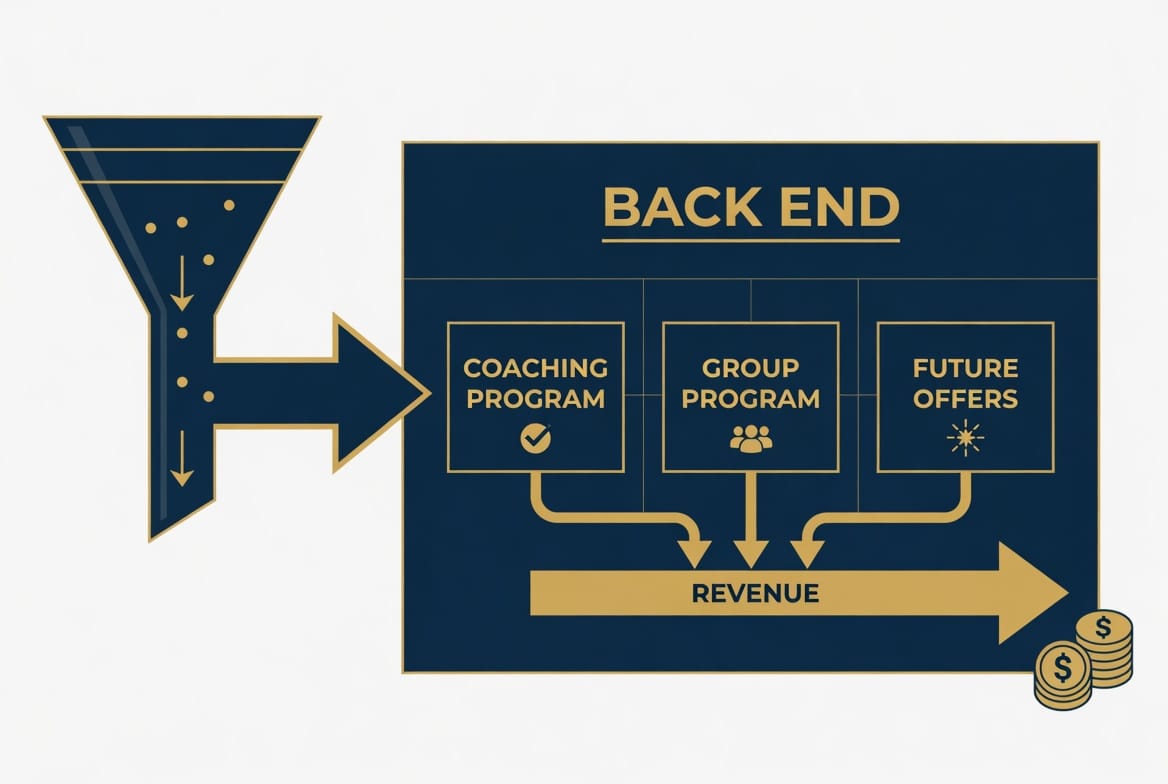
The salary replacement lives in the back end.
It lives in the coaching program, the group program, the higher-ticket offer that your front-end buyers eventually say yes to after going through your Bridge sequence and deciding they want to go further. The front end builds the list and covers its own costs. The back end is where the real revenue compounds.
Jennifer's path to $8,000 a month looked like this in rough terms. Front-end funnel generating $2,800 a month in combined product, order bump, and upsell revenue. Back-end coaching program with nine clients at $500 a month each generating $4,500. A small group program she had launched to her buyer list generating $900 in its first month.
Total: $8,200.
The funnel hadn't replaced her salary on its own. It had built the buyer list that made the back end possible. The back end was what actually crossed the line.
That relationship between front end and back end is the thing most side-hustle business owners don't fully grasp when they first encounter the low-ticket funnel model. The front end is not the business. It's the machine that builds the audience the business runs on.
The Timeline Most People Don't Want to Hear
Jennifer's timeline from first funnel launch to quitting her job was fourteen months.
Not four months. Not six months. Fourteen.
The first three months were validation and early testing. Months four through eight were optimization and scaling. Months nine through twelve were back-end growth as the buyer list compounded and more people moved through the Bridge sequence into her coaching program. Months thirteen and fourteen were confirmation, waiting for the number to hit consistently before making the move.
Fourteen months is longer than most people want to hear when they're tired of their day job and excited about what they're building. It's a lot shorter than the alternative, which is quitting before the foundation is solid and spending years trying to make a business work while also trying to make rent.
The timeline isn't a punishment. It's the thing that makes the landing clean.
Jennifer's last day at her job was not stressful. She didn't leave with anxiety about whether the business would hold. She left with nine months of revenue data showing a clear and consistent upward trend, a buyer list of over 1,200 people, a back end generating reliable recurring revenue, and enough front-end momentum to know the list would keep growing.
She had not taken a leap of faith. She had walked through a door that had been open for four months and waited until she was absolutely certain it would stay open.
What the Day Job Actually Buys You
If you're building a side-hustle business right now and the day job feels like a constraint, it might be worth reframing what it actually is.
It's not a cage. It's a subsidy.
Every month you keep the job while the funnel is building, you're getting paid to grow the business correctly instead of urgently. You're buying yourself the time to validate before you build, to test before you scale, to let the back end compound before you need it to pay your bills.
Most businesses fail not because the model was wrong but because the founder ran out of runway before the model had time to prove itself. The day job is runway. And runway is the most valuable thing an early-stage business can have.
Jennifer's coaching business exists in the form it does today because she kept her job for fourteen months while it was being built. The patience wasn't passive. It was one of the most active and important strategic decisions she made.
The full system behind what Jennifer built, the front-end offer, the structure that makes the math work, the back-end framework that turns buyers into coaching clients, is laid out in complete detail inside Get Paid to Get Leads.