How to Create an Online Course to Sell: The Process That Actually Produces Revenue
Most online courses that fail to sell weren't bad courses.
They were good courses built around the wrong question.
The wrong question is: what do I know enough about to teach?
The right question is: what specific problem is my ideal customer already trying to solve, already spending money on, and not yet finding a satisfying answer to?
Those two questions produce completely different courses. One produces a course shaped around your expertise. The other produces a course shaped around a buyer's existing urgency. The first one might be excellent content. The second one sells.
This distinction sounds simple. Almost nobody actually applies it before they start building. The result is a massive amount of genuinely good content sitting on course platforms that nobody is buying, and creators who conclude that the course model doesn't work when the real issue is that they answered the wrong question before they wrote a single lesson.
This article is about how to create an online course that actually sells. Not just a good course. A course people pay for.
Start With the Purchase, Not the Curriculum
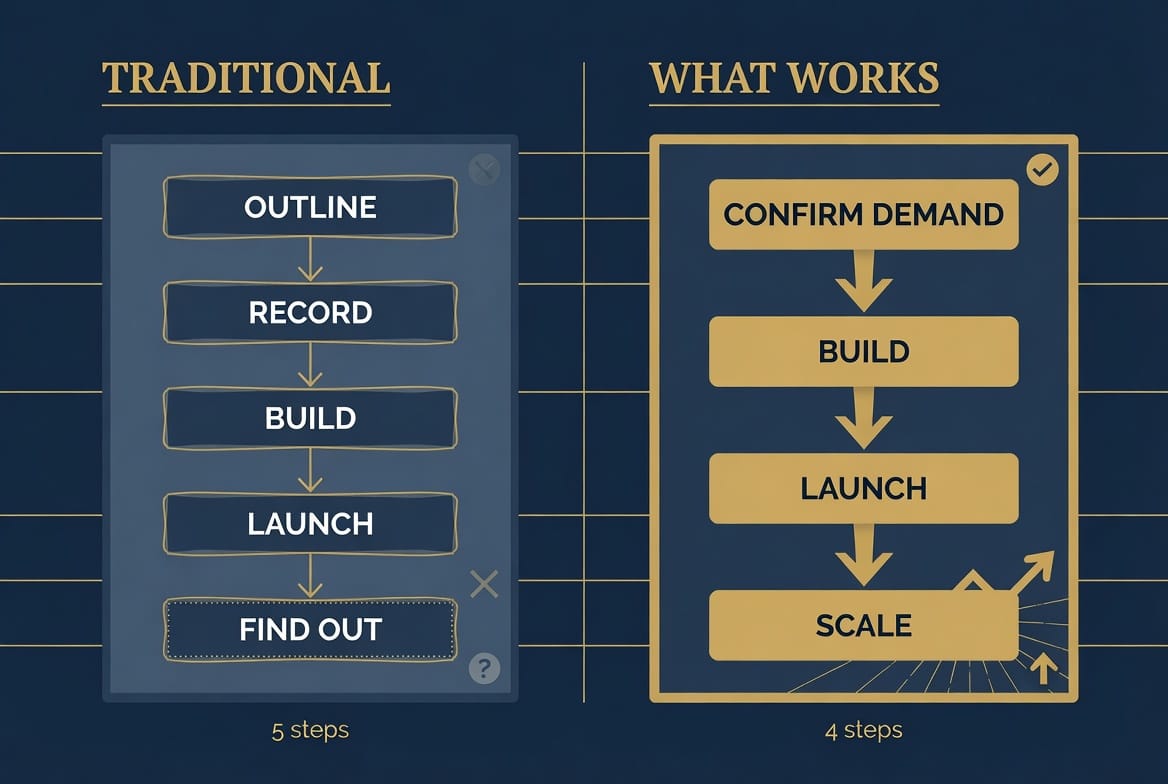
The traditional course creation process looks like this.
You identify a topic you're qualified to teach. You outline the modules. You record the content. You build the course platform. You write the sales page. You launch it. Then you find out whether anyone wants it.
The fundamental problem with this process is that the most expensive step, building the course, happens before the most important question gets answered: will real people pay real money for this?
The process that produces courses that sell inverts this sequence entirely.
You start by confirming demand. Not assumed demand. Not survey demand. Actual purchase behavior from real strangers who have no prior relationship with you and no goodwill to draw on.
Then you build.
Sarah Mitchell, a life and mindset coach, spent eleven weeks building her first course before launching it. She made nine sales. The course content was solid. The problem was that she had never confirmed that real strangers, people who didn't already follow her and weren't being charitable with their enthusiasm, would actually pay for this specific solution at this specific price point.
Her second course launched eight months later and produced 61 sales. The difference wasn't the content. It was the sequence. She confirmed demand first, then built.
How to Confirm Demand Before You Build
Real demand confirmation has one definition.
A stranger paid you money.
Not a stranger who told you in a survey they'd be interested. Not a follower who commented that they need exactly this. A cold prospect who has never heard of you, encountered your offer through a paid ad, and made a buying decision purely based on whether your offer addressed a problem they were already experiencing.
The mechanism for getting this confirmation quickly and cheaply is a low-ticket product. Something priced between $7 and $47 that solves one specific, immediate problem in your space. Not a preview of your full course. Not a watered-down module from what you're planning to build. A standalone product that delivers a complete solution to one narrow, acute problem.
You put it on a simple page. You drive a small amount of paid traffic to it for five days. You watch the conversion rate.
If the page converts at 2 percent or better on cold traffic, real demand exists. People who don't know you are willing to pay for a solution to this type of problem from someone who presents themselves the way you do. That's meaningful confirmation.
If it converts below 1 percent, something isn't working. The problem isn't specific enough, the price is off, the headline isn't connecting, or the demand isn't as real as you thought. You've learned that for a few hundred dollars instead of months of your life.
The validation product isn't just a demand test. It becomes the front end of your funnel once the full course is built. The low-ticket product feeds buyers to the course. The course becomes the natural next step for someone who got value from the front-end product and wants to go further.
The Specificity Problem Every Course Creator Faces
Here's the single biggest content-level mistake course creators make when building something they intend to sell.
They make it too broad.
A broad course is easier to build because you can include everything you know about a topic without making hard decisions about what's essential and what's extra. It feels more valuable because it's more comprehensive. It's also dramatically harder to sell.
Here's why.
A broad course creates a broad buying decision. The prospect has to evaluate whether the entire scope of what you're covering is relevant to their specific situation right now. Most of it probably isn't. They're not looking for everything about your topic. They're looking for the specific piece of it that addresses the problem they're experiencing today.
A specific course creates a specific buying decision. The right person reads the title and immediately recognizes themselves. The evaluation is simple: do I have this problem? If yes, this course is probably for me.
The course that sells consistently to cold traffic is almost always more specific than the creator's instinct tells them it should be.
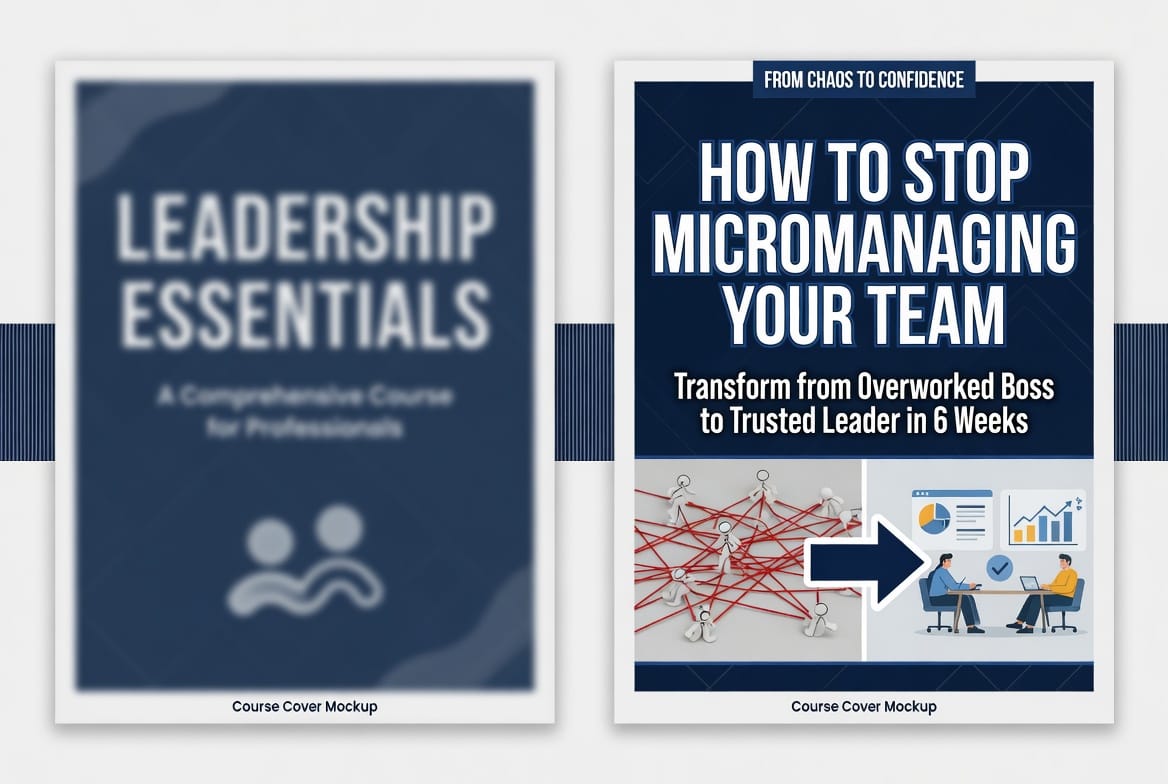
"The Complete Guide to Building a Coaching Business" asks a prospect to evaluate whether they need everything inside it.
"How to Get Your First Three Paying Coaching Clients Without a Big Audience or a Sales Call" asks them to evaluate whether they have that specific problem.
If they have that problem, the second course is a near-automatic purchase. The first course might be better. It converts at a fraction of the rate.
Once you've confirmed demand and committed to a specific enough topic, the content question becomes much easier to answer.
Because now you have a filter.
Everything that moves the buyer from the exact problem they entered with to the exact outcome you promised stays in. Everything else comes out.
This is harder than it sounds. Subject matter experts almost always know more about their topic than belongs in any single course. The temptation to add the advanced material, cover the edge cases, include the nuance that reflects deep expertise, is constant and understandable.
Resist it.
A course that delivers one complete transformation is worth more to the buyer than a course that delivers half of three transformations. Overwhelm is one of the primary reasons people don't finish courses. Every module that isn't on the direct path from the problem to the promised solution is another opportunity for the buyer to fall off and another piece of evidence they use when asking themselves whether this course is working.
The most legitimate, effective courses tend to be shorter than their creators initially planned. Not because short is better. Because ruthless focus on the outcome produces a course where every piece earns its place and nothing is padding.
When Priya Sharma rebuilt her second course, she started with 14 modules planned. She finished with 8. Every module she cut was content that was interesting but not essential to reaching the promised outcome. Her completion rate on the second course was 40 percent higher than the first. Her testimonials were more specific. Her refund rate was lower.
The shorter course did more for her buyers and more for her business.
The Price Point Decision
Most course creators price their courses by looking at what competitors charge and picking something in the same range.
This produces prices that are defensible in conversation and often wrong for the specific buyer journey you're trying to create.
Price sends signals that affect who buys, what they expect, and how committed they are to completing the course and getting a result.
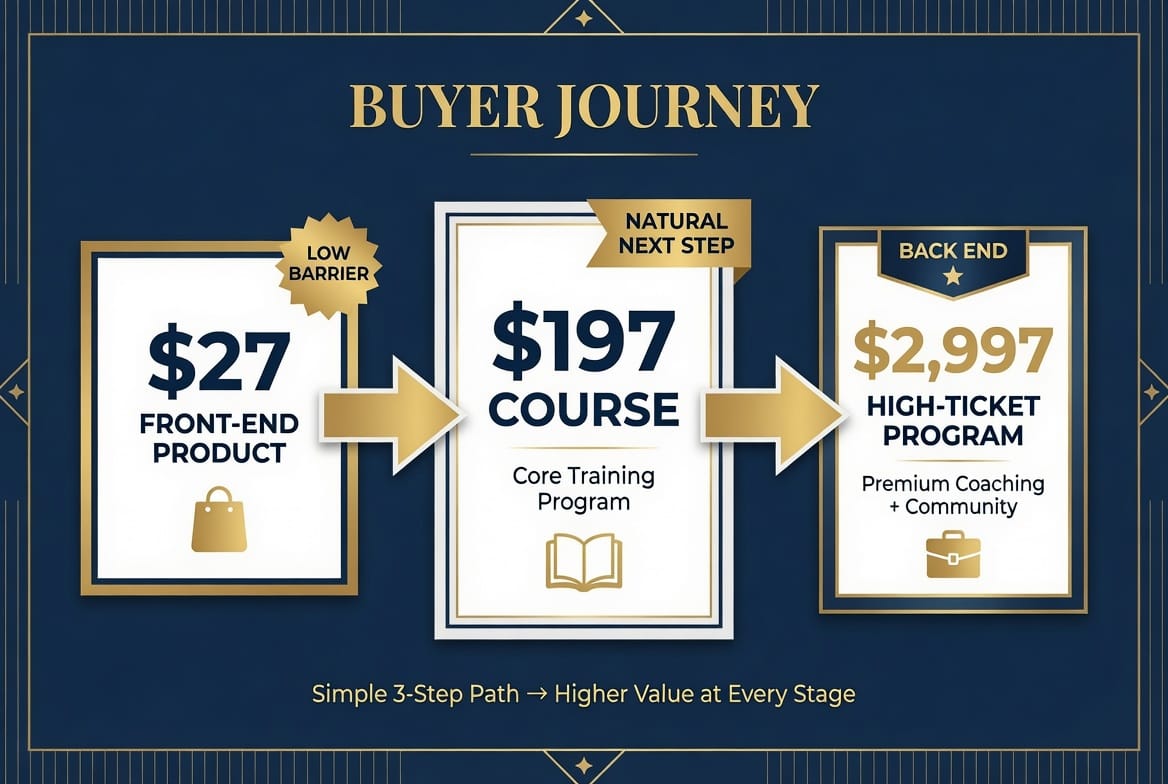
A $27 product attracts someone making a small, easy commitment to explore a solution. A $197 course attracts someone making a more significant investment who expects a more substantial transformation. A $997 program attracts someone serious enough to invest at a level that changes how they show up.
The most common pricing mistake for creators building the type of funnel discussed throughout this series is placing a $197 course as the first offer to cold traffic.
Cold traffic won't pay $197 to someone they just met at a meaningful conversion rate. The trust required to justify that purchase doesn't exist yet. That's not an objection to overcome with better copy. It's a structural reality about how trust develops between a buyer and a seller they've never transacted with before.
The structure that works is a low-ticket front-end product that creates a prior buying relationship at a low barrier to entry, followed by the $197 course as the natural next step for buyers who want more. The course converts dramatically better to buyers who have already paid you once than it ever will to cold traffic encountering you for the first time.
This is why knowing where your course sits in the funnel matters as much as knowing what's in it.
The Production Question
One of the things that delays most course creators is the belief that the production quality of the course has to be high before they can sell it.
It doesn't.
The courses generating the most revenue in most niches are not the most beautifully produced ones. They're the ones that solve the most specific problem for the most clearly defined person with the most direct path from where the buyer is to where they want to be.
A screencast recording with clear audio and a simple slide deck is sufficient for most course content. A direct-to-camera recording in a reasonably quiet room with decent lighting is sufficient for the pieces that benefit from seeing a face. Neither of these requires professional equipment or production assistance.
The production question worth asking isn't "is this good enough for people to buy?" People are buying courses recorded on iPhones in spare bedrooms every day. The question is "does the quality of this content respect the buyer's investment of time and money?"
Clear audio matters. Inaudible or distracting audio is the one production element that consistently drives refund requests and completion drops. Everything else is secondary.
Get the audio right. Everything else can be good enough.
What Happens After Someone Buys
where the most important part of the relationship begins.
What happens in the 72 hours after purchase determines whether the buyer becomes a testimonial, a repeat customer, and an advocate for your work, or whether they forget they bought the course, never open it, and either request a refund or quietly disappear.
The first email after purchase should go out immediately. It should give them clear access to what they just bought, deliver one piece of immediate value from inside the course to start the momentum, and make them feel like buying was the right decision before doubt has a chance to settle in.
The emails that follow over the next five to seven days should do three things in order. Keep buyers engaged with the content and making progress. Build the relationship so they feel like they know you, not just your course. And introduce the next offer, whether that's a coaching program, a group program, or a higher-tier course, as the natural next step for someone who got value from what they just bought.
This sequence, built intentionally and executed automatically, is what turns a one-time $27 buyer into a $197 course student into a $500 a month coaching client. Not through pressure. Through delivering on every promise you made at each stage and showing them what's waiting on the other side when they're ready for more.
The System Behind the Course
Creating an online course that sells isn't primarily about what's inside the course.
It's about understanding where the course fits in a system designed to find the right buyers, deliver them to the course in a state of existing trust and momentum, and move them naturally toward the next level of your work.
The validation product that confirms demand. The front-end funnel that acquires buyers at a cost the math can support. The course itself that delivers the promised transformation. The post-purchase sequence that bridges buyers to the back end. The back-end offer that's where the real business lives.
Each piece has a specific job. The course is one piece of that system, not the whole system.
The course creators who consistently generate revenue aren't the ones with the best content necessarily. They're the ones who understand how all the pieces connect and build the system that delivers buyers to their course in the right context at the right moment.
How to build that complete system, from the front-end product through the course and into the back end, is exactly what Get Paid to Get Leads covers.