How to Get Your First Paying Coaching Clients
Getting your first paying coaching clients is a completely different problem from getting your tenth or your fiftieth.
At ten clients, you have testimonials. You have case studies. You have proof that what you do works. You have a track record that removes the primary objection a new prospect has when deciding whether to trust you with their money.
At your first client, you have none of that. You have expertise, a desire to help, and the challenge of convincing someone to pay you for something they have no direct evidence you can deliver.
This article is about solving that specific problem in the most practical way possible. Not theory about building a brand or creating content that resonates. The actual moves that produce paying clients for coaches who are starting without an established following, without a long client list, and without a marketing budget that can absorb expensive mistakes.
The Fastest Path Is Not the Most Obvious One
Most coaches who are trying to get their first clients spend time on things that feel productive but don't directly produce revenue.
They build a website. They design a logo. They spend weeks perfecting their niche statement. They create a content strategy. They set up social media profiles and start posting consistently.
None of these things are wrong. Some of them matter eventually. But almost none of them produce paying clients for someone who has no established audience, no existing content library, and no track record.
The fastest path to your first paying clients involves almost none of the above.
It involves talking directly to people who might be your ideal clients, understanding their problems precisely, making offers that directly address those problems, and iterating based on what you hear until someone says yes.
That's the uncomfortable truth about getting first clients. It requires more human contact and more direct offers than most coaches are initially comfortable with. But it's the path that works most reliably without an established platform.
Start With People Who Already Know You
Your first clients are almost certainly not going to come from cold strangers on the internet.
They're going to come from your existing network. Former colleagues. Past clients from whatever work you did before coaching. Friends who know about your expertise. People you've had meaningful conversations with who know what you're good at.
The exercise worth doing before anything else is sitting down and listing every person you know who might be, or might know, someone who is dealing with the type of problem you help solve.
You're not going to pitch all of them. You're going to have conversations with them. Ask them about their situation. Find out whether the problem you solve is one they're experiencing or one they see others experiencing. Listen more than you talk.
Some of those conversations will reveal potential clients. Some will reveal referral sources. All of them will give you language: the specific words real people use to describe the problem you solve. That language is invaluable for everything you do later.

The Offer That Gets First Clients
The offer that gets first clients is almost always different from the offer that generates the most revenue at scale.
At scale, a $2,000 coaching program sold to pre-qualified buyers who came through a front-end funnel makes economic sense. It's repeatable, predictable, and doesn't require your personal involvement in every acquisition.
For your first clients, a lower-barrier, shorter-commitment offer often works better. Not because you should undervalue your work permanently, but because you're asking someone to make a financial commitment based on no direct evidence of results. Reducing the size of that commitment while still delivering genuine value is how you give people an easy first yes.
A four-week sprint. A single focused session. A 30-day program targeting one specific outcome. These are easier first sales than a six-month program at full price to people who don't yet have proof that you deliver.
The other thing that gets first clients is specificity.
"I help people with their mindset" doesn't help someone recognize whether they need you.
"I help corporate marketing managers who want to go out on their own figure out the exact financial threshold where leaving their job is no longer a risk" helps a very specific person recognize that this conversation is for them.
The more precisely you can name the person and the problem, the less convincing is required in the conversation. The right person self-selects. The wrong person doesn't waste your time.
Outreach That Actually Works
For coaches without an established audience, some version of direct outreach is necessary to get the first few clients.
Direct outreach gets a bad reputation because most of it is terrible. Generic cold DMs that could have been sent to anyone. Connection requests followed immediately by a sales pitch. Messages that are transparently about the sender and not at all about the recipient.
Outreach that works is fundamentally different in one way: it leads with genuine interest in the other person's situation rather than with your offer.
Find people who are publicly talking about the problem you solve. On LinkedIn, in Facebook groups, in comment sections. People who are asking questions, expressing frustration, or sharing challenges that fall squarely in your area of expertise.
Respond with something genuinely useful. Not a pitch. A real piece of advice that addresses what they said. Then, if the response to that is positive, offer to continue the conversation.
This process is slower than sending 100 cold pitches. It produces better results because the people who respond to genuine value are the people who are actually dealing with the problem you solve and are open to help.
The Role of Content in Getting First Clients
Content doesn't produce first clients quickly when you're starting from scratch.
Growing an organic audience from zero to the point where it produces consistent client inquiries takes months or years. That timeline is real and shouldn't be dismissed. But it's not the answer when you need clients now.
What content can do in the early stages is provide context and credibility for conversations you're already having. If you're reaching out to someone or having a conversation with a referral, having a few pieces of content that demonstrate how you think about their problem gives them something to evaluate before committing to a paid relationship.
This doesn't require a full content strategy. It requires a handful of pieces: one or two articles or posts that demonstrate your thinking clearly on the specific problem you solve. Enough for someone who is curious about working with you to verify that you know what you're talking about.
Build this alongside the direct outreach rather than instead of it. The content supports the conversations. It doesn't replace them.
The Bridge to a Sustainable Client Pipeline
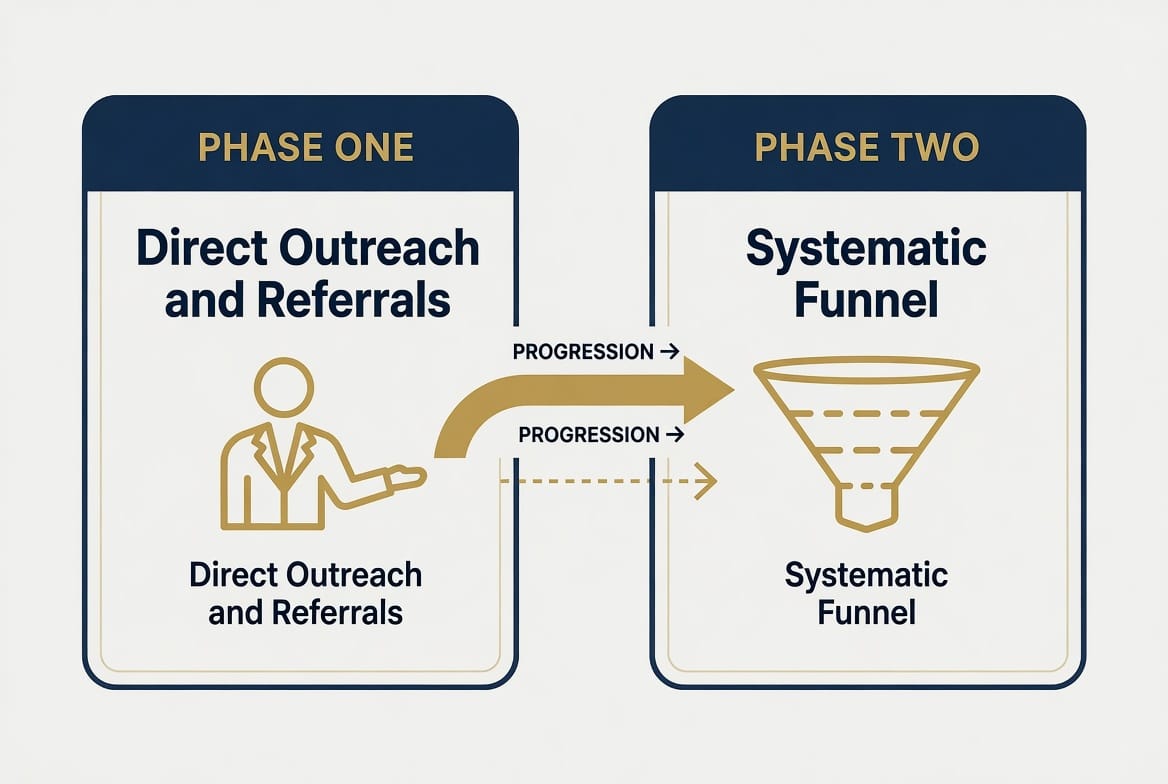
Getting your first three to five clients through direct outreach and conversations is a phase, not a strategy.
It works at the beginning because you can invest significant personal time in each potential client. You can have the conversations, follow up thoughtfully, and close a high percentage of the right people.
At some point, the time required for that approach becomes the ceiling on your growth. There are only so many hours in a day and only so many quality conversations you can have.
The bridge from "getting first clients through direct effort" to "having a sustainable pipeline" is usually one of two things.
The first is referrals from early clients. Coaches who deliver exceptional results get referrals. Sometimes without asking. Always if you ask. Your first three clients, treated exceptionally well, can produce your next six clients through referrals without any additional outreach.
The second is a systematic front-end funnel that generates pre-qualified buyers continuously without requiring your personal involvement in each acquisition.
The transition to the funnel model typically makes sense once you have enough client results and testimonials to make a front-end product credible and compelling to cold traffic. That's usually somewhere between three and ten satisfied clients, depending on the specificity and strength of the results they got.
What the First Client Actually Buys You
The first paying client is not primarily about the revenue.
It's about the data.
The first client tells you whether the problem you think you're solving is the problem they actually needed help with. They tell you, through the questions they ask and the results they get, whether your process produces what you promised. They tell you, in their own words when you ask them, what changed and what it was worth to them.
That information is more valuable in the early stages than almost anything else. It shapes the offer. It shapes the language. It shapes the process.
Most importantly, a satisfied first client becomes the proof of concept that makes the second client easier to close and the third easier still.
Getting that first client is hard partly because the path is genuinely uncertain and partly because the stakes feel higher than they are. The reality is that most coaches who are genuinely good at helping people and willing to have direct conversations with potential clients can find their first paying client within 30 to 60 days.
The system that produces clients consistently at scale after those first few is a different challenge. The complete framework for building that system is what Get Paid to Get Leads covers.