How to Know If Anyone Will Pay For Your Offer Before You Spend a Dollar on Ads
After two failed ad campaigns Jennifer Walsh made herself a promise.
She would never spend money driving traffic to an offer again until she knew, with as much certainty as possible, that people would actually pay for it.
Not that they'd download it for free. Not that they'd tell her it was a great idea. Not that they'd leave a comment saying they needed exactly this.
That they'd pay for it.
Because here's what Jennifer had learned the hard way: the distance between "I would totally buy that" and an actual credit card transaction is enormous. People are generous with their enthusiasm and careful with their money. An audience full of people who love your content and think your ideas are brilliant can produce almost no sales if the offer isn't structured correctly or if the demand was never real in the first place.
Before she built anything new, she wanted to know the math would work. And she wanted to know it cheaply, quickly, and without spending months creating a product that flopped on launch day.
The Expensive Way Most People Validate
The traditional approach to finding out whether an offer will sell looks something like this.
You spend two to three months building a course or program. You record the modules, design the workbooks, set up the membership site. You invest real time and sometimes real money into production. Then you launch it to your audience and find out whether anyone wants it.
If it sells, great. If it doesn't, you've spent three months and several thousand dollars finding out that the demand either wasn't there or wasn't strong enough at that price point.
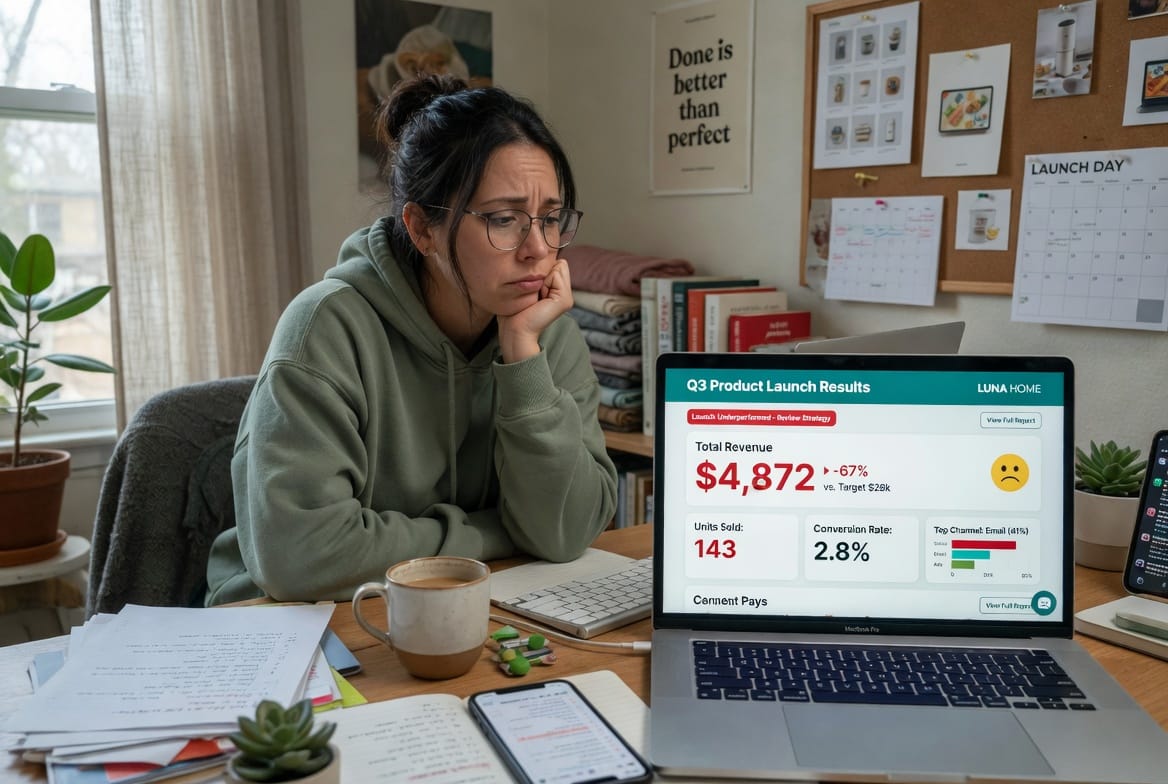
This is the model Jennifer had been using. Her first course had taken her eleven weeks to build. She launched it to her list of 2,200 free subscribers at $197. She made six sales. Eleven weeks of work, six sales, and a product she now had to somehow justify continuing to support and update.
The launch hadn't failed because the content was bad. It had failed because she had validated the wrong thing. She had validated that people were interested in the topic, not that they would pay $197 for her specific solution to their specific problem.
Those are completely different validations.
What Real Validation Actually Looks Like
Real validation has one simple definition.
Someone paid you money.
Not a survey response. Not a thumbs up on a poll. Not a reply to an email saying they'd definitely buy it when it's ready. An actual transaction where a real person gave you real money in exchange for something you offered.
Everything else is data about interest. Only a purchase is data about buying behavior.
The way to get that data quickly, cheaply, and before you build anything significant is with a low-ticket front-end product. Something priced between $7 and $47 that solves one specific problem your ideal customer is already trying to solve right now.
Not a full course. Not a comprehensive program. One problem. One solution. Packaged simply and priced low enough that the buying decision takes seconds rather than days.
The low ticket price does something that a $197 course can't do in a validation context. It removes price as a variable. If people aren't buying a $27 product, the problem is either the offer itself, the audience, or the messaging. If people are buying it, you've confirmed that real demand exists and that your audience will actually open their wallets for this type of solution.
That's the information you need before you spend months building something bigger.
The Five-Day Validation Test
Jennifer's turning point came when she stopped thinking about validation as a launch and started thinking about it as a test.
The test has a simple structure. Build the simplest possible version of a low-ticket product. A short guide, a focused workshop recording, a template, a framework. Something that genuinely solves one specific problem and can be created in a day or two rather than weeks.
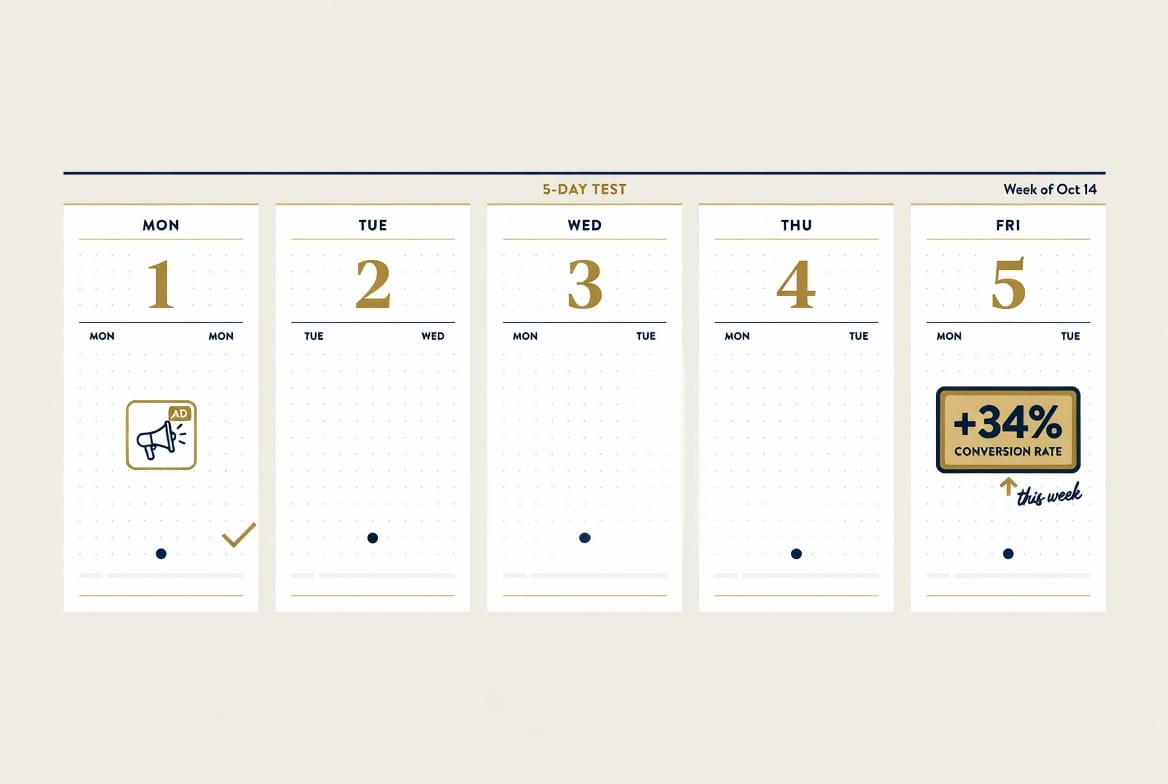
Put it on a simple page with a clear headline, a price, and a buy button. Drive a small amount of paid traffic to it for five days. Not a large budget. Enough to get 200 to 400 people to the page and see how many of them buy.
The conversion rate on that page tells you everything you need to know.
If the page converts at 2 percent or better on cold traffic, the offer has legs. The demand is real. The messaging is connecting. You have confirmation that people will pay for this type of solution before you've invested months building the full version.
If it converts below 1 percent, something isn't working. Either the offer isn't specific enough, the price is off, the headline isn't connecting, or the demand isn't as strong as you thought. You've found that out for a few hundred dollars instead of three months of your life.
The test isn't about making money. It's about buying information. The cheapest, fastest way to find out whether the foundation of your business model is solid before you build the whole house on top of it.
What Jennifer Found Out
Jennifer ran her first validation test on a $27 guide that addressed a specific problem she had been hearing from her audience repeatedly for months.
She spent $150 over five days driving cold traffic to the page.
The page converted at 3.1 percent. She made 11 sales and recovered $297 of the $150 she spent. Her front-end revenue covered her ad spend before she had built a single module of a full course.
More importantly she had confirmed something she had never been able to confirm before. Real people, who had never heard of her, who found her through a paid ad, were willing to open their wallets for this specific solution at this specific price point.
That's a completely different foundation to build on than eleven weeks of course creation followed by a launch to a list of people who already liked her for free.
The guide took her two days to create. The validation test took five days to run. In seven days she had more useful business intelligence than eleven weeks of course building had ever given her.
The Other Thing Validation Tells You
The purchase data from a validation test tells you more than just whether people will buy.
It tells you who is buying.
When Jennifer looked at the people who had purchased her $27 guide, she noticed patterns in how they described their problem, what language they used in their replies to her thank you page survey, what they said they were hoping to get from the product.
That information was pure gold for building the next offer. Not because she had surveyed her existing audience and gotten polite responses. Because she had surveyed actual buyers who had self-selected by paying money. Their language became the copy for her next product. Their problems became the outline for her full course. Their words told her exactly how to talk about what she did in a way that connected with people who were actually going to buy.
Free lead magnets produce data about what free subscribers are interested in. Buyer validation tests produce data about what paying customers actually want. Those two things are not the same and the difference between them is the difference between building an offer you think people want and building an offer you know people will pay for.

What This Changes About the Fear of Ads
Jennifer's relationship with paid traffic changed completely after her first validation test.
Before the test, running ads felt like putting money into a machine and hoping something came out. Every campaign carried the weight of potential loss. Every dollar spent was a dollar that might not come back.
After the test, she understood that the fear hadn't been about ads at all. It had been about spending money without knowing whether the foundation was solid. The ad campaigns she'd lost money on before hadn't failed because ads didn't work. They had failed because she had been sending paid traffic to an offer she hadn't properly validated at a price point that the math couldn't support.
With a validated low-ticket offer producing a confirmed conversion rate on cold traffic, paid traffic stops being a gamble. It becomes a system with known inputs and predictable outputs.
That shift, from gambling to arithmetic, is what makes it possible to build a self-funding funnel on a side-hustle budget without the fear of losing money you can't afford to lose.
How to structure that funnel so the math works from the first day of running traffic, even on a budget that has to be careful...