How to Replace Cold Outreach With a Funnel That Sends Pre-Qualified Buyers Straight to Your Calendar
David Chen sent his last cold outreach message on a Tuesday in February.
Not because he had a dramatic realization that morning. Not because something went wrong. He sent it, looked at his calendar, looked at his funnel dashboard, and quietly decided he was done.
His front-end funnel had been running for four months. His buyer list had grown to just over 600 people. He had taken 24 discovery calls that month, all of them from people who had come through the funnel. He had closed 8 of them.
His best month of cold outreach had ever produced 6 closes from 52 calls.
The last cold outreach message wasn't a declaration. It was just the natural end of something that had already been replaced by something better.
What David had built over those four months wasn't complicated. It wasn't expensive. And it didn't require him to learn an entirely new set of skills. It required him to understand one structural shift and build the right pieces around it.
Here's what that looks like from the outside.
The Structural Shift
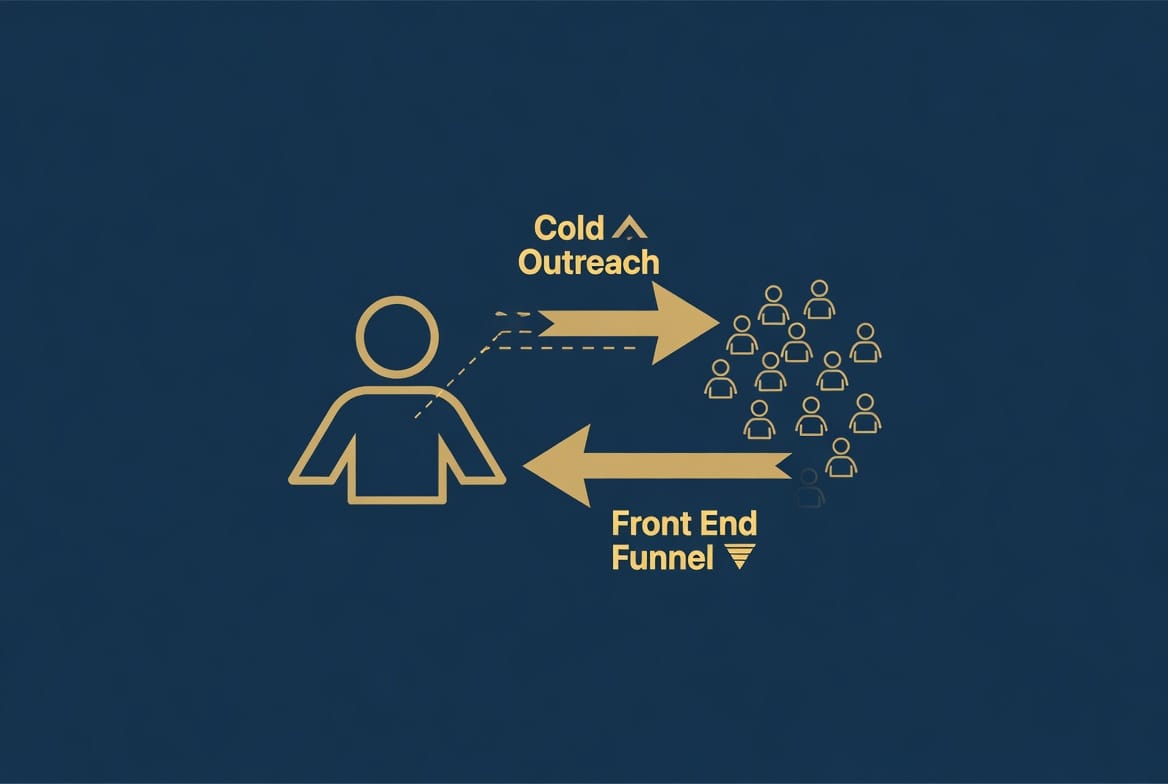
Cold outreach puts you in the position of chasing people who haven't yet decided they have a problem worth solving.
A front-end funnel inverts that entirely.
Instead of you going out to find prospects, the funnel brings prospects to you. Not random prospects. People who found you because they were already searching for a solution to a specific problem. People who then paid to access your thinking on that problem. People who have been through a sequence of touchpoints that built trust and established your credibility before you ever speak to them.
By the time they book a call they've already done most of the work of becoming a client. The call is the final step in a journey they chose to take, not the first step in a sales process you're trying to move them through.
That inversion changes everything about the experience of running the business. The leads come to you. The qualification happens automatically. The trust is already built. Your job on the call shrinks from convincing a stranger to confirming a fit.
David described the feeling of his first month running purely on funnel leads as "finally having a business that worked for me instead of one I had to constantly work at."
Large Call to Action Headline
Six months after David launched his front-end funnel his business looked like this.
His buyer list had 847 people on it. Every one of them had paid to be there. Every one of them had gone through a post-purchase sequence that delivered value, built the relationship, and introduced the option of working with him directly.
His discovery call volume had dropped from eight to ten calls a week to two to three. His close rate had gone from 11 percent to 34 percent. His monthly revenue had climbed from an inconsistent $7,000 to $9,000 range to a consistent $14,000 to $16,000.
He was working fewer hours on sales activity than at any point in the previous three years.
His pipeline, the thing that had required constant manual effort to fill when he was running cold outreach, was now filling itself. Every day the funnel ran, new buyers came in. Every week a handful of those buyers moved through the sequence and booked calls. The calendar populated without him having to do anything to make it happen.
He had taken a week off in month five, the first real break he had taken in two years, and come back to find the pipeline exactly as full as when he left.
That's not a minor operational improvement. That's a fundamentally different relationship with your own business.
What Happens to Cold Outreach
Most consultants and agency owners who build a front-end funnel don't stop cold outreach on day one. They wind it down gradually as the funnel ramps up and the quality difference between the two types of leads becomes impossible to ignore.
David ran both in parallel for the first three months. He noticed the shift in call quality almost immediately. Funnel buyers arrived differently. The conversations moved faster. The trust was already established. The close rate was visibly higher from the first month.
By month three the cold outreach was producing a fraction of his closed business despite consuming a significant share of his time. The math made the decision for him.
If you're running cold outreach right now, you don't have to stop tomorrow. But it's worth being clear-eyed about what it's actually producing relative to what it's costing you in time, energy, and opportunity.
The consultants and agency owners who make this transition consistently describe the same experience on the other side. The calendar dread disappears. The close rate climbs. The clients who come through are better fits because they self-selected through a process that filtered for serious buyers rather than curious browsers.
The business becomes something you look forward to running rather than something you have to push through every week.

The Five Things Working Together
Everything David built comes down to five components that work together to create the system he's running now.
There's the front-end offer that brings the right buyers in. The structure that makes the ad math work so the funnel covers its own costs. The post-purchase sequence that moves buyers toward the back-end offer naturally. The ad campaign setup that finds profitable traffic without requiring a large budget or deep paid media expertise. And the daily process for managing the campaign and scaling it without it taking over his life.
Each component has a specific job. None of them are complicated in isolation. Together they create something that the cold outreach model can never produce: a pipeline that runs automatically, pre-qualifies its own leads, and gets better over time as the buyer list grows and compounds.
David's pipeline today is stronger than it has ever been. He's doing less to maintain it than at any point in the past three years. The buyers keep coming in. The calls keep booking. The clients keep closing.
He sent that last cold outreach message in February and never looked back.
The complete system behind what David built is inside Get Paid to Get Leads.