How to Scale Your Online Coaching Business: 5 Proven Systems
Most coaching businesses don't have a revenue problem.
They have a leverage problem.
The revenue is there. Three clients, five clients, maybe ten. The work is good. The clients are getting results. The referrals are coming in.
But the business is also completely full. Adding one more client means working more hours. Taking a week off means revenue drops. The calendar is packed and somehow the income still doesn't feel proportional to the effort.
That's not a scaling problem. That's the natural ceiling of a coaching model that hasn't been designed to scale.
Scaling a coaching business doesn't mean working more hours. It means building systems that generate revenue, deliver results, and create consistency without requiring proportionally more of your time.
Here are the five systems that make that possible.
System 1: The Buyer Acquisition System
You cannot scale what you cannot fill.
The first system a coaching business needs is one that consistently delivers qualified buyers into the top of the funnel without requiring your active daily involvement to sustain it.
For most coaches trying to scale, this means a front-end funnel. A low-ticket product priced between $7 and $47 that solves one specific problem your ideal client is already trying to solve. Paid traffic driving potential buyers to that product. An order bump and upsell that push average order value high enough to cover the cost of the traffic. A post-purchase sequence that moves buyers toward the coaching offer.
When this system is working, your discovery call calendar fills with pre-qualified buyers who already paid you, already got value from your front-end product, and already decided they trust you before they ever got on a call.
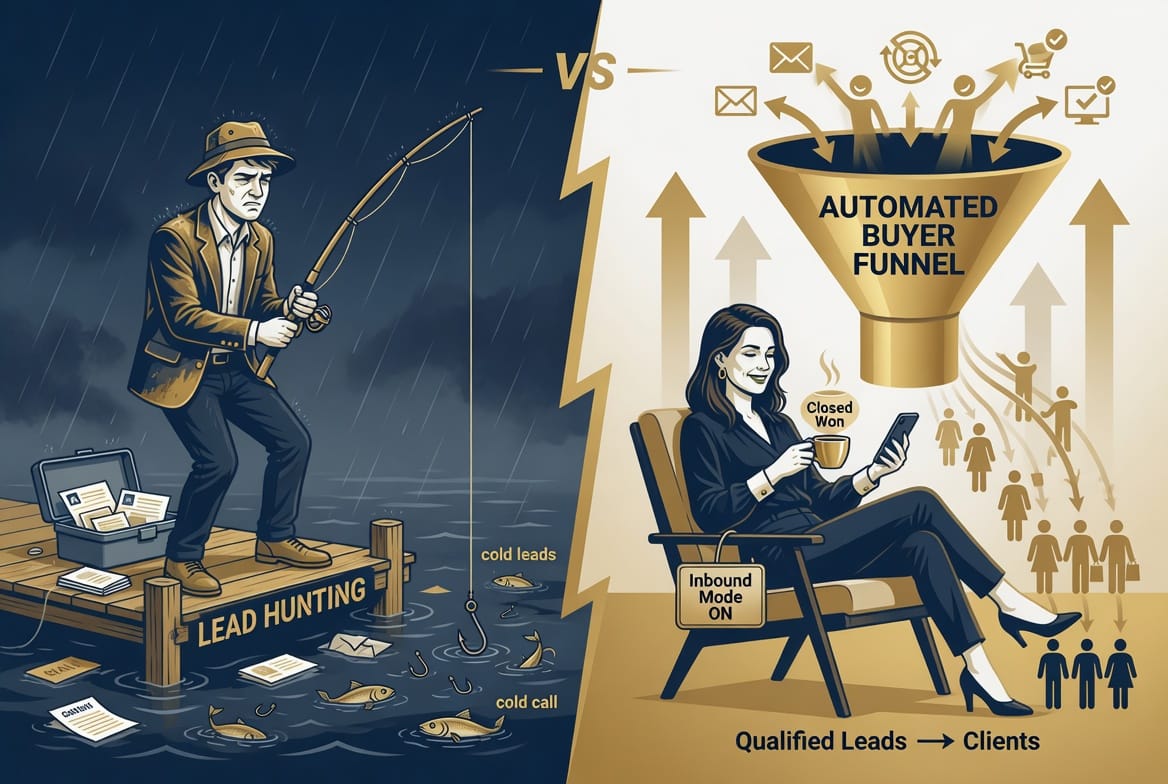
The difference between filling discovery calls through cold outreach and filling them through a front-end funnel is the difference between hunting and farming. Cold outreach is hunting: high effort, unpredictable results, starting from zero every week. The front-end funnel is farming: consistent effort upfront, compounding results over time, a pipeline that doesn't stop when you do.
System 2: The Client Conversion System
Getting qualified buyers into the conversation is half the equation. Converting those conversations into paying clients is the other half.
Most coaches close clients through discovery calls. The effectiveness of those calls varies enormously, not because some coaches are better salespeople but because the quality of the prospect arriving on the call varies enormously.
A structured client conversion system has two components.
The first is a qualifying process that happens before the call. An application, a short questionnaire, or a minimum prerequisite like having completed the front-end product. This ensures that the people who land on your calendar are actually positioned to benefit from coaching and are seriously considering investing.
The second is a consistent call structure. Not a manipulative sales script. A framework that efficiently understands the prospect's situation, identifies whether coaching is the right fit, presents the offer clearly to people who are a fit, and declines gracefully to people who aren't.
Coaches who have a repeatable call structure close at dramatically higher rates than coaches who wing each conversation. Not because they're more persuasive. Because consistency produces predictable outcomes and predictable outcomes are how you know what needs to improve.
The goal of the conversion system is to know your close rate with enough precision that you can calculate exactly how many qualified discovery calls you need to fill your practice.
System 3: The Delivery System
Client results are the foundation of every referral, every testimonial, and every piece of social proof that makes future selling easier.
A delivery system is the structured process by which you produce those results consistently, not just for your best clients or your most engaged clients, but for everyone who goes through the program.
Most coaches deliver coaching in a way that works well when the client is motivated and engaged and works less well when they're not. Results become highly dependent on the individual client's effort rather than the structure of the program itself.
A delivery system shifts that dynamic by making the process, not the client's willpower, responsible for results.
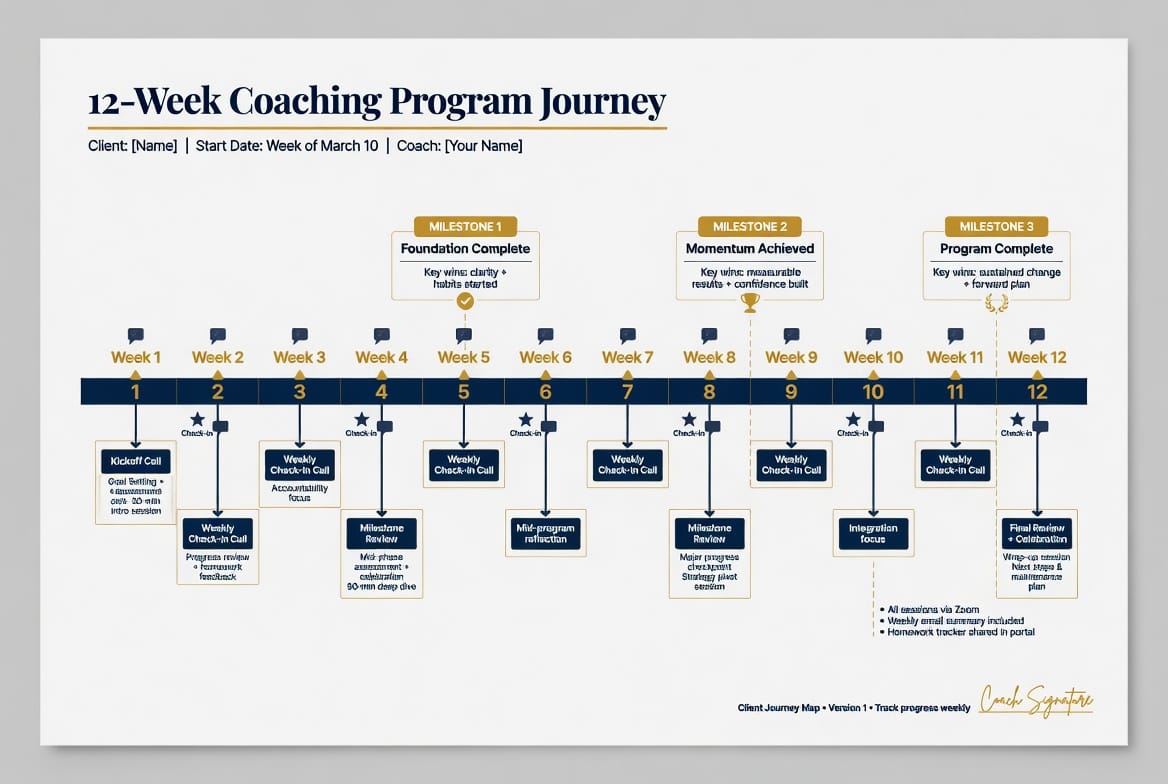
This might look like a structured weekly session agenda that ensures every conversation covers the most important ground. A between-session accountability structure that keeps clients implementing rather than just consuming. A clear milestone framework that both the coach and client use to track progress. Automated check-ins that catch clients who are falling behind before they fall off entirely.
The more systematized your delivery, the more consistently you produce results across your full client roster. And consistent results across your full client roster is what produces the testimonials and referrals that make scaling possible.
System 4: The Retention and Ascension System
Getting a client to their first result is the beginning, not the end, of the relationship.
A client who got a result from your coaching has proven two things. They're willing to invest in solutions to their problems. And your approach works for them.
That's the profile of the person most likely to become a long-term client, to ascend to a higher tier of your offering, or to refer someone else who is in the same situation they were in when they started.
The retention and ascension system is the structured process for making sure none of those outcomes happen by accident.
For retention, it might look like a clear continuation offer presented at the end of the initial engagement for clients who want to keep going. Not a passive hope that they'll ask to continue. An active conversation about what the next phase looks like and what's possible with continued support.
For ascension, it might look like a higher-tier program or a group offer that gives your best clients access to a deeper or broader version of your work. Some clients want more of what's working. A higher-tier offer gives them somewhere to go.
For referrals, it might look like a structured ask at a specific moment in the client journey, typically when the client has just experienced a meaningful result and their enthusiasm is high. A simple, direct ask for anyone they know who might benefit from similar support produces significantly more referrals than a general mention that you accept them.
System 5: The Revenue Diversification System
A coaching business where 100 percent of revenue comes from one-on-one clients has a specific ceiling: the number of hours you can work with clients in a week.
Breaking through that ceiling requires revenue that doesn't scale linearly with your time.
For most coaches, this means one or more of the following.
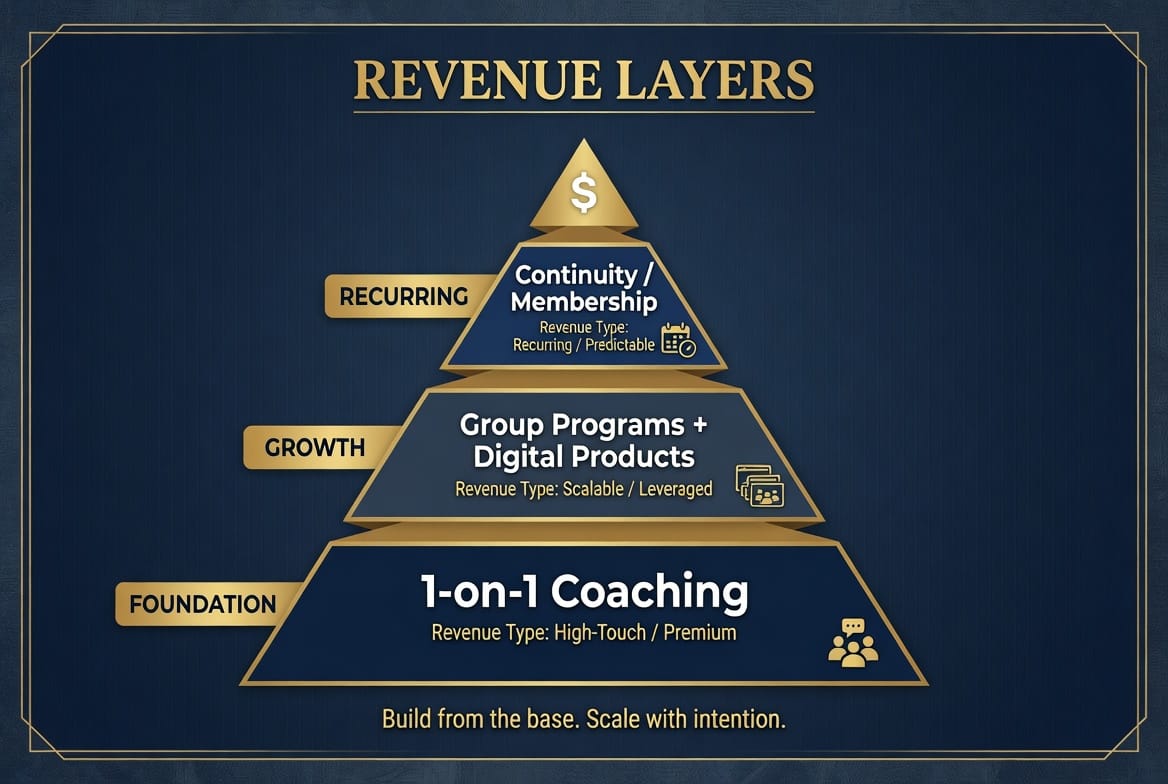
Group programs. Taking multiple clients through a structured process simultaneously. The revenue per hour of your time increases dramatically. The client experience can be as good or better than one-on-one if the program is designed well, because the peer community adds a dimension that one-on-one can't provide.
Digital products. A course, a guide, a workshop, or any other product that delivers a contained transformation without requiring your live presence. The front-end product in the acquisition funnel is often the starting point for this, with higher-ticket courses as a middle layer between the micro offer and the live coaching.
Continuity offers. A membership, a retainer, or any other structure where clients pay a recurring amount for ongoing access to you or your content. Predictable monthly revenue that doesn't require a new sale each month to sustain.
These additional revenue streams don't need to be built simultaneously. Most coaches add them in layers as the business matures. The one-on-one foundation gets replaced or supplemented by group programs. Group programs get supplemented by digital products. Digital products get supported by the front-end funnel.
Each layer makes the others more effective. The digital products feed the group program. The group program feeds the one-on-one work for clients who want that level of support. The front-end funnel feeds everything.
The Order of Operations
The coaches who scale successfully don't try to build all five systems at once.
They start with the buyer acquisition system because without consistent qualified leads, nothing else matters. They build the conversion system because without a reliable close rate, the leads don't become clients. They build the delivery system because without consistent results, the referrals and testimonials that fuel the next stage don't exist.
Once those three foundations are in place, the retention and ascension system extends the value of each client relationship. The revenue diversification system breaks through the time ceiling.
Most coaching businesses that are stuck aren't stuck because they're missing an advanced strategy. They're stuck because one of the foundational systems is missing or underperforming, usually either the buyer acquisition system or the delivery system.
Fix the foundation before adding layers on top of it.
The buyer acquisition system that most coaches need starts with the front-end funnel. The complete framework for building it, from the micro offer through the value stack, the ad campaign, and the back-end sequence, is what Get Paid to Get Leads covers.