How to Sell Digital Products Online
Selling digital products online sounds simpler than it is.
No inventory. No shipping. No physical production costs. You create something once and sell it as many times as the market will bear. The margins are extraordinary compared to almost any other business model. The upside is theoretically unlimited.
And yet most people who try it either make very little money or burn out trying to figure out why the model that looks so straightforward on paper keeps underperforming in practice.
The problem almost never lives where people think it does. It's not the product. It's not the platform. It's not the niche. It's not the copy, the funnel software, the email sequence, or the social media strategy.
It's the economic structure sitting underneath all of those things. Whether the system is built to acquire buyers at a cost the math can support, or whether it's built on a set of assumptions that look reasonable and don't hold up when real money is on the line.
This article is going to walk through what actually works, why most approaches fail before they get a real chance, and what the difference looks like between a digital product business that compounds and one that plateaus.
What a Digital Product Actually Is
Before anything else, it's worth being precise about what we're talking about.
A digital product is any deliverable that exists in digital form and can be transferred to a buyer without physical shipping or manufacturing. That includes online courses, ebooks, guides, templates, swipe files, audio programs, video trainings, membership content, software, and any number of other formats.
The format matters less than most people think. What matters is whether the product solves a specific problem for a specific person well enough that they feel the price was worth paying.
A ten-page PDF that solves one acute problem completely is worth more to the right buyer than a twelve-module video course that addresses the same problem loosely. The depth of the transformation determines the value, not the production format or the length.
That's the first thing worth internalizing before you build anything: the market doesn't pay for effort or comprehensiveness. It pays for outcomes.
Why Most Digital Product Businesses Plateau Early
The most common arc for someone building a digital product business looks like this.
They identify a topic they're knowledgeable about. They build a product around that topic. They grow an audience through free content. They launch the product to that audience. They make some sales, feel initial excitement, and then hit a ceiling that seems impossible to push past regardless of how much effort they put in.
The ceiling isn't a content problem. It isn't a product quality problem. It's almost always an economics problem.
Specifically: the model they're running doesn't have a mechanism for acquiring buyers profitably at scale.
The free audience model, building a list through free content and free lead magnets and then periodically launching to that list, works at small scale when the audience is warm and the creator's energy is high. It stops working reliably when the creator needs predictable revenue, when the audience gets fatigued from repeated launches, or when the math of paid traffic can't support a business that has no front-end revenue to offset acquisition costs.
Jennifer Walsh built a digital product business on the free model for two years. She was making $2,800 a month. Her corporate salary had been $78,000 a year. She was working more hours than she had at her job and generating less than half the income.
The products were good. The audience liked her. The content was solid.
The model was the problem. And switching models, not improving the content or working harder, was what changed her trajectory.

The Economic Problem at the Heart of Free
When you build an audience primarily through free content and free lead magnets, you're making a specific trade.
You're trading the cost of content creation and ad spend for email addresses and social followers. The hope is that over time a portion of that free audience converts into paying customers and the back-end revenue justifies the front-end investment.
Sometimes it does. More often the math is tighter than it looks.
Here's why.
A person who opts in for a free lead magnet has told you one thing about themselves: they like free things. They have not demonstrated any willingness to pay for anything. They have not crossed the line from consumer to customer. And that line, once crossed through an actual purchase, changes everything about how someone behaves on your list.
Buyers buy again. Free subscribers collect free things.
The revenue per subscriber on a buyer list runs somewhere between $1 and $3 per month in most coaching and course creator niches. The revenue per subscriber on a free list runs somewhere between $0.10 and $0.40 per month.
That gap is not a small operational difference. It's a fundamental difference in the quality of the asset you're building.
Ten thousand buyers generating $1.50 per month each is $15,000 a month in recurring revenue potential. Ten thousand free subscribers generating $0.25 per month each is $2,500.
Same effort to build. Same platform costs to maintain. Dramatically different economic output.
The business that scales is the one building a list of buyers. The business that plateaus is the one building a list of free subscribers and hoping enough of them eventually convert.

The Product Stack Most People Are Missing
One of the most common structural problems in digital product businesses is treating each product as a standalone offer rather than as one part of a connected stack.
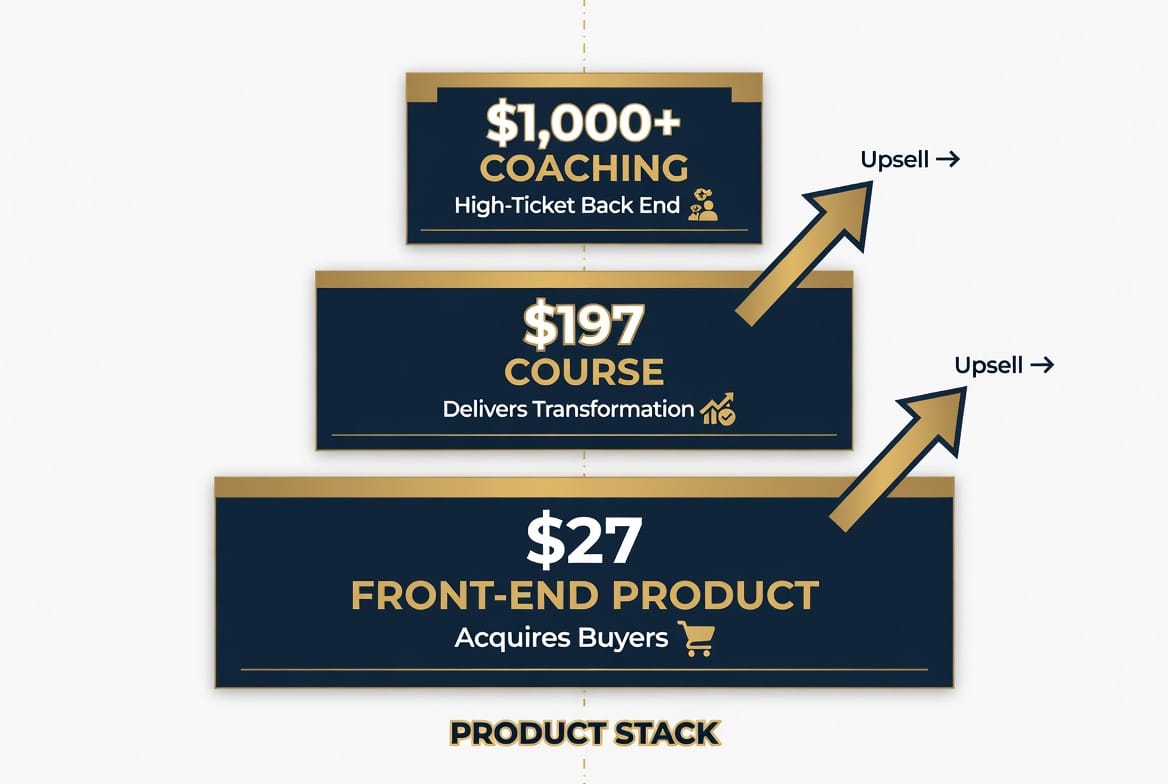
A product stack is a set of offers at different price points that serve the same person at different stages of their journey with you. Entry-level products that solve immediate problems. Mid-tier products that deliver deeper transformations. High-ticket offers that provide the most comprehensive support and the most significant outcomes.
Most digital product creators have a version of this even if they haven't thought about it deliberately. They have a course at one price point and maybe a coaching offer at a higher one.
What they often don't have is the connective tissue between those offers. The front-end product that acquires buyers at a price point the math can support. The order bump and upsell that push the average transaction value high enough to cover the cost of the traffic finding it. The post-purchase sequence that moves buyers naturally from one level of the stack to the next without requiring a new launch every time they need to make a sale.
Marcus Thompson sold digital products for three years without a properly connected stack. Each product was a standalone launch. Each launch required its own promotional campaign. His revenue spiked during launches and dropped between them.
When he built a connected stack with a low-ticket front end feeding a mid-tier course feeding a high-ticket coaching program, the launch-dependent revenue pattern disappeared. The stack generated consistent revenue from the continuous flow of buyers moving through it rather than from periodic bursts of promotional activity.
The products didn't change. The connections between them did.
The Price Point That Changes Everything
There's a specific price point that most digital product creators either skip entirely or underprice to the point where it can't do its job.
The low-ticket front-end product. Something priced between $7 and $47.
This product has one specific job in the stack. Acquire a buyer at a cost the math can support. It's not supposed to be your most comprehensive work. It's supposed to be your most targeted work. One problem, one solution, one clean transaction that crosses the buyer over the line from stranger to customer.
The reason most digital product creators skip this or underprice it is that they underestimate what it does to the rest of the business.
A buyer who paid $27 for a front-end product converts to a $197 course at somewhere between 15 and 25 percent. A free subscriber who downloaded a lead magnet converts to the same $197 course at somewhere between 1 and 3 percent.
The $27 front-end product isn't just a revenue source. It's a filter, a trust builder, and a pre-qualifier for every higher-ticket offer that follows it. The buyers it produces are fundamentally different from the free leads that most digital product businesses are trying to convert.
That difference in buyer quality compounds through every subsequent offer in the stack. Better front-end buyers produce better course conversion rates, better coaching conversion rates, better word of mouth, and better lifetime value.
The low-ticket front end isn't the least important product in the stack. It's the one that determines the quality of everything that comes after it.
Why Paid Traffic Fails Most Digital Product Sellers
The majority of digital product creators who try paid traffic lose money on it and conclude it doesn't work for their business.
In almost every case the conclusion is wrong. The diagnosis is wrong.
Paid traffic doesn't fail because the platform is wrong or the targeting is off or the creative isn't good enough. It fails because the funnel receiving the traffic has no mechanism for recovering the cost of the traffic on the front end.
Sending paid traffic to a free lead magnet means spending money with an AOV of zero. Every dollar you put into the ad account stays spent. The only path to profitability is a back-end conversion that may or may not happen before the budget runs out. For most digital product creators running real budgets with real constraints, it doesn't happen fast enough.
Sending paid traffic to a properly structured front-end funnel with an order bump and upsell changes the equation entirely. The front end generates revenue. The average order value covers the cost per acquisition. The buyers who come through cost nothing net to acquire by the time the transaction is complete.
When paid traffic costs nothing net, you can spend more of it. When you spend more, the buyer list grows. When the buyer list grows, the back end compounds. The business scales without requiring a new launch every month to keep the revenue flowing.
Priya Sharma tried paid traffic twice before understanding this. Both times she sent traffic to a free lead magnet and lost money. The third time she sent traffic to a validated low-ticket offer with a proper value stack behind it. The front end covered her ad spend in the first week. Three months later her digital product business was generating more monthly revenue than her first two launches combined.
Same platform. Same general market. Different funnel structure. Completely different result.
What Consistent Digital Product Revenue Actually Looks Like
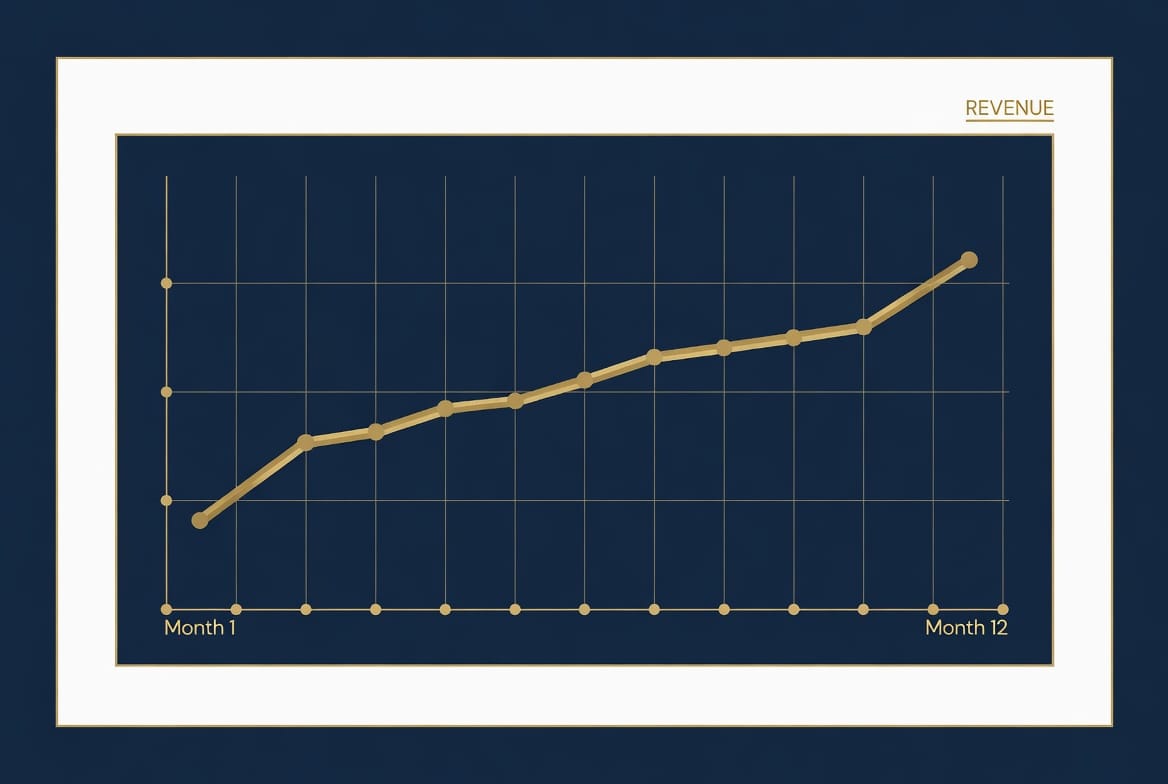
Most digital product businesses generate revenue in spikes. Launch month is good. The months between launches are quiet. The creator works hard to build toward the next launch, generates a burst of revenue, and the cycle repeats.
This model works. It's just exhausting and financially unpredictable in ways that make it hard to plan, hard to invest back into the business, and hard to separate from because the revenue is never consistent enough to feel truly secure.
Consistent digital product revenue looks different.
It comes from a front-end funnel that runs continuously, acquiring buyers every day from paid traffic that covers its own costs. It comes from a post-purchase sequence that moves those buyers through the product stack naturally over time. It comes from a back end that generates revenue from an ever-growing list of buyers who arrived pre-qualified and pre-warmed rather than from a periodic burst of promotional energy directed at a list of mostly free subscribers.
Sarah Mitchell's digital product business generates revenue every single day. Not from a launch. Not from a promotional campaign. From a front-end funnel that brings in buyers, a product stack those buyers move through, and a back end that compounds as the buyer list grows.
She checks her dashboard in the morning. There are sales from overnight. She didn't do anything to generate them. The system did.
That's what consistent digital product revenue looks like. Not a spike every 90 days. A baseline that moves steadily upward as the buyer list grows and the back end deepens.
The One Thing That Determines Whether This Works for You
Every digital product creator reading this is at a different stage. Some are building their first product. Some have products that underperformed. Some have a business that's working but not scaling the way they want it to.
The single variable that determines whether any of this works is whether the economic structure of the business is built to acquire buyers profitably.
Not leads. Buyers.
At a cost the math can support before the back end ever enters the picture.
Everything else, the content quality, the platform choice, the email sequence, the launch strategy, these things matter at the margin. The economics matter at the foundation.
Get the economics right and almost everything else can be figured out. Get the economics wrong and no amount of better content or harder work will produce a business that scales.
The framework for getting the economics right, including how to structure the offer stack, how to validate demand before you build, how to make paid traffic cover its own costs, and how to build the system that generates consistent buyer flow without constant manual effort, is exactly what Get Paid to Get Leads covers.