How to Sell Online Courses: What the Courses That Actually Make Money Have in Common
There are more online courses available today than at any point in history.
There are also more course creators making almost nothing from them.
The gap between those two facts is not a content quality problem. There are genuinely excellent courses sitting on platforms that have never made their creators more than a few hundred dollars. There are mediocre courses generating six figures a year.
The difference is almost never the content. It's the system behind the course. Specifically, how buyers are found, what relationship exists when they arrive at the course page, and whether the economics of the whole thing are built to work at scale.
This article is about what the courses that actually make money have in common and what you can apply to your own course regardless of what stage you're at.
The First Thing: A Buyer Is Not the Same as a Lead
Most course creators think about growing their audience as the path to selling more courses.
Get more followers. Build a bigger email list. Create more content. Eventually the numbers will be large enough that a meaningful percentage of the audience will buy the course.
This logic is not entirely wrong. But it's missing something important.
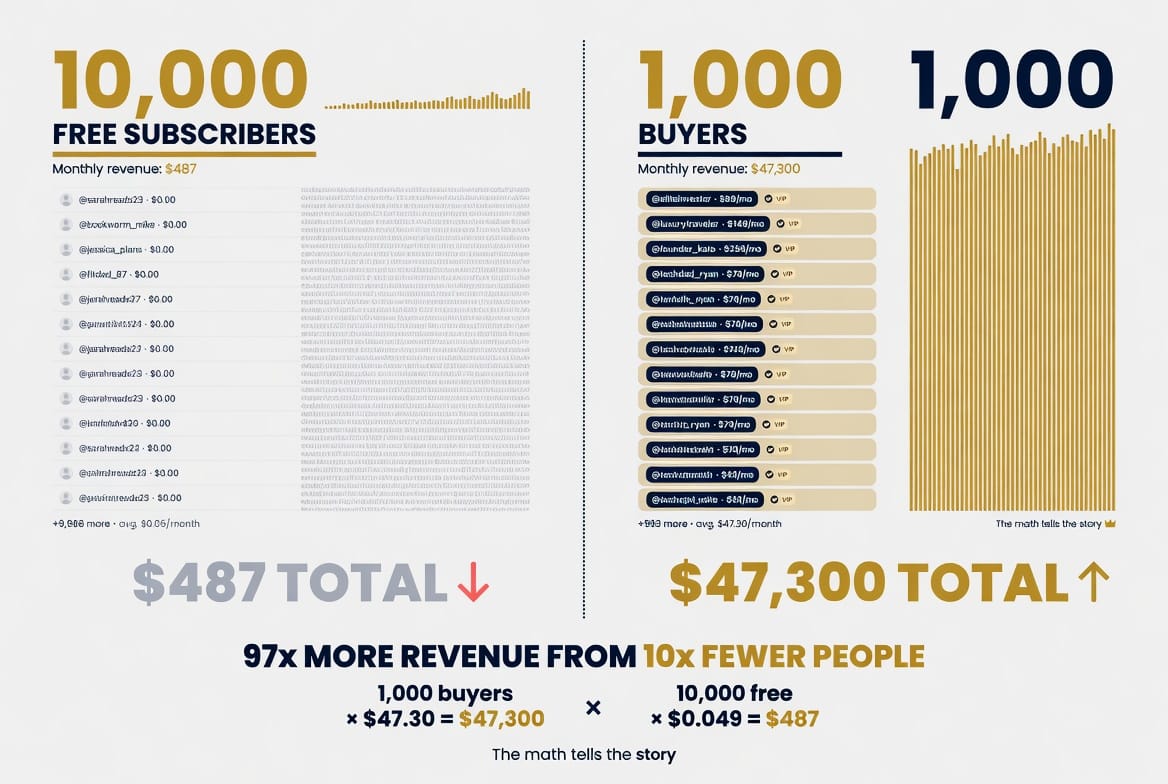
A person who opted in for a free lead magnet is not the same as a person who paid you money. They're on the same list and they look the same in your subscriber count. But they behave completely differently when you send them an offer.
The free subscriber has demonstrated one thing about themselves: they like free things. That tells you almost nothing about whether they'll ever spend money. Purchase rates for free lists in the coaching and course creator space run between 1 and 3 percent. That means 97 to 99 out of every 100 people who joined your list for free will never buy your course.
The buyer has demonstrated something qualitatively different. They crossed the line from consumer to customer. They made a financial decision to invest in a solution. That act changes everything about how they respond to future offers. Purchase rates for buyer lists on follow-up offers run between 5 and 15 percent. The same list, one-tenth the size, generates the same or more revenue.
The first thing the courses that sell have in common is that they're positioned behind a system designed to build a list of buyers, not just subscribers.
The Second Thing: The Trust Gap Gets Closed Before the Course Ask
Here's a specific, uncomfortable truth about selling online courses to cold traffic.
Cold traffic won't pay $197 for a course from someone they met ten minutes ago at a meaningful conversion rate. Not because people are stingy. Because the trust required to justify that level of investment in someone you've never transacted with doesn't exist at the moment of first contact.
This is not a copy problem. Better headlines and more compelling benefits bullets don't fix it. Neither does a longer sales page or stronger social proof.
It's a structural problem. The distance between "never heard of this person" and "$197 purchase decision" is too large to close in the span of a single sales page visit.
The courses that sell consistently have almost always closed some version of that trust gap before the full-price ask is made.
The most common and reliable way to do this is a low-ticket front-end product. A $7 to $47 product that solves one specific problem gives the right buyer a low-friction way to make a first purchasing decision. That single act of paying, even a small amount, transforms the relationship. The buyer is no longer a stranger evaluating whether to trust you. They're a customer who already has.
When that buyer encounters your $197 course, they're not being asked to make a leap of faith. They're being invited to the next logical step in a relationship that already exists.
Priya Sharma's first course launch produced nine sales from a list of 3,400 people. Her second launch, eight months later after building a front-end funnel that had added 340 buyers to her list, produced 61 sales from a list that was only marginally larger. The course hadn't changed. The audience composition had changed. The 340 buyers behaved completely differently from the free subscribers when the launch emails went out.
The Third Thing: The Math Is Built to Work Before the Back End
The courses that sell at scale are almost always sitting inside a funnel where the economics work before the course revenue ever enters the picture.
This sounds technical. The practical implication is straightforward.
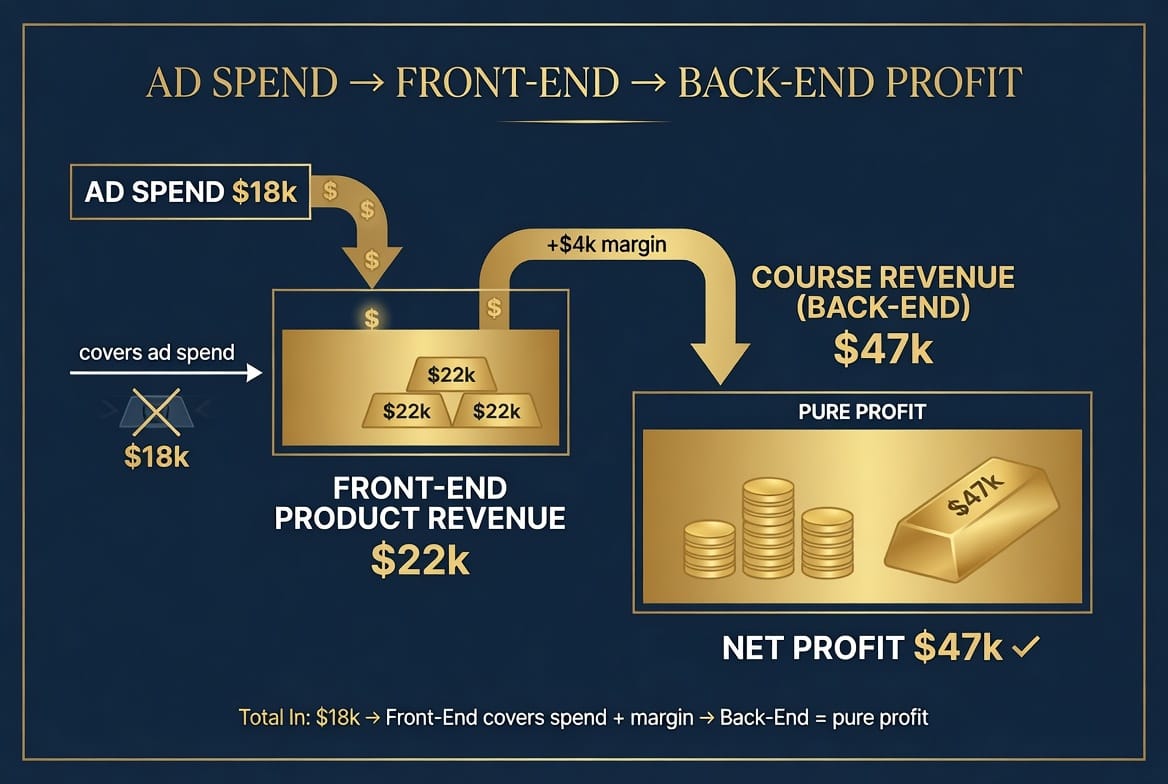
If you're running paid traffic to sell your course and the ad cost of acquiring each buyer is higher than the revenue from the initial transaction, you're losing money on every student you add. You're dependent on back-end revenue, email sequences, and future offers to eventually make up the loss.
Sometimes that works. Consistently, at scale, it's a fragile model.
The courses that scale are positioned as back-end offers behind a low-ticket front-end product with an order bump and upsell that push the average order value high enough to cover the cost of the traffic on the front end. The ad spend comes back out as front-end revenue before the course is ever promoted.
Then the course becomes something you can promote to a buyer list that cost you nothing net to build. Every email you send about the course goes to people who already paid you, already got value from the front-end product, and are predisposed to say yes to more.
That's a fundamentally different selling environment than promoting a $197 course to cold traffic and hoping the conversion rate is high enough to justify the ad spend.
The Fourth Thing: The Course Delivers What It Promised
This one sounds obvious. It's violated more often than you'd expect.
A course that promises a specific transformation and delivers something more general, more complex, or more comprehensive than what was promised produces buyers who feel misled even if the content is genuinely good.
The mismatch between what was promised and what was delivered shows up in low completion rates, high refund rates, and testimonials that are vague or unenthusiastic. All of which affect the next launch.
The courses that sell consistently over time, not just once but repeatedly as the business grows, deliver specifically what was promised. Not more. Not a broader take on the topic. The specific outcome the buyer was told they'd reach.
When the course delivers that specific outcome, something else happens automatically.
The buyer becomes a testimonial source. Their specific, detailed account of the result they got is the most powerful sales tool the next launch will have. Social proof that says "I went from X to Y in Z timeframe" converts dramatically better than social proof that says "this course is really good."
The course that delivers specifically what it promised produces those specific testimonials. The course that over-delivers on scope but under-delivers on the specific transformation produces vague ones.
The Fifth Thing: There's a Clear Path After the Course
The courses that build real businesses are never the final destination.
They're a waypoint.
A buyer who completes your course and gets a result is your most valuable asset. They've proven they invest in solutions. They've proven they get results from your approach. They're the person most likely to invest in the deeper, higher-ticket work you do.
The courses that generate the most business over time have a deliberate, intentional path from the course completion to the next offer. Not a hard sell. A natural invitation for the buyer who got the result and wants more.
That path is usually the back-end coaching program, the group program, or the higher-ticket course that serves people who want a deeper transformation than the course provides.
The post-purchase email sequence that introduces this path isn't optional. It's where the real business lives.
Marcus Thompson's front-end funnel generated buyers at close to break-even on ad spend. His course converted 22 percent of front-end buyers. His Bridge email sequence, five emails over five days after course purchase, converted 6 percent of course buyers into his $2,000 coaching program.
The ad spend paid for itself on the front end. The course generated back-end leads. The coaching program generated the real margin.
Three pieces, each with a specific job, each making the others more effective.

What This Means If Your Course Isn't Selling
If you have a course that isn't generating the revenue you expected, the answer is almost never to rewrite the content or redesign the sales page or try a different launch strategy.
The answer is almost always one of these three things.
The course is being presented to cold traffic without a prior buying relationship being established first. The fix is a front-end product that closes the trust gap before the course ask.
The economics of the funnel don't support paid traffic because there's nothing on the front end covering the cost of acquisition. The fix is a value stack that makes the math work.
The course is sitting in isolation without a connected system delivering the right buyers to it in the right context. The fix is building the front end and the post-purchase sequence that make the course part of a connected flow rather than a standalone page people find and hope to buy.
The course you built isn't the problem. In almost every case, it's the infrastructure around the course that needs to change.
Priya's first course made nine sales. The same course, repositioned as the back end of a properly structured funnel eight months later, became the centerpiece of a business generating consistent monthly revenue. Same content. Same price. Different system.
The System Behind Every Course That Sells
There's a pattern underneath every online course business that generates consistent revenue.
A front-end product that finds and qualifies the right buyers. A value stack that covers the cost of the traffic delivering those buyers. The course itself that delivers the promised transformation. A post-purchase sequence that moves buyers toward the back end. A back-end offer that's where the real margin lives.
These five pieces work together. Remove any one of them and the system underperforms. Put them together correctly and the course sells consistently without requiring a new launch every 90 days to keep revenue flowing.
The complete framework for building that system, from the front-end product through the course and into the back end, is what Get Paid to Get Leads covers.