How to Test Paid Traffic on a Side-Hustle Budget Without Blowing Money You Can't Afford to Lose
Jennifer Walsh had $300 left in her business account when she decided to try paid traffic for the third time.
Not $300 she could afford to lose. $300 she had set aside specifically for this test after two previous campaigns had taken a combined $1,000 and returned almost nothing.
Her husband knew about the $300. He didn't say anything. But she knew what it meant if this one didn't work either.
She wasn't operating from a position of strength. She was operating from a position of someone who had a day job, a family, a mortgage, and a side business she believed in enough to keep trying despite two expensive lessons that hadn't yet produced results.
What was different this time wasn't the ads. It wasn't the targeting. It wasn't the copy.
It was the math sitting behind the campaign.
She had a validated low-ticket offer. She had an order bump. She had a simple upsell. She had confirmed on a small test that cold traffic would convert on this specific offer at this specific price point.
For the first time she wasn't hoping the campaign would work. She had reason to believe the structure would support it.
That $300 came back as $340 in front-end revenue over the first eight days. She reinvested it. Then reinvested again. Three months later her funnel was generating $4,200 a month on a budget that had started at $300.
Here's what the math looked like and why it worked when the previous campaigns hadn't.
Why Small Budgets Fail With the Wrong Structure
Most side-hustle business owners who try paid traffic start with a small budget. That's not the problem.
The problem is running a small budget through a funnel that has no mechanism for recovering the spend on the front end.
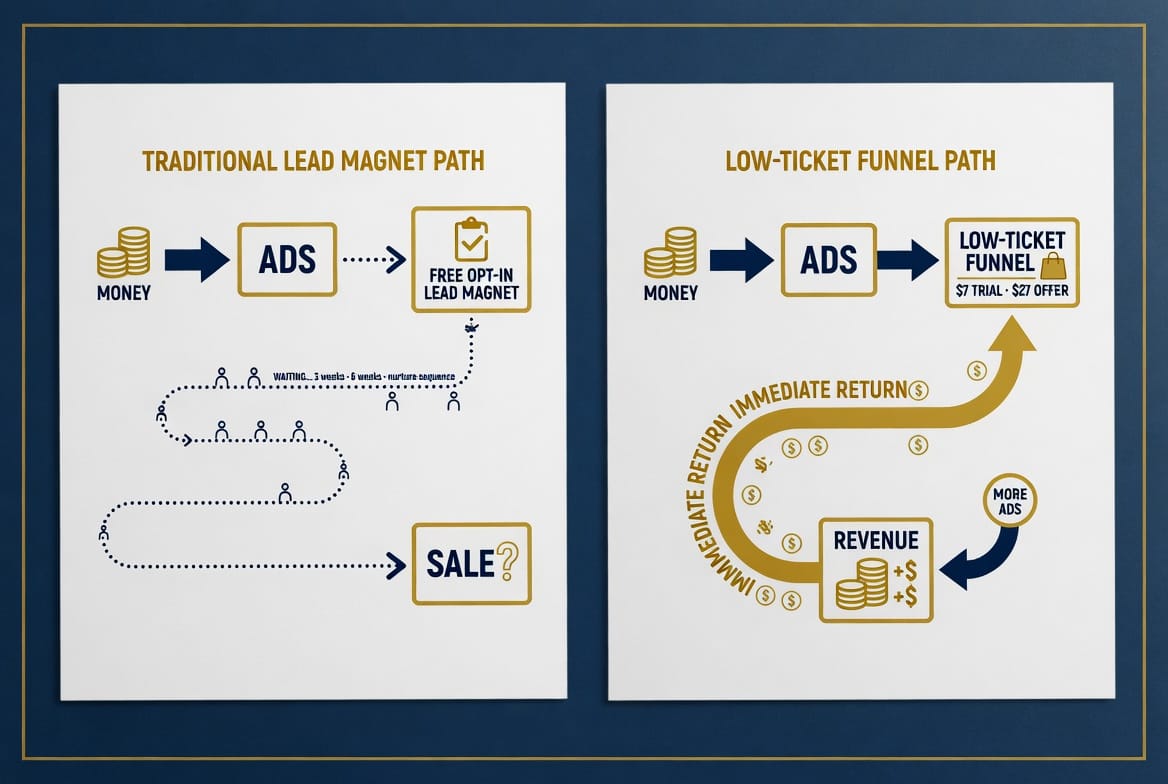
When you send $300 to a free lead magnet, you get leads. Maybe 30 to 50 of them at $6 to $10 each. Those leads go onto your list. Most of them never buy anything. The $300 is gone and the only way to get it back is through a back-end conversion that may or may not happen weeks or months later.
For someone operating on a tight budget, that timeline is brutal. You can't reinvest money you don't have yet. You can't scale a campaign that's losing money on the front end. You're stuck waiting for back-end revenue to trickle in before you can afford to run ads again.
The cycle looks like this: small burst of ad spend, long wait for back-end conversions, small burst of ad spend, long wait. The business grows in stutters instead of building momentum.
A front-end funnel that recovers its costs immediately changes that cycle entirely. When the front end covers the ad spend, you can reinvest faster. When you reinvest faster, the buyer list grows faster. When the buyer list grows faster, the back end compounds faster. The same $300 that disappears into a free lead magnet campaign can become a self-sustaining growth engine when the structure behind it is right.
The Math Jennifer Ran Before Spending a Dollar
Before Jennifer launched her third campaign she did something she hadn't done before either of the first two.
She ran the math forward.
She knew her front-end product converted at 3.1 percent on cold traffic from her validation test. She knew her order bump was priced at $17. She had seen order bump conversion rates of 25 to 35 percent cited consistently in the resources she'd been studying. She had a $47 upsell she believed would convert at somewhere around 15 to 20 percent based on the offer quality.
So she built a simple projection.
If 100 people land on her page and 3.1 percent buy, that's 3.1 buyers per 100 visitors. Average order value with a 30 percent order bump conversion and a 17 percent upsell conversion comes out to roughly $38 per buyer. Cost per click on Meta in her niche was running about $1.20 to $1.50.
To get 100 visitors she needed to spend $120 to $150. To get 3.1 buyers she needed to spend $120 to $150. Those 3.1 buyers would generate roughly $118 in front-end revenue.
Nearly break-even before a single back-end sale.
That projection told her something critical. The structure was viable. The math could work. She wasn't guaranteed to break even on day one but she was close enough that the gap was closeable without a large budget or a long runway.
She also knew what the single biggest lever was if the numbers came in slightly below projection: the order bump conversion rate. A 5 percent improvement there would likely flip the campaign from slightly below break-even to slightly above it without changing anything else.
Running that math before spending anything meant she wasn't flying blind. She knew what success looked like, what failure looked like, and exactly which number to watch most closely in the first week.
What a Responsible Test Budget Actually Looks Like
There's a specific logic to how much to spend when you're testing a front-end funnel on a limited budget.
The goal of the test phase isn't to scale. It's to confirm that the math works at a small level before committing more. You need enough spend to generate statistically meaningful data without putting yourself in a position where a failed test causes real financial damage.
For a front-end product priced between $17 and $47, a daily budget of $30 to $50 run for seven to ten days gives you enough data to make a real decision. That's $210 to $500 total for a complete first test.
That budget should generate enough traffic to produce 10 to 20 buyers if the funnel is working. Ten to twenty buyers is enough to see whether your order bump is converting at a reasonable rate, whether your upsell is resonating, and whether your overall AOV is anywhere close to your CPA.
It's not enough to optimize. It's enough to confirm whether the foundation is solid.
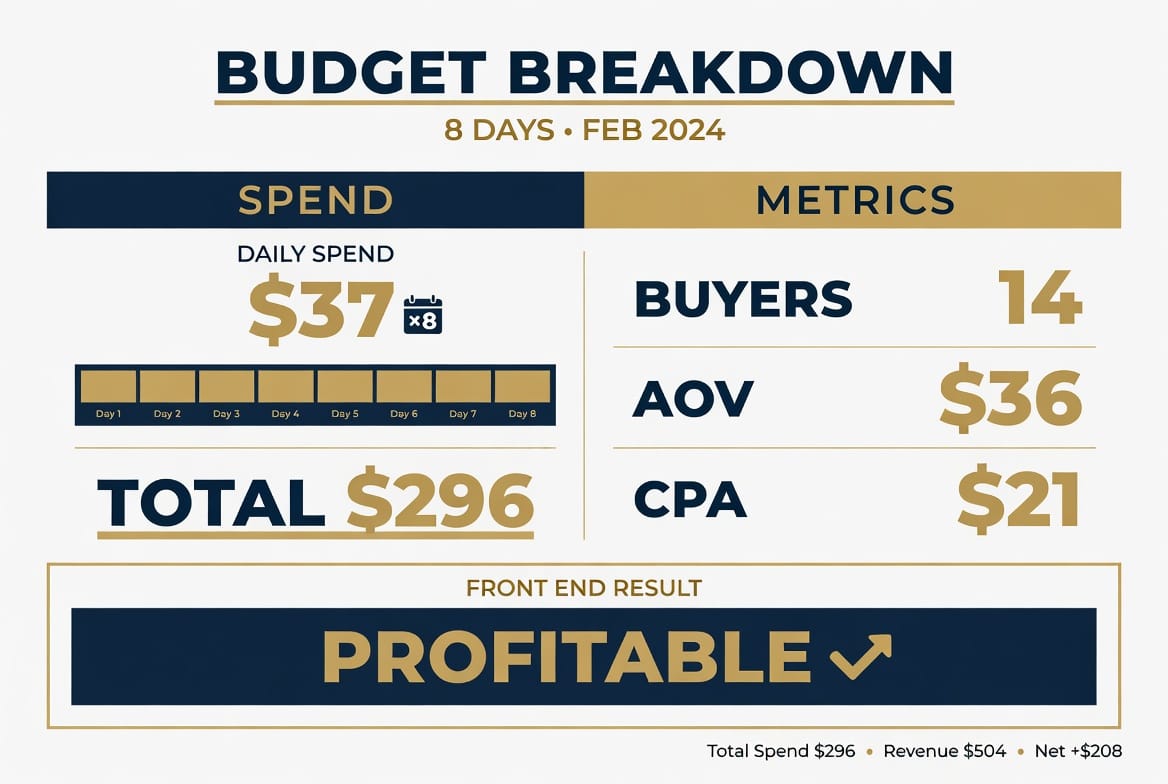
Jennifer's $300 test budget ran for eight days at roughly $37 per day. She got 14 buyers. Her AOV came in at $36. Her CPA came in at $21. Front end profitable from day one.
She hadn't expected it to be profitable quite that quickly. The validation test had suggested it was close but not certain. What the validation test couldn't tell her was how the order bump and upsell would actually perform with real buyers going through the full checkout flow. The $300 test answered that question.
The One Number to Watch in the First Week
When you're running a test on a limited budget, you can't track everything. Trying to optimize multiple variables simultaneously with limited data leads to bad decisions.
There's one number that matters more than anything else in the first seven days.
Cost per acquisition relative to average order value.
Everything else, click through rates, cost per click, landing page bounce rate, these are inputs that affect the CPA. But the CPA itself, measured against the AOV your funnel is actually producing, tells you the only thing you need to know at this stage: is the math working?
If your AOV is above your CPA, the structure is sound. You're acquiring buyers at a net cost of zero or better. Optimize from there.
If your AOV is below your CPA by a small margin, there are two levers. The order bump conversion rate and the landing page conversion rate. One of those two is almost always the culprit when the math is close but not quite working.
If your AOV is dramatically below your CPA, the issue is more fundamental. Either the offer isn't specific enough, the price point is wrong, or the audience isn't right. That's a different kind of problem that requires going back to the validation stage rather than trying to optimize your way out of it.
Jennifer's first week of data showed an AOV of $36 and a CPA of $21. She didn't touch anything for the full eight days. She let the campaign run, collected the data, and only looked at those two numbers each morning. Everything else was noise until she had enough signal to act on.
What Happens After the Test Works
When a test campaign produces an AOV above CPA, even by a small margin, the next move is straightforward.
Reinvest the front-end revenue into the ad budget.
Not aggressively. Not doubling the budget overnight. Slowly and systematically, increasing spend by a controlled amount every 48 to 72 hours while monitoring that the AOV to CPA relationship holds at the higher spend level.
Jennifer went from $37 a day to $45 a day in week two. Then $55 in week three. Then $70. By month two she was spending $90 a day and her funnel was generating $4,200 a month in front-end revenue alone. Her back-end coaching program had added two new clients from her Bridge email sequence.
The $300 she had been afraid to spend had become a self-funding growth system that was generating more monthly revenue than her first two failed campaigns combined, at a fraction of the anxiety.
The fear hadn't disappeared entirely. But it had been replaced by something more useful: a set of numbers she understood, a structure she trusted, and a clear picture of exactly what to watch and when to act.
That's what running ads on a side-hustle budget is supposed to feel like.
The Last Piece of the Puzzle
You now understand why small budgets fail with the wrong structure, how to run the math before spending anything, what a responsible test budget looks like, and how to read the numbers in the first week without overreacting to noise.
The last question is what the full picture looks like once the funnel is working. Not just covering ad costs but actually replacing a salary. Building toward the point where the side hustle becomes the main thing and the day job becomes optional.