How to Turn the Course You Already Built Into the Back End of a Funnel That Actually Sells It
Eight months after her launch produced nine sales, Priya Sharma sold 22 copies of the same course in a single week.
Same content. Same modules. Same workbooks. Same price.
The only thing that had changed was where the course sat in relation to everything else she was doing.
In her first launch it had been the front door. The first thing cold traffic encountered. The $197 ask to people who had never paid her anything before. The leap of faith she was asking strangers to take based on three weeks of launch content and a sales page they had found through an ad.
In her restructured funnel it was the back door. The natural next step for someone who had already bought her $27 guide, gone through five days of emails, gotten real value from what she had built, and decided they wanted to go further.
Same course. Different position. Seven times the sales.
The course hadn't failed the first time because it was bad. It had failed because it was being asked to do a job it was never designed to do: close cold strangers at $197 with no prior relationship to support the ask.
Repositioned as a back-end offer behind a front-end funnel, it was doing the job it was actually built for: delivering a deep, comprehensive transformation to people who had already decided they trusted her enough to invest in the fuller version of her work.
The Difference Between a Front End and a Back End
Most course creators don't think in terms of front end and back end. They think in terms of offers. A course is a course. You build it, you price it, you sell it.
The front end and back end distinction is one of the most useful reframes in online business because it clarifies the specific job each product is supposed to do and why putting the wrong product in the wrong position produces the results Priya got in her first launch.
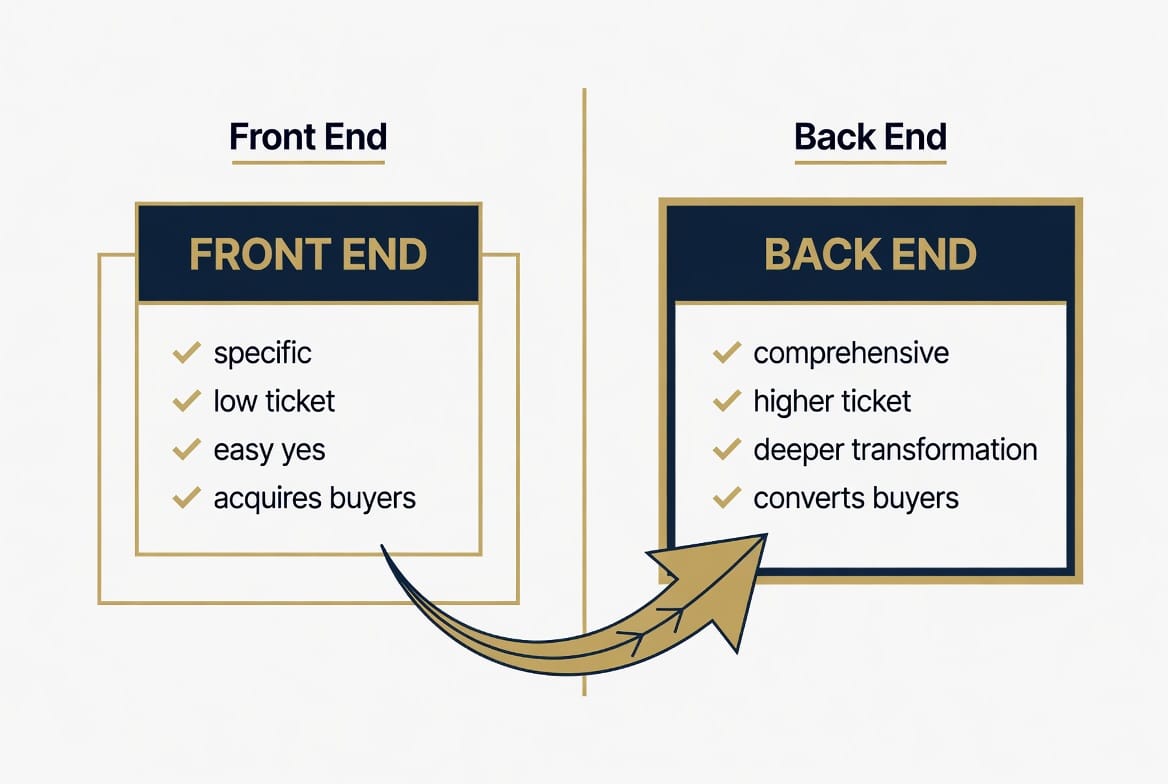
A front-end product has one job: acquire a buyer at a cost the math can support. It needs to be specific enough to attract the right person, priced low enough that the buying decision is easy, and valuable enough that the buyer feels good about the transaction immediately. It is not supposed to be your most comprehensive work. It is supposed to be your most targeted work.
A back-end product has a completely different job: deliver a deeper transformation to someone who has already bought from you and wants more. It can be comprehensive. It can be priced higher. It can require more of the buyer's time and commitment because the buyer has already demonstrated they're serious by making a prior purchase.
A $197 course is almost always a back-end product. The depth and comprehensiveness that makes it valuable at $197 is exactly what makes it the wrong offer to put in front of cold traffic as a first ask.
Priya's course had been built as a back-end product and launched as a front-end product. That mismatch was the entire problem.
What the Front End Does for the Back End
When Priya launched her $27 guide and put her existing course behind it as the upsell and back-end offer, something happened that her launch sequence had never been able to produce.
The people who arrived at her $197 course page were different.
They had already bought from her. They had already consumed her $27 guide and gotten value from it. They had gone through five emails that had built the relationship, delivered additional insight, and introduced the course as the natural next step for someone who wanted the full transformation rather than the starting point.
By the time they saw the $197 price tag they had already made one positive buying decision about her. The trust gap that had killed her launch, the distance between stranger and paying customer, had already been crossed. The $197 ask wasn't a leap of faith. It was the next logical step in a relationship that had already been established.
That's what the front end does for the back end. It doesn't just build a list. It builds a list of people who have already crossed the line. Every buyer who comes through the front end arrives at the back end already warm, already trusting, already predisposed to say yes to the bigger offer if it's the right fit for them.
Priya's $197 course converted at 22 percent to her front-end buyers. Industry average for a cold launch to a free list is somewhere between 1 and 3 percent. The same course, the same content, the same price, performing at seven to twenty times the rate simply because of who was seeing it and what relationship they had with her before they saw it.
What to Do With the Course You Already Have
If you have a course sitting in your business right now that underperformed on launch, the question isn't whether to rebuild it or relaunch it or reposition the messaging.
The question is what front-end product would naturally lead someone to want what your course delivers.
That question has a specific answer for every course. The front end should solve one narrow, acute problem that sits just upstream of the broader transformation your course delivers. It should be specific enough that someone who buys it and gets the result immediately wants more. It should create natural appetite for the fuller version of the work.
Priya's course taught a comprehensive system for building a coaching business from scratch. Her $27 guide solved one specific early-stage problem within that system: how to land the first three paying clients without a large audience. Someone who bought the guide, implemented it, and got their first few clients was now in exactly the right position to want the full course that taught them how to build the sustainable business on top of that early traction.
The front end created the problem the back end solved. Not artificially. Naturally. Because one was genuinely the starting point and the other was genuinely the next stage.
Finding that relationship between your existing course and a potential front-end product is usually faster than people expect. The front end is almost always already somewhere inside the course. The first module, the foundational framework, the one concept your students consistently say was the most immediately useful thing they learned. Pull that out, package it as a standalone $27 product, and you have your front end.

The Upsell Timing That Most People Get Wrong
There are two moments when a front-end buyer can be introduced to the back-end course. Most people choose the wrong one.
The wrong moment is the email sequence. The right moment is immediately after purchase.
When someone buys your $27 front-end product, they are in a specific psychological state that will never be more favorable to a second purchase. They have just made a positive buying decision. Their credit card is out. Their buying resistance is at its lowest point. They are in motion.
The thank you page is the single most valuable piece of real estate in the entire funnel. The person who lands there has just proved they will spend money. Introducing your $197 course on that page, as the immediate next step for someone who wants the full transformation rather than just the starting point, will convert at significantly higher rates than introducing it days later in an email sequence when the initial buying momentum has faded.
Priya introduced her course as the upsell on her thank you page. It converted at 22 percent. That means roughly one in five buyers of her $27 guide bought the $197 course immediately, in the same session, on the same day.
Those buyers hadn't thought about it for a week. They hadn't been nurtured through a sequence. They had simply arrived at the next logical step in a journey they had already started and said yes.
The email sequence that followed the purchase introduced the course again for the buyers who hadn't taken it immediately. That sequence converted an additional 8 percent of front-end buyers in the following week. Combined, roughly 30 percent of her front-end buyers eventually purchased the $197 course through some combination of the immediate upsell and the follow-up sequence.
Thirty percent of front-end buyers converting to a $197 course. Compared to a fraction of a percent during her original cold launch.
What This Does to the Launch Model
Here's where things get interesting for someone who has already been through a disappointing launch and is thinking about whether to launch again.
The front-end funnel doesn't replace the launch. It makes the next launch dramatically more likely to succeed.
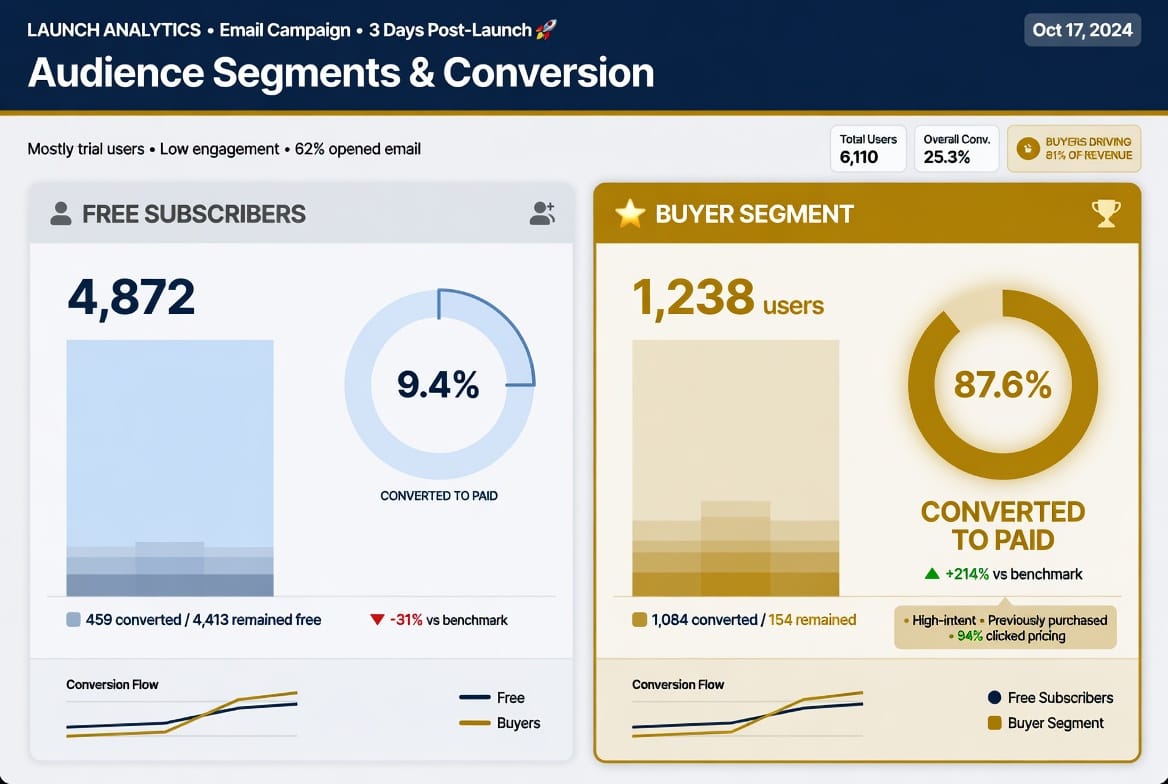
When Priya ran her second launch eight months after her first, she was launching to an audience that looked completely different. It still contained her original free subscribers. But it now also contained 340 buyers who had come through her front-end funnel in the preceding months. People who had already paid her. Already consumed her content. Already gotten results from her $27 guide.
Those 340 buyers behaved completely differently during the launch than her free subscribers did. Their open rates on launch emails were higher. Their click rates were higher. Their conversion rate to the $197 course was dramatically higher.
The 340 buyers produced 47 of the 61 total sales in that second launch. They represented less than 10 percent of her total list but generated more than 75 percent of the launch revenue.
That's the compounding effect of building a buyer list in the months before a launch. By the time the launch comes, the audience contains a core of people who are pre-warmed, pre-qualified, and predisposed to buy in a way that no launch sequence alone can produce.
The Course You Built Wasn't a Mistake
If you spent months building a course that underperformed, the temptation is to write off that investment as a loss and start over.
It isn't a loss. It's an asset in the wrong position.
The content you created, the modules you recorded, the workbooks you designed, none of that disappears because the launch didn't go the way you planned. It sits there waiting for the right front end to send the right people to it.
Priya's course exists today as the centerpiece of a funnel that generates consistent monthly revenue without a launch. The $27 front end feeds it a steady stream of pre-qualified buyers. The thank you page upsell converts roughly one in five of them immediately. The email sequence converts more over time. The occasional launch to her accumulated buyer list produces a burst of revenue on top of the consistent baseline.
The four months she spent building that course weren't wasted. They were early. She built the right thing in the wrong sequence and then spent eight months figuring out how to put it in the right place.
Now it's in the right place.
How to build the complete system that puts your existing course in that position, including the front-end offer, the funnel structure, the ad setup, and the daily process for running it without it consuming your life...