Micro Offer Funnel vs. High Ticket Funnel: Which Model Makes You More Money
Two coaches. Same niche. Same level of expertise. Roughly the same size audience.
One is running a micro offer funnel. Front-end product at $27, order bump at $17, upsell at $47. Paid traffic going in. Buyers coming out at close to break-even on the front end. Back-end coaching program doing $15,000 to $20,000 a month from a buyer list that grows automatically.
The other is running a high-ticket funnel. Organic content driving traffic to a free lead magnet. Email nurture sequence leading to a webinar. Webinar closing into a $3,000 program. Back-end revenue is higher per sale but completely dependent on the webinar converting that week.
Which one is making more money?
The honest answer is it depends on where you are in your business, what your goals are, and how you define more money. Revenue per transaction and total revenue are different numbers. Consistent monthly revenue and peak launch revenue are different experiences.
This article is going to break down both models honestly so you can make the right choice for your specific situation rather than adopting whatever model the last podcast you listened to was selling.
What a Micro Offer Funnel Actually Is
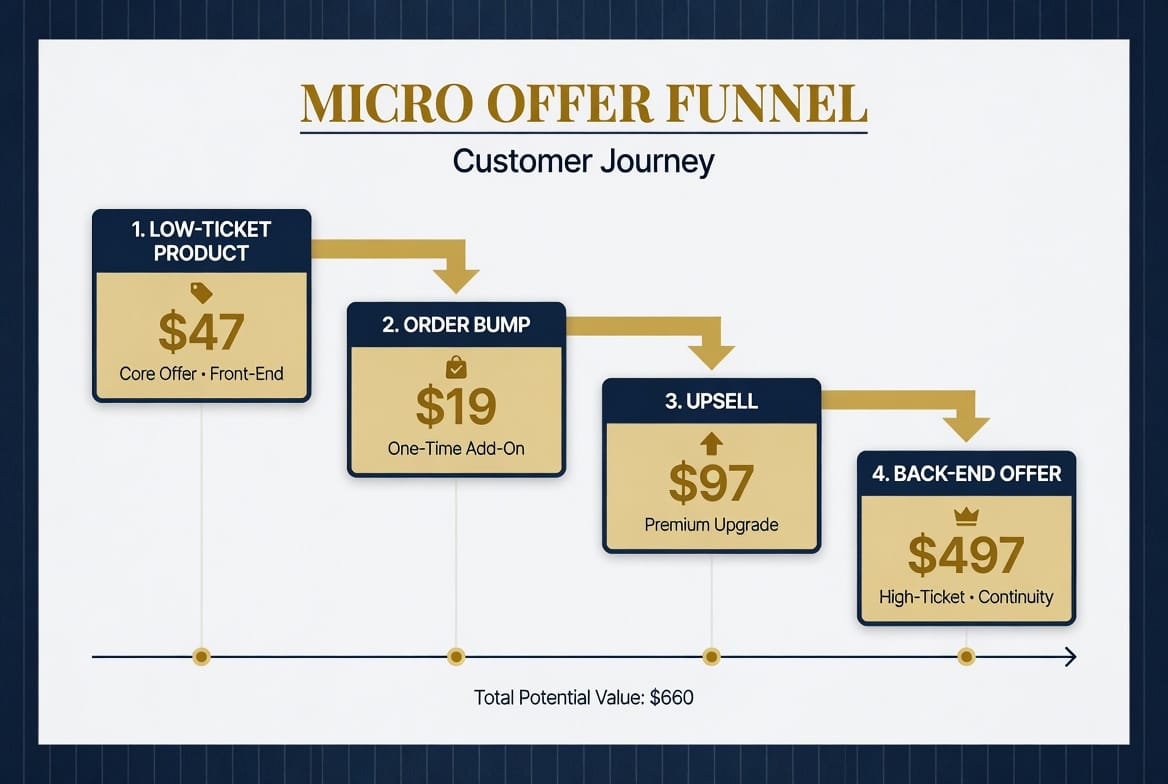
A micro offer funnel starts with a low-ticket product priced between $7 and $47 as the entry point.
The product solves one specific, immediate problem. It's not a preview of a bigger program. It's a complete solution to one narrow, acute problem the right buyer is already looking to solve.
Behind the front-end product is a value stack. An order bump on the checkout page, typically $17 to $27, that complements the main product and converts somewhere between 25 and 40 percent of buyers. An upsell immediately after purchase, typically $37 to $97, that delivers a deeper version of what they just bought and converts somewhere between 15 and 25 percent.
Together these push the average order value from $27 to somewhere between $40 and $55 depending on the specific prices and conversion rates.
Behind the value stack is a post-purchase sequence that moves buyers toward a higher-ticket back-end offer over five to seven days.
The entire system is designed to do one thing: acquire buyers at a cost that paid traffic can cover on the front end, and then move those buyers toward the back end where the real margin lives.
What a High-Ticket Funnel Actually Is
A high-ticket funnel is built around selling a premium offer, typically $1,000 or more, directly as the primary revenue model.
The most common version looks like this. Organic content or a free lead magnet builds an audience. That audience is invited to a webinar or a discovery call. The webinar or call closes into a high-ticket coaching program or course.
Some high-ticket funnels use paid traffic to drive webinar registrations or application funnels directly. Others rely entirely on organic traffic and warm audiences.
The economics look attractive on paper. A single $3,000 sale produces more revenue than 111 $27 sales. The close rate on well-run discovery calls with warm audiences is often 20 to 40 percent. A good webinar can generate five to fifteen sales in a single 90-minute presentation.
The structural challenge is that the high-ticket funnel is almost entirely dependent on the quality and warmth of the audience at the moment of the ask. Cold traffic rarely converts to high-ticket offers at rates that make the economics work. And building the warm audience required to make a high-ticket funnel consistently productive takes significant time or significant ad spend or both.
The Economics Side by Side
Let's run the math on both models at a realistic scale for someone with a modest paid traffic budget.
Micro Offer Funnel
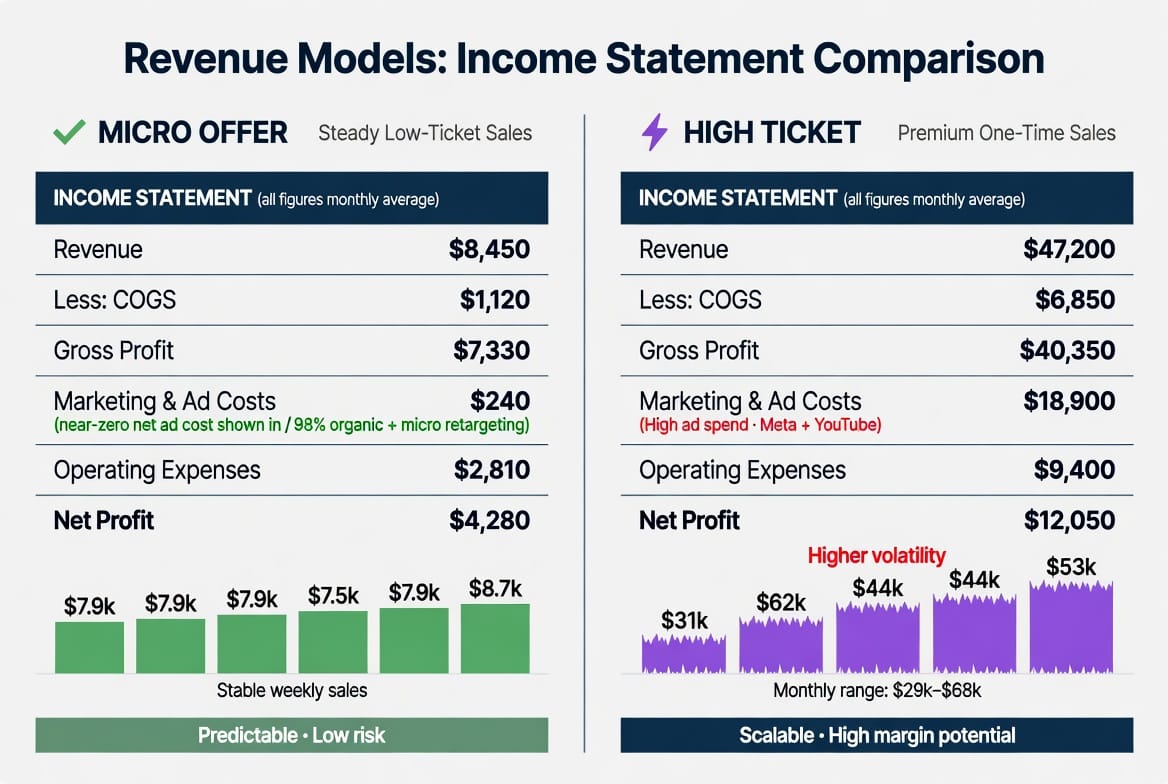
Daily ad spend: $100 Cost per buyer: $35 (achieving close to break-even on a $41 AOV) Buyers per day: roughly 3 Monthly buyers: roughly 90 Front-end monthly revenue: $3,690 (90 buyers x $41 AOV) Ad spend recovered: roughly 90 to 100 percent on the front end.
Of those 90 monthly buyers, 6 percent book discovery calls from the Bridge sequence. That's 5 to 6 calls per month. At a 30 percent close rate into a $2,000 program, that's 1 to 2 new clients per month from the funnel alone.
Back-end revenue: $2,000 to $4,000 per month from funnel buyers. Total monthly revenue: $5,690 to $7,690. Net ad cost after front-end recovery: close to zero.
High-Ticket Funnel on Cold Traffic
Daily ad spend: $100 Cost per webinar registrant on cold traffic: $8 to $15 Daily registrants: 7 to 12 Show-up rate: 30 to 40 percent Attendees per week: 15 to 25 on a weekly webinar Webinar close rate to $3,000 offer: 8 to 12 percent Monthly sales from webinar: 5 to 12 Monthly revenue: $15,000 to $36,000
The revenue looks dramatically higher. The costs are also dramatically higher.
Ad spend to fill the webinar on cold traffic: $3,000 per month Revenue minus ad spend: $12,000 to $33,000
On paper the high-ticket model wins on total revenue.
But this math assumes the webinar consistently performs, the show-up rate holds, the close rate stays consistent, and you're willing and able to run a live 90-minute presentation every week or every other week. It also assumes cold traffic will pay $3,000 to someone they watched on a webinar for 90 minutes, which requires exceptional positioning, social proof, and presenting ability to achieve consistently.
Where Each Model Wins
The micro offer funnel wins on consistency, scalability, and the quality of the buyers it builds.
Because the front end is self-funded or close to it, you can increase your budget without increasing your financial risk proportionally. The business can run without your active involvement beyond the daily 10-minute ROAS check. The buyer list compounds over time even when you're not actively working. The leads that come through for the back end are pre-qualified because they've already paid you once.
The high-ticket funnel wins on revenue per transaction and time to significant revenue if you already have a warm audience.
If you have a list of 5,000 engaged subscribers who already trust you, running a high-ticket launch or webinar sequence to that audience can generate $30,000 to $50,000 in a week. No paid traffic required. No front-end product needed. Pure offer to warm audience.
The problem is that this model doesn't scale the same way. Once you've sold to your warm audience, you need to rebuild warmth in new people before you can sell again. The launch cycle becomes the treadmill, and the revenue between launches depends on how consistently you can maintain and grow the warm audience.
The Model Most Businesses Should Start With
If you're building from scratch or haven't yet established a large warm audience, the micro offer funnel is almost always the right starting point.
Here's why.
It validates demand before significant build investment. A $27 product that converts on cold traffic confirms that real strangers will pay for your solution before you commit to building a $3,000 program.
It builds a list of buyers rather than free subscribers. Every person who comes through the front end has already crossed the line from consumer to customer. That list is worth dramatically more per person for any future offer you make.
It creates consistent, predictable revenue that doesn't depend on your performance on a specific Tuesday. The funnel runs whether you're working or not.
It pre-qualifies leads for the high-ticket back end. The buyers who come through the funnel and book discovery calls have already paid you once. They show up to calls differently. They close at higher rates. They're better clients.
Ironically, the micro offer funnel often produces better high-ticket clients than the high-ticket funnel itself does, because the filtering process of making a prior purchase selects for people who are serious about solving their problem with money rather than just attention.
Combining Both Models
The most sophisticated version of this, which is what mature course and coaching businesses often run, uses the micro offer funnel to continuously grow a buyer list and run high-ticket launches to that accumulated list.
The micro offer funnel runs in the background every day. Buyers come in. They go through the Bridge sequence. Some become discovery call bookings. Some become coaching clients. The funnel operates automatically.
Then periodically, every 90 days or so, a webinar or launch goes out to the full buyer list. The buyers who came in through the front end over the previous months are warmer than any cold traffic you could ever buy. They already know you. They already trust you. They've already paid you.
A launch to a buyer list converts at dramatically higher rates than a launch to a free subscriber list. The same email sequence, the same webinar, the same offer, produces different results depending on whether the audience contains buyers or just subscribers.
This is why the micro offer funnel isn't just a standalone revenue model. It's the engine that makes every future launch more productive than the last.
The complete system for building that engine and making the math work from day one is what Get Paid to Get Leads covers.