Self-Funded Advertising: How to Recover Ad Spend Fast and Scale Profitably
Most people who run paid ads treat them like a slot machine.
You put money in. You hope enough comes back out. If it doesn't, you pull back and try something else. If it does, you quietly wonder when it's going to stop working.
That's not advertising. That's gambling with a dashboard.
Self-funded advertising is something different. It's a specific structure where the revenue generated by the front end of your funnel covers the cost of the traffic feeding it before a single back-end sale ever happens. When that structure is in place, scaling isn't a risk. It's arithmetic.
This article is about how that structure works, what makes ad spend recoverable fast, and what it actually takes to get to the point where you can scale without bleeding money every time you increase your budget.
Why Most Ad Campaigns Never Recover Their Spend
The reason most paid traffic campaigns lose money has nothing to do with targeting, creative quality, or ad copy.
It's a structural problem that exists before the first ad is written.
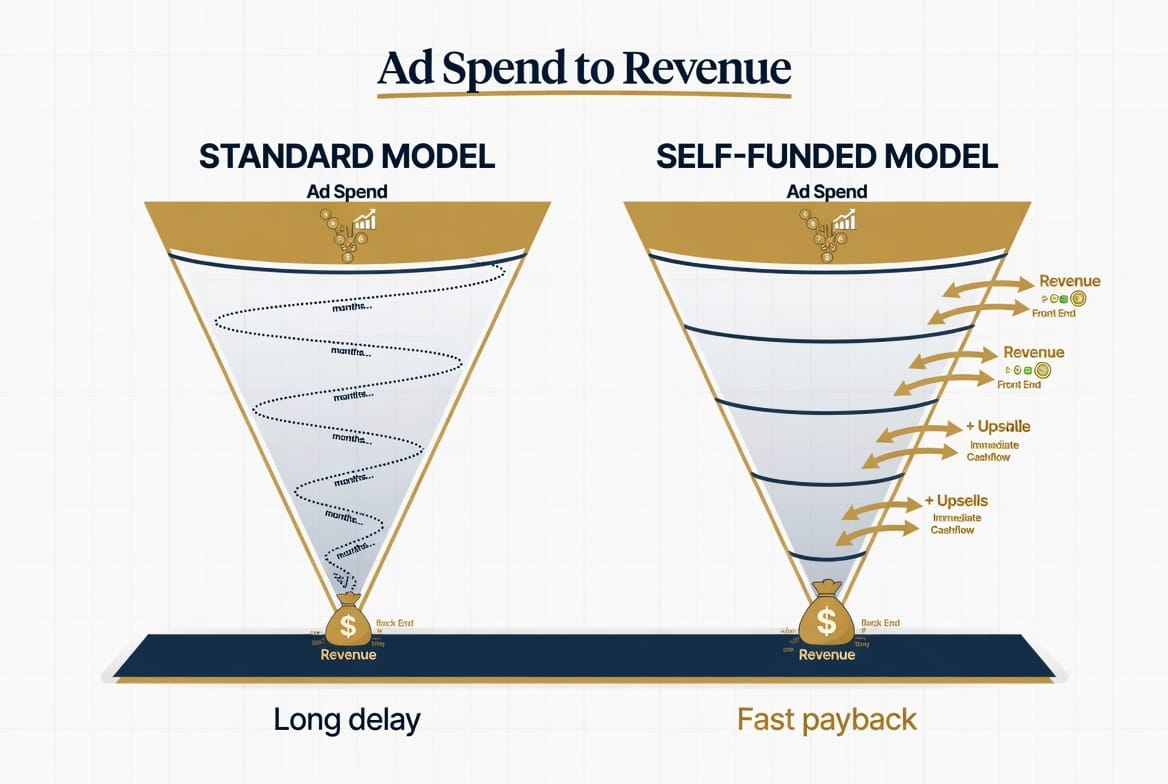
When you send paid traffic to a free lead magnet, your average order value on the front end is zero. Every dollar you spend on ads stays spent. The only path to profitability is a back-end conversion that happens weeks or months later, after a nurture sequence, after building enough trust for a cold lead to make a larger purchase decision.
For most businesses running real budgets with real time constraints, the back end never converts fast enough or at a high enough rate to cover what was spent on the front end.
When you send paid traffic directly to a high-ticket offer, you're asking cold strangers to make a significant financial commitment to someone they just met. Cold traffic conversion rates on high-ticket cold offers are low enough that the cost per customer almost always exceeds the margin on the sale.
Both models share the same core flaw. There's no mechanism on the front end to return money in the same transaction window as the ad spend.
Self-funded advertising fixes this by putting a product on the front end of the funnel that generates revenue immediately. Not eventually. From the moment someone clicks the ad and completes a purchase.
The Three Numbers That Determine Everything
Self-funded advertising comes down to one equation managed through three numbers.
Average order value minus cost per acquisition equals your margin per buyer.
If that number is positive, your front end is self-funded. Every buyer costs you nothing net to acquire. The back end is pure profit.
If that number is negative, you're subsidizing your own list growth. You're paying more to acquire each buyer than they spend in the initial transaction. The back end has to save you.
Average Order Value
This is what the average buyer spends going through your funnel in a single session. It includes the front-end product price plus the order bump if they take it plus the upsell if they take it.
A $27 front-end product alone produces an AOV of $27. Add a $17 order bump converting at 30 percent and that adds $5.10. Add a $47 upsell converting at 20 percent and that adds $9.40. AOV becomes $41.50 without changing the price of the main product.
The order bump and upsell are what make self-funded advertising possible at typical front-end price points. Without them, a $27 product can almost never cover the cost per acquisition on paid traffic. With them, it often can.
Cost Per Acquisition
This is what you spend on ads to generate one buyer. It's determined by two things: how much you pay per click and what percentage of people who land on your page complete a purchase.
If you pay $1.20 per click and your page converts at 3 percent, you need roughly 33 clicks to get one buyer. That's about $40 in ad spend per buyer.
If your page converts at 4 percent, you need 25 clicks. That's $30 per buyer.
The landing page conversion rate is often the most leveraged thing you can improve when trying to get to self-funded status. A one percentage point improvement in conversion rate can drop your CPA by $10 or more without touching the ad itself.
ROAS
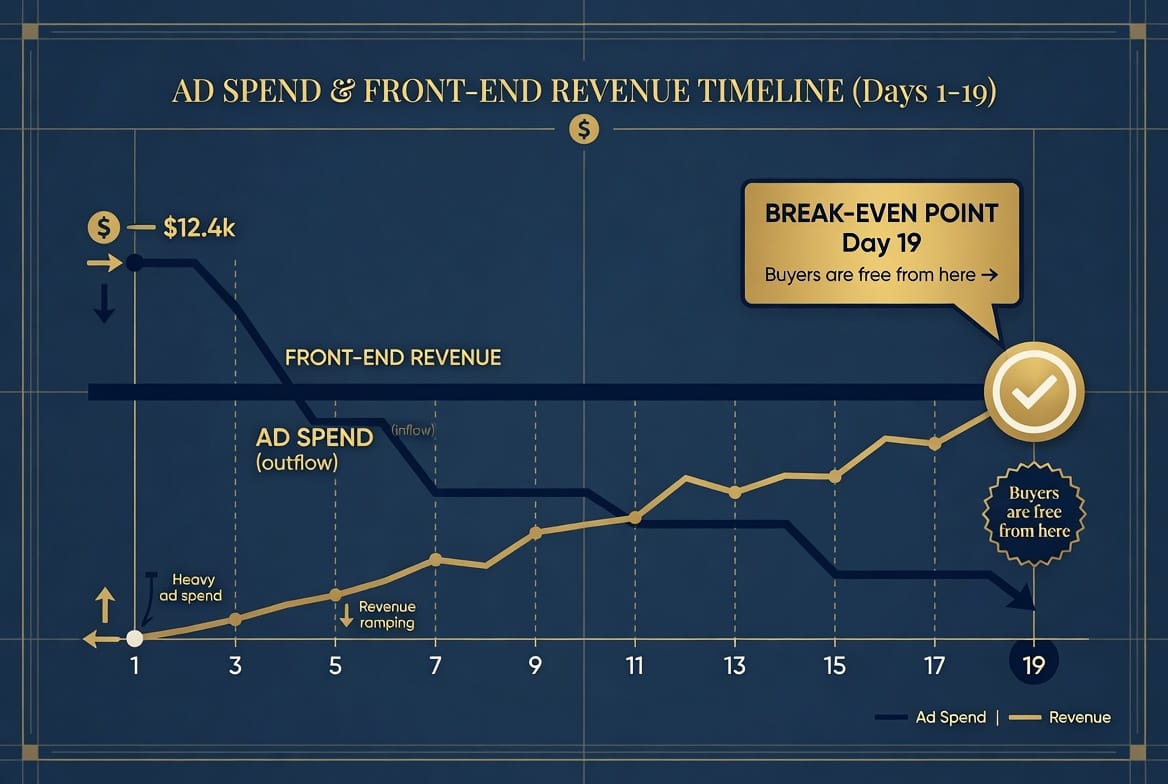
Return on ad spend is total revenue divided by total ad spend. A ROAS of 1.0 means break-even. Your front end is returning exactly what you put in. Above 1.0 means you're making money on the front end before the back end enters the picture.
For self-funded advertising, break-even is the initial goal. Not profitability on the front end. Break-even.
Break-even means your buyers are free. Every dollar you put into the ad account comes back out as front-end revenue. The back end is pure profit built on a buyer list that cost you nothing net to build.
How Fast Can You Recover Ad Spend?
The answer depends almost entirely on whether your funnel has a value stack.
A front-end product with no order bump and no upsell recovers spend slowly if at all. The transaction is complete at the initial purchase price. There's nothing else to buy in the session. The only way to recover more is through back-end sales that happen days or weeks later.
A front-end product with a well-constructed order bump and upsell recovers a significant portion of ad spend in the same session as the click. The buyer who takes both adds 50 to 100 percent more revenue to the transaction before leaving the checkout flow.
In practical terms, this means the difference between recovering ad spend in the same week it was spent versus recovering it, if at all, in the following months.
Marcus Thompson ran his front-end campaign for 19 days before his ROAS crossed 1.0. His AOV was $42.61. His CPA was $31. From day 20 onward, his buyers were free. His back-end coaching program generated $14,000 in that same month from buyers who had come through the funnel at zero net cost.
The speed of recovery is a direct function of how high your AOV is relative to your CPA. The order bump and upsell are the levers that raise AOV without raising the front-end price.
What Scaling Looks Like When the Front End Is Self-Funded
Scaling a paid traffic campaign that isn't self-funded is stressful.
Every budget increase means more money going out with no guarantee of when or whether it comes back. Doubling the budget doubles the risk. The business is perpetually one bad week away from a cash flow problem.
Scaling a self-funded campaign is arithmetic.
When your ROAS is at 1.0 or above, increasing your budget doesn't increase your risk. It increases your buyer volume at the same net cost per buyer. More budget in means more buyers acquired at zero net cost. More buyers means more back-end revenue from a list that grows without cost.
The scaling process itself is mechanical. When ROAS is green, meaning at or above your break-even target, you increase the daily budget by 20 percent. You wait 48 hours for the algorithm to recalibrate before evaluating again. You don't touch the creative or the targeting. You let the system find its footing at the new spend level before making any further changes.
When ROAS dips yellow, meaning slightly below break-even for one to two days, you hold the budget steady. One bad day doesn't mean the campaign is broken. Pulling back at the first sign of variance is one of the most reliable ways to destroy campaigns that would have recovered on their own.
When ROAS goes red, meaning consistently below break-even for three or more days, you pause the underperforming creative and introduce a new angle. You don't reduce budget. You replace the creative and let the campaign stabilize before evaluating whether to scale again.
The 20 percent increase rule matters. Larger budget jumps force Meta's algorithm to reset its optimization, often causing performance drops in campaigns that were working well. Small, consistent increases compound without disrupting what the algorithm has learned.
The Front-End Product That Makes This Possible
Self-funded advertising requires a front-end product that can realistically cover its acquisition costs at a price point the buying decision is easy.
That tension, high enough AOV to cover CPA, low enough price that the buying decision is frictionless, is why the $7 to $47 range with a well-constructed value stack is the model that works in most coaching and course creator contexts.
A $27 product alone won't cover most paid traffic CPAs in competitive niches. A $27 product with a $17 order bump and a $47 upsell generating an AOV of $41 to $45 often can.
The front-end product itself needs to solve one specific, immediate problem. Not a broad topic. Not an introduction to your full methodology. One problem, one solution, one clean transaction that moves the right person across the line from free to paid.
The specificity of the offer affects conversion rates at the ad level and at the landing page level. A vague offer produces lower click-through rates and lower page conversion rates, both of which raise CPA and make self-funded status harder to achieve. A specific offer that names a real problem in precise language produces higher engagement at every stage.
What to Do When the Math Isn't Working Yet
Most funnels don't hit self-funded status on the first version.
The first week of a new campaign is almost always more expensive than it will become once the algorithm has found its buyers. CPA is typically highest in days one through five and trends down as the algorithm optimizes.
When you're in the early stages and the math isn't there yet, there are two levers worth pulling before changing anything else.
The first is landing page conversion rate. Run the campaign for seven days and look at what percentage of visitors are completing the purchase. If it's below 2 percent on cold traffic, the page has a problem. Usually it's the headline, the specificity of the offer description, or friction in the checkout process. Small improvements here have an outsized effect on CPA.
The second is order bump conversion rate. If your order bump is converting below 20 percent, the offer, the copy describing it, or the price point is off. An order bump that converts at 35 percent versus 20 percent can add $3 to $5 to your AOV, which can be the difference between a campaign that's $10 below break-even and one that's at break-even.
Fix one thing at a time. Changing multiple variables simultaneously makes it impossible to know what caused any improvement or deterioration in performance.
The Back End Is Where the Business Lives
Self-funded advertising solves the acquisition cost problem. It doesn't, by itself, build the business.
The business lives in the back end. In the coaching program, the group program, the higher-ticket course, the continuity offer that buyers move toward after going through the front-end funnel.
When the front end is self-funded, every back-end sale is pure profit built on a buyer list that cost nothing net to build. The buyers who come through the funnel have already demonstrated they spend money on solutions. They've already had a positive transaction with you. They're a qualitatively different prospect for the back end than any cold traffic or free subscriber you could generate through any other method.
This is what self-funded advertising actually produces. Not just cheaper leads. A continuously growing list of pre-qualified buyers who arrived at zero net cost and carry a back-end value that compounds over time.
The complete framework for building the front-end funnel that makes this possible, from the product through the value stack, the ad setup, and the scaling process, is exactly what Get Paid to Get Leads covers.