The 5-Step System That Turns a Flopped Course Into a Functioning Funnel
Priya Sharma's course made nine sales in its first launch.
It made 340 sales in the twelve months that followed.
Not from a second launch. Not from a better email sequence or a stronger sales page or a more aggressive promotion strategy. From a system that ran quietly in the background every single day, sending a steady stream of pre-qualified buyers to the same course page that had produced almost nothing when it was the front door of her business.
The course hadn't changed. The content was identical. The price was the same. The transformation it delivered was exactly what it had always been.
What had changed was everything around it. The front end that fed it. The sequence that warmed buyers before they arrived at it. The ad campaign that filled the top of the funnel automatically. The daily process that kept the whole thing running without requiring Priya to be present for any of it.
She describes the twelve months after her failed launch as the period where she stopped trying to fix the thing that wasn't broken and started building the thing that had been missing.
The course was never the problem. The infrastructure around it was the problem. And once the infrastructure was right, the course did exactly what it had always been capable of doing.
What the Business Looked Like at 90 Days
Ninety days after Priya launched her front-end funnel, here's what her business looked like.
Her buyer list had grown to 280 people. Every one of them had paid to be there. Every one of them had gone through a post-purchase sequence that delivered real value, built the relationship, and introduced her existing course as the natural next step for someone who wanted to go further than the $27 guide had taken them.
Sixty-two of those 280 buyers had purchased the course. At $197 each that was $12,214 in course revenue from 280 people, in 90 days, without a launch.
Her original launch had generated $1,773 from 3,400 people over three weeks of full-effort promotion.
The math didn't require much commentary.
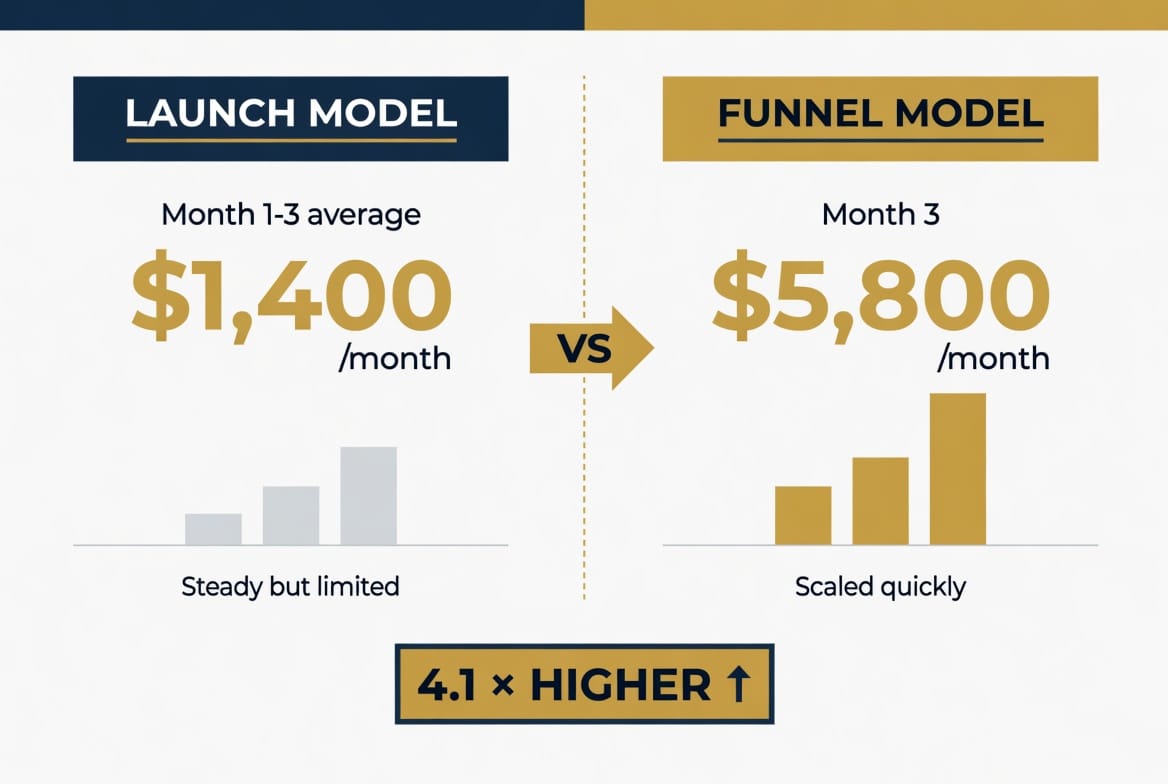
Her front-end funnel was running at close to break-even on ad spend. The course revenue sitting behind it was pure back-end profit. Her total monthly revenue in month three was $5,800, up from the $1,400 average her business had been producing in the months after her failed launch.
She had not recorded a new module. She had not redesigned a workbook. She had not rewritten her sales page. She had built a front end, positioned her existing course correctly behind it, and let the system do what systems do when they're built right.
What the Day-to-Day Actually Looks Like
One of the things Priya hadn't anticipated when she built the funnel was how different the day-to-day experience of running her business would feel.
The launch model had demanded constant attention. There was always something that needed doing. Content to create, emails to send, promotions to run, engagement to maintain. The business had a way of consuming every hour she made available to it and asking for more.
The funnel model is different in a way that takes some getting used to.
Most days Priya checks one number. Her ROAS. It takes about ten minutes. If the number is where it should be, she moves on with her day. If it needs attention, she knows exactly what to look at.
The course sales happen without her involvement. A buyer comes in through the front end. They go through the email sequence. Some of them buy the course immediately on the thank you page. Others buy it a few days later through the sequence. None of it requires her to write a new email, record a new video, or show up anywhere.
She describes her Tuesdays now as the clearest illustration of the difference. Tuesdays used to be content creation days. Hours spent producing the free material that kept her audience engaged and growing slowly. Now Tuesdays are for client work, creative projects, or simply not working if life has other plans.
The funnel keeps running either way.

What Happens to the Launch Model
Priya still launches. She ran her second launch eight months after the first one.
But the launch looked nothing like the first one and produced nothing like the first one's results.
The difference was what she was launching to. Her list now contained 340 buyers sitting alongside her original free subscribers. Those 340 buyers had already paid her. Already consumed her content. Already decided she was someone worth investing in.
When the launch emails went out that second time, that segment of her list behaved completely differently from the free subscribers. Their open rates were higher. Their click rates were higher. Their conversion to the $197 course was dramatically higher.
The 340 buyers generated 47 of the 61 total sales in the launch. Less than 10 percent of her total list produced more than 75 percent of the revenue.
The front-end funnel hadn't replaced the launch. It had made the launch work in a way it had never worked before by filling the audience with people who were already buyers before the launch ever started.
Imagine running a launch knowing that a significant portion of your list has already bought from you, already trusts you, and is already predisposed to say yes to the bigger offer. That's not a fantasy version of the launch model. That's what the launch model looks like when the front-end funnel has been running for several months before it.
The Five Things Behind This
Everything in Priya's story, the 340 course sales, the consistent monthly revenue, the second launch that performed seven times better than the first, comes from five specific components working together.
There's the front-end offer that brings buyers in and creates natural appetite for the course sitting behind it. There's the structure that makes the ad math work so the funnel covers its own costs before the course revenue ever enters the picture. There's the post-purchase system that moves buyers from the front end to the back end without pressure or hard selling. There's the ad setup that finds and delivers the right buyers automatically. And there's the daily management process that keeps the whole thing running without consuming more than a few minutes of attention each morning.
Each of those five components has a job. None of them are complicated in isolation. Together they create the infrastructure that Priya's course had always needed and never had.
The course wasn't the problem. It never was.
It just needed the right five things around it.
The complete system, exactly how each of those five components works and how to build them around the course you already have, is what Get Paid to Get Leads covers from the first page to the last.