The 5-Step System That Turns Your Email List Into a Buyer Machine
You've seen the problem with free lead magnets.
You understand why a list of 1,000 buyers outperforms a list of 20,000 freebie collectors.
You've seen the funnel math that makes paid traffic pay for itself.
Now the question is: how do you actually build this thing?
That's what this article covers. The complete five-step system behind a self-liquidating front-end funnel, from the product all the way through to the daily process of scaling what's working.
This is the same system that took Sarah Mitchell from $4,200 a month and a list of 19,000 people who rarely bought anything, to a consistent $14,000 a month with a buyer list that was still growing.
Let's go through it step by step.
Step 1: The Impulse Offer
Everything starts here.
The Impulse Offer is a low-ticket product priced between $7 and $47 that solves one specific, immediate problem your ideal customer is already looking for a solution to right now.
Not a broad topic. Not an introduction to your methodology. Not a watered-down version of your flagship program.
One problem. One solution. One product.
The price point matters for two reasons. First, it needs to be low enough that the buying decision is easy. You want someone to see it and think "that's a no-brainer" without having to think hard about whether they can afford it. Second, it needs to be high enough that when combined with the order bump and upsell it can cover your cost per acquisition on paid traffic.
The $7 to $47 range hits both of those marks in most coaching and course creator niches.
The other thing that matters is specificity. A product called "The Complete Guide to Growing Your Business" will convert poorly. A product called "The 3-Day Content Plan for Coaches Who Hate Posting Every Day" will convert well. The more precisely it names the problem and promises the solution, the better it performs.
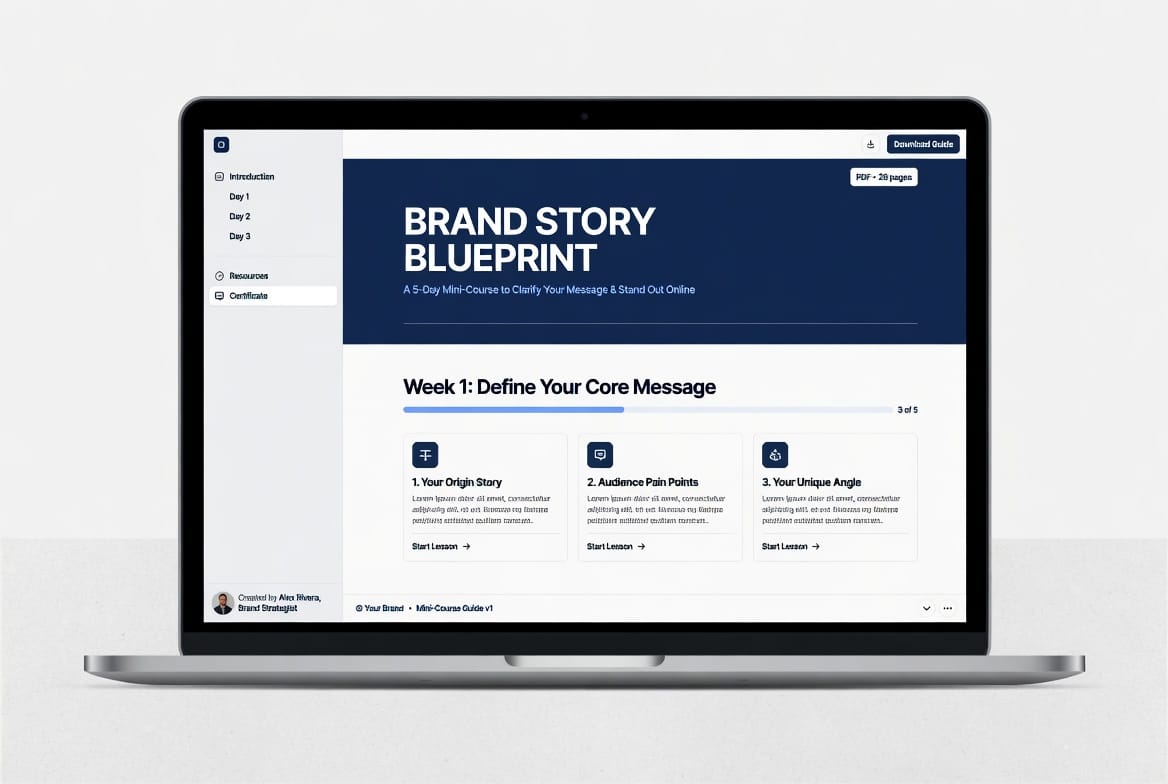
Sarah's first Impulse Offer was a $27 guide that solved one specific mindset block her clients kept running into in their first 90 days of business. She had addressed it dozens of times on coaching calls. She knew exactly how to solve it. She packaged it, put it on a simple page, and drove traffic to it.
It converted at 4.2 percent on cold traffic. That's a strong number.
Step 2: The Value Multiplication Stack
The Impulse Offer alone rarely covers the cost of paid traffic. That's where the Value
Multiplication Stack comes in.
The stack has two parts: the order bump and the upsell.
The order bump sits on the checkout page as a simple checkbox offer. It should be something that directly complements the main product, priced between $17 and $27, and describable in two or three sentences. The buyer has already decided to purchase. The order bump gives them a fast, easy way to get more value from the decision they just made.
The upsell comes immediately after the purchase is complete, before the buyer reaches the thank you page. It's a deeper or broader version of what they just bought, priced between $37 and $97. At this point the buyer has their credit card out and their buying resistance is at its lowest. A well-constructed upsell converts between 15 and 25 percent of front-end buyers.
Together the order bump and upsell take an average order value of $27 and push it to $40, $47, or higher. That gap is often the difference between a campaign that loses money and one that pays for itself.
Sarah's order bump was a $17 companion workbook. Her upsell was a $47 video training that went deeper on the same topic. Her average order value landed at $44.
Her cost per acquisition on Meta ads was $33.
Front end profitable. Ads paying for themselves. Buyer list growing on autopilot.
Step 3: The Bridge System
Most people who buy your front-end product will never see your back-end offer unless you deliberately move them toward it.
That's what the Bridge System does.
It has two components. The first is the thank you page. The moment someone completes their purchase, the thank you page delivers their product and introduces the back-end offer with a short video or written explanation. This isn't a hard sell. It's an invitation to the next logical step for someone who just bought and is in an engaged, receptive state.
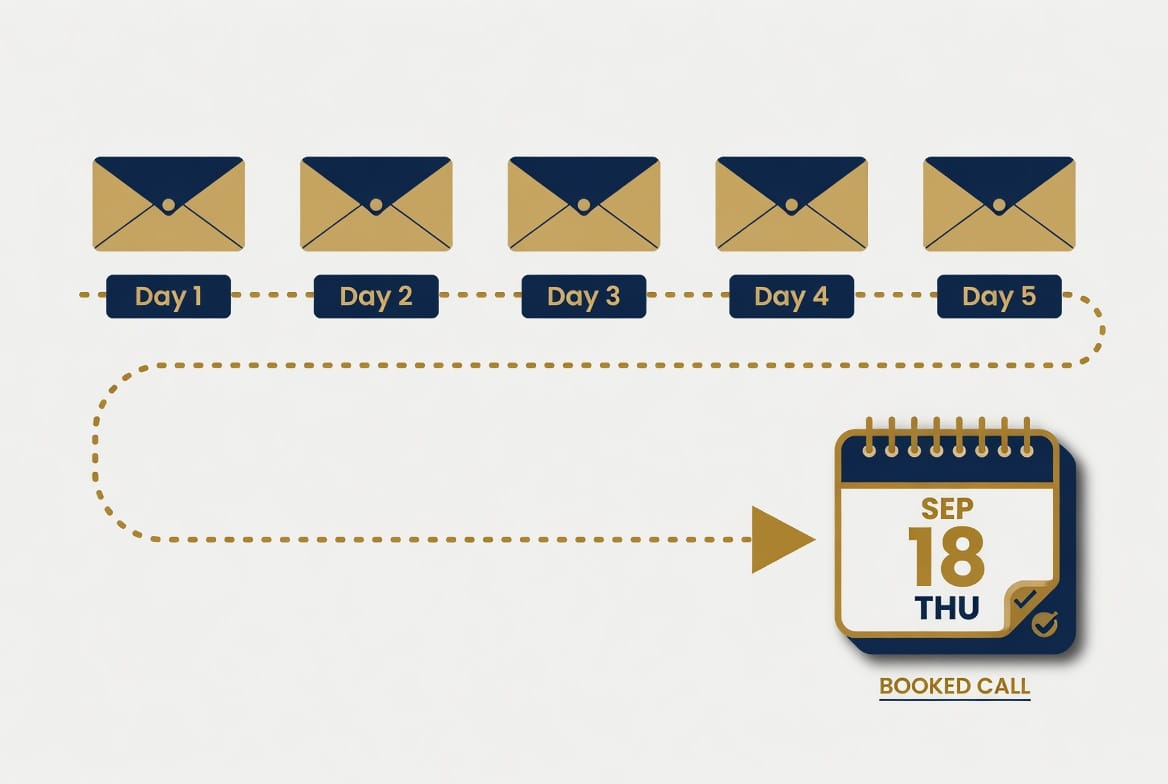
The second component is the post-purchase email sequence. Five to seven emails, one per day, starting immediately after purchase. The sequence does three things in order: it delivers value from inside the product to make sure buyers actually use what they bought, it builds the relationship so they feel like they know you, and it introduces the back-end offer as the natural next step for someone who wants to go further.
The Bridge System is what turns a one-time $27 buyer into a $350 a month coaching client. Not through pressure or hard selling. Through delivering on the promise of the front-end product and showing them what's possible at the next level.
Sarah's five-email Bridge sequence converted 6 percent of her front-end buyers into discovery calls for her coaching program. At her volume, that was enough to add two to three new coaching clients every month from her front-end funnel alone.
Step 4: The Rapid Testing Ad System
With the funnel built, the next step is getting traffic into it.
The Rapid Testing Ad System is designed to find a profitable campaign as fast as possible without burning through budget while you figure out what works.
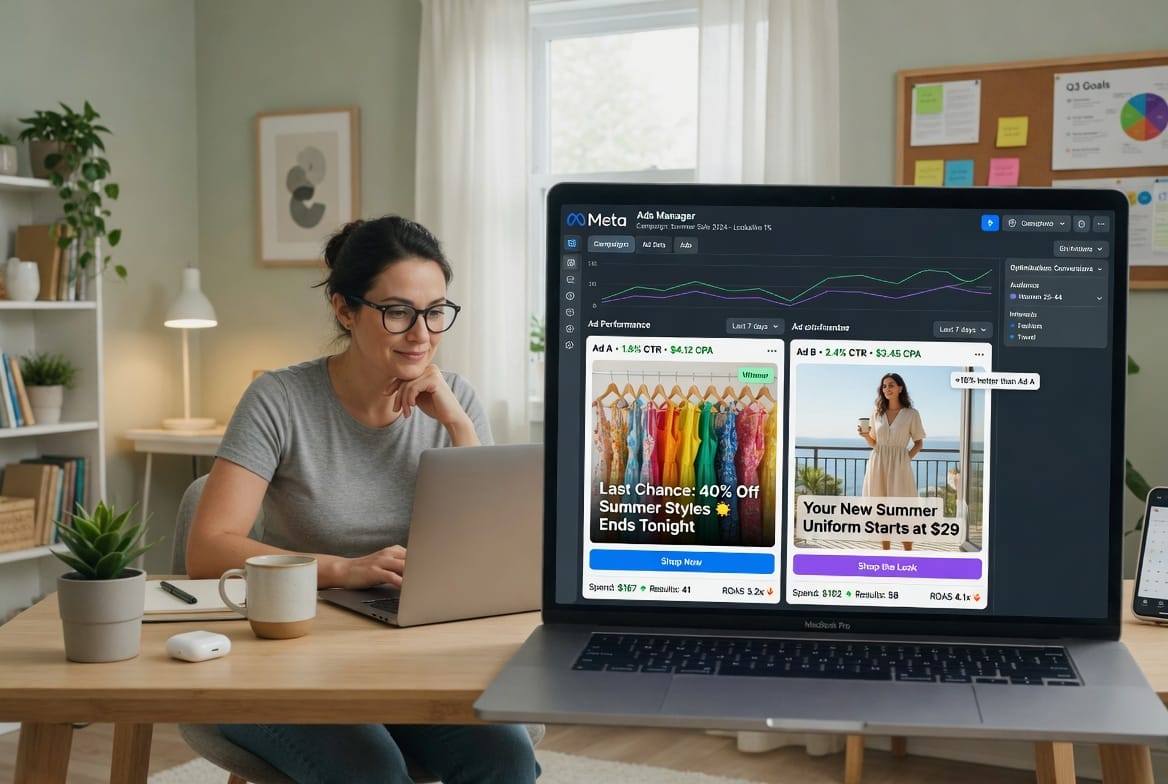
The setup is simple. One Advantage+ campaign on Meta with open targeting. No interest restrictions, no demographic filters. Two ads running simultaneously with two different angles. Daily budget set at three to five times the price of your front-end product.
For a $27 product that means $81 to $135 per day during the testing phase.
Open targeting works here for a specific reason. Meta's algorithm uses the first buyers who convert to identify more people who match their behavioral profile. The ad is the targeting mechanism. Your job is to give the algorithm enough spend to find the right people, not to manually restrict who sees the ad.
Two ad angles covers more ground without overcomplicating the test. One angle leads with the problem. One leads with the outcome. You run both simultaneously and let the data tell you which one the market responds to.
Within five to seven days you'll have enough data to know whether the funnel is working. If your ROAS is at or above 1.0, the math is working and you move to the scaling phase. If it's below 1.0, you have a clear diagnostic process for identifying which part of the funnel needs adjustment.
Step 5: The Red-Yellow-Green Scaling System
Once the funnel is profitable, the goal is to scale it without breaking what's working.
The Red-Yellow-Green Scaling System is a ten-minute daily process for making ad decisions based on ROAS data rather than gut feel.
Green means your ROAS is above your break-even target. Increase your daily budget by 20 percent and check again in 48 hours. Do not touch the creative or the targeting. Let the algorithm recalibrate to the new budget before making any other decisions.
Yellow means your ROAS is within 20 percent below break-even. Hold the budget steady. Give it 48 to 72 hours before making any changes. One bad day doesn't mean the campaign is broken.
Red means your ROAS has been below break-even for three or more consecutive days. Pause the underperforming ad. Launch a new angle to replace it. Do not increase budget until ROAS recovers.
The 20 percent scaling rule is important. Increasing budget by more than 20 percent at a time forces Meta's algorithm to reset its optimization, which can cause performance to drop even on a campaign that was working well. Small, consistent increases compound without disrupting what the algorithm has learned.
Marcus scaled his campaign from $90 a day to $340 a day over six weeks using this exact process. His ROAS stayed between 1.3 and 1.6 the entire time. His buyer list grew by 1,200 people in those six weeks. His back-end coaching program had a waiting list for the first time.
The System Working Together
Each of the five steps depends on the others.
The Impulse Offer brings in buyers. The Value Multiplication Stack makes the math work. The Bridge System converts buyers into back-end clients. The Rapid Testing Ad System finds a profitable campaign fast. The Red-Yellow-Green Scaling System grows it without breaking it.
Remove any one of the five and the system underperforms. Add all five together and you have a front-end funnel that acquires buyers, covers its own costs, and feeds your back-end offers automatically.
This is the complete framework inside Get Paid to Get Leads. If you want the full step-by-step breakdown including templates, worksheets, and the exact campaign setup process, that's what the training covers.