The Best Sales Funnels for Coaches
Coaches are sold on funnels constantly.
Webinar funnels. Challenge funnels. VSL funnels. Application funnels. High-ticket funnels. Low-ticket funnels. Every guru with a course to sell has a specific funnel they claim is the one that works.
Most of that advice ignores the most important variable: what stage of business you're actually in and what your specific constraints are right now.
A funnel that works beautifully for a coach with a 50,000-person email list and a team to manage campaigns will produce very different results for a coach who is starting from scratch and running everything themselves.
This article is going to cover the funnels that actually work for coaches at different stages, what each one is designed to do, and how to think about which one makes sense for where you are right now.
What a Funnel Is Actually Supposed to Do
Before getting into specific funnel types, it's worth being clear about what a funnel is actually supposed to accomplish for a coach.
A funnel is a structured sequence that takes the right person from first contact to paying client as efficiently as possible.
That's it. The specific mechanics, the pages, the emails, the ads, are just the implementation of that idea. The question to ask about any funnel isn't whether it's the right category. It's whether it moves the right person from first contact to paying client efficiently given your specific offer, audience, and stage of business.
With that framing, here are the funnel types that consistently work for coaches.
The Discovery Call Funnel
The discovery call funnel is the simplest version of a coaching funnel and often the first one coaches build.
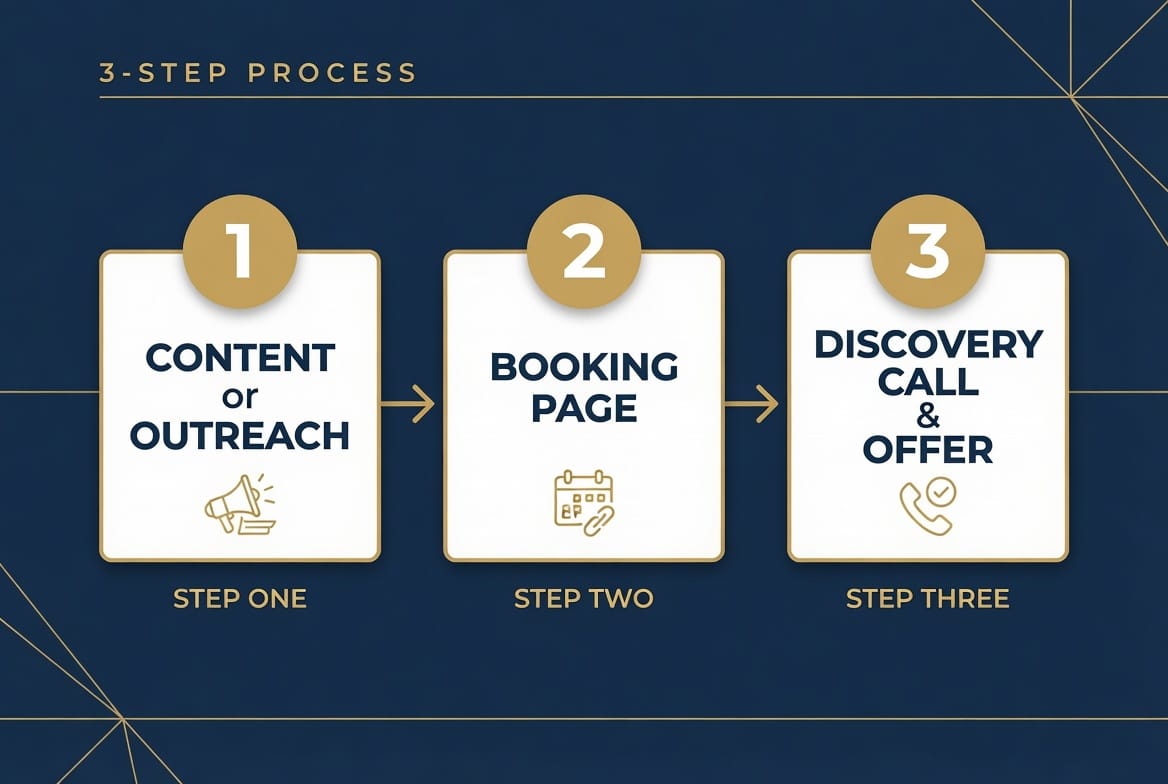
It looks like this. Content or outreach drives someone to a booking page. The booking page qualifies them with a few questions. They book a call. You have a conversation. You make an offer. They say yes or no.
This funnel works well when you have a warm audience who already knows you and trusts you enough to get on a call. It works for high-ticket offers where the margin per client justifies the time cost of the conversation.
It stops working when the audience is cold. Cold traffic almost never books discovery calls at economically viable rates. The cost per booking from cold paid traffic on a discovery call funnel is usually too high to justify the close rate on the other end.
The discovery call funnel is a relationship-conversion tool, not a cold acquisition tool. Use it for warm audiences. Don't use it as your primary cold traffic strategy.
The Webinar Funnel
The webinar funnel has been one of the most popular coaching funnels for the last decade and for good reason. A well-run webinar can take a cold prospect from curious to buying a $1,000 or higher offer in 90 minutes better than almost any other format.
The structure is: ad or content drives traffic to a webinar registration page. The registrant attends the webinar. The webinar delivers value and makes an offer. A post-webinar email sequence follows up with non-buyers.
The webinar funnel works well when you're a strong presenter, when you have a compelling offer that lends itself to the education-to-pitch format, and when you can fill the room with enough qualified registrants to make the math work.
The problems with the webinar funnel for coaches are well documented. Show-up rates have declined significantly. Webinar audiences have become more sophisticated and more resistant to the standard format. The model requires a live performance every week to generate revenue, which means the business stops the moment you do.
For coaches with strong presentation skills and an established warm audience, the webinar funnel remains powerful. For coaches starting from scratch or trying to build something that runs without their constant involvement, it's a demanding model to sustain.
The Low-Ticket Funnel
The low-ticket funnel, or micro offer funnel, is the model that solves most of the problems the webinar funnel creates.
Instead of a free webinar registration as the entry point, it uses a paid product priced between $7 and $47. Instead of requiring a live performance to generate revenue, it runs automatically. Instead of acquiring free leads who may or may not ever buy, it acquires buyers from the first transaction.
The structure is: ad drives traffic to a low-ticket product page. Buyer completes purchase. Order bump and upsell increase average order value. Thank you page and email sequence Bridge the buyer toward the high-ticket coaching offer. Discovery calls are booked by buyers who are already warm.
The low-ticket funnel is the best all-around funnel for coaches who want something that runs without their constant involvement, acquires buyers instead of leads, and feeds a high-ticket back end with pre-qualified prospects.
The limitation is that it requires building and validating a front-end product before it can run. That's an upfront investment of time that the discovery call funnel and some webinar approaches don't require.
The Challenge Funnel
The challenge funnel runs a free five to seven day challenge as the lead generation mechanism. Participants get daily content, implement something each day, and are pitched a paid offer at the end.
Challenges can be highly engaging when executed well. They build community, create momentum, and position the paid offer as the natural next step for participants who want to continue the transformation they started in the challenge.
The limitations are significant for coaches building something sustainable. Running a good challenge requires substantial time and energy during the challenge period. The conversion window is compressed. Once the challenge is over, the momentum dissipates quickly and you need to run another challenge to generate the next cohort of buyers.
The challenge funnel is a launch mechanism, not a sustainable acquisition system. It's effective for generating a burst of revenue and buyers but requires repeated effort to sustain.
The VSL Funnel
A VSL, or video sales letter, funnel uses a longer-form video as the primary sales mechanism instead of a written sales page.
Ad drives traffic to a page with a video. The video tells a story, builds the case for the offer, and makes the pitch. Below the video is a call to action: book a call, buy a product, or submit an application.
VSL funnels work well for coaches whose personality and story are the primary differentiator for their offer. A compelling person telling a compelling story on video can convert cold traffic at rates that written copy can't match in certain contexts.
The limitation is that VSLs require a well-produced video and a strong script, both of which take meaningful time and skill to create. A weak VSL performs worse than a clean written page. The format rewards execution more than most.
How to Choose the Right One
The right funnel for a coach depends on three things: the warmth of your current audience, your offer price point, and how involved you want to be in the day-to-day operation of your acquisition system.
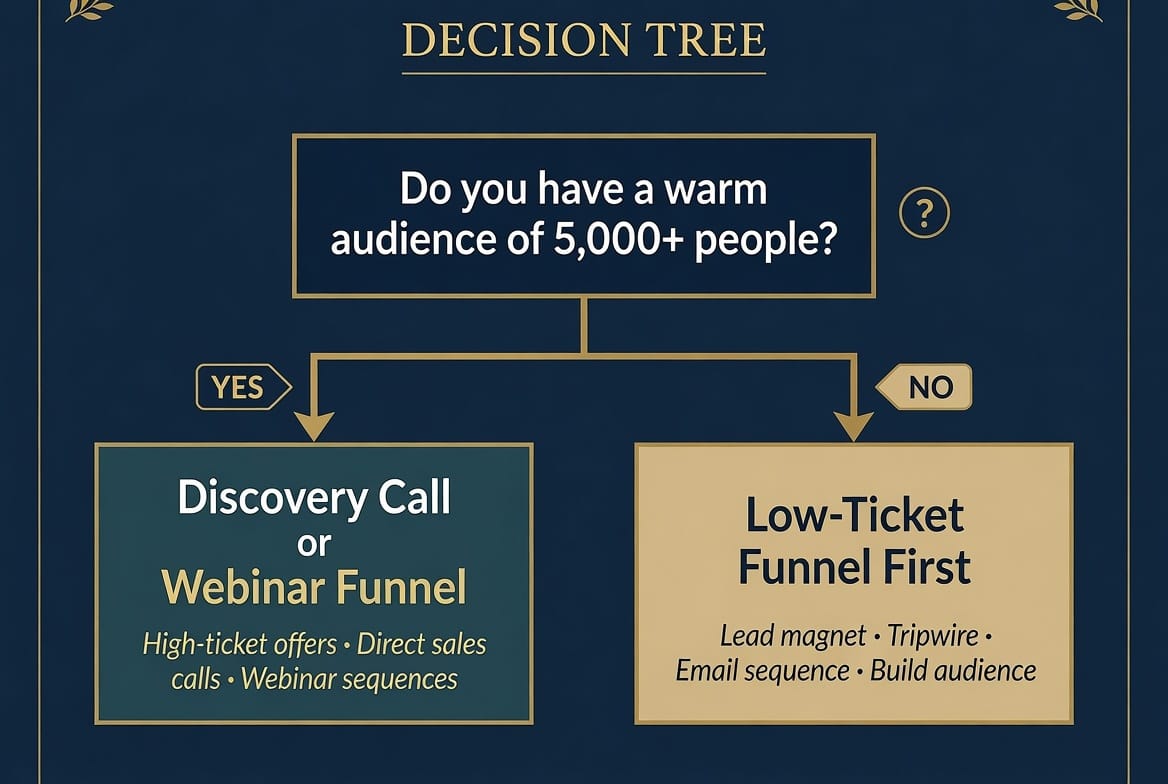
If you have a warm audience of 5,000 or more engaged people who already trust you, the fastest path to high-ticket clients is a discovery call funnel or a webinar to that existing audience. You don't need to build a low-ticket front end to earn their trust. It already exists.
If you're building from scratch or your audience is small and cold, the low-ticket funnel is almost always the right starting point. It validates your offer with real purchase behavior, builds a buyer list, and creates consistent pipeline for your high-ticket back end without requiring a weekly performance.
If you want something that runs without your constant involvement and compounds over time regardless of whether you're actively marketing, the low-ticket funnel is the only option on this list that delivers that reliably.
The webinar and challenge funnels are powerful amplifiers once you have a buyer list to run them to. They're inefficient as primary cold acquisition strategies.
The Funnel That Scales
Every funnel on this list can generate coaching clients. Only one of them scales without requiring proportionally more of your time as it grows.
The low-ticket funnel, once the front-end economics are working and the back-end sequence is converting, generates coaching clients continuously from a system that runs without your active management beyond the daily ROAS check.
It doesn't require you to show up live every week. It doesn't require a new challenge every month. It doesn't require outreach or content creation to sustain the pipeline. It requires an ad campaign that's working, a front-end product that converts, a value stack that covers the cost of the traffic, and a Bridge sequence that moves buyers toward the back end.
Those things require effort to build. Once built, they run.
The complete framework for building that system from the ground up, including how to validate the front-end offer, structure the value stack, set up the ad campaign, and scale without breaking what's working, is exactly what Get Paid to Get Leads covers.