The Funnel Math That Makes Your Ads Pay For Themselves
Most people who try Facebook ads lose money the first time.
They set up a campaign, run it for two or three weeks, check the numbers, and quietly conclude that paid traffic just doesn't work for their business. They go back to organic content and tell themselves ads are for people with bigger budgets.
Here's what actually happened.
The ads probably worked fine. The targeting was likely decent. The creative was good enough.
The problem was the math sitting behind the ad. Specifically, the funnel structure that received the traffic had no mechanism for covering its own costs.
That's not an ad problem. That's a funnel design problem. And it's completely fixable.
Why Most Ad Campaigns Are Set Up to Lose Money
When you run paid traffic to a free lead magnet, here's the financial reality.
You spend money to get a click. The person clicks, lands on your opt-in page, and downloads your free guide. You've just spent somewhere between $3 and $12 to acquire that lead, depending on your niche and how well the ad performed.
Nothing comes back in.
You now have a free subscriber on your list who may or may not ever buy anything. You'll spend the next several months emailing them, nurturing them, and hoping they eventually pull out a credit card. Most won't.
Every single dollar you spent on that campaign stays spent. There's no mechanism to recover it on the front end. The only way the math ever works is if your back end converts well enough to justify the losses on the front.
For most coaches and course creators, it doesn't. And that's why the campaign looks like a failure.
The campaign wasn't the problem. The funnel structure was.
The Equation That Changes Everything
There's a simple equation that determines whether a paid traffic campaign is viable before you spend a single dollar.
Average Order Value minus Cost Per Acquisition.
If your AOV is higher than your CPA, your front end is profitable. Your ads are paying for themselves before your back end ever enters the picture. You can scale without bleeding money every month.
If your AOV is lower than your CPA, you're losing money on every customer you acquire and hoping the back end saves you. Sometimes it does. Usually it doesn't.
The goal of a properly structured front-end funnel is to get AOV above CPA on the front end alone. When you do that, the back end becomes pure profit.
Here's what that looks like in practice.
Walking Through the Math
Meet Marcus Thompson.
Marcus is a business coach who had been running weekly webinars for three years. He'd tried Facebook ads twice before, lost money both times, and written them off entirely. His revenue was decent but completely dependent on him showing up live every week.
When Marcus restructured his funnel, here's what the numbers looked like.
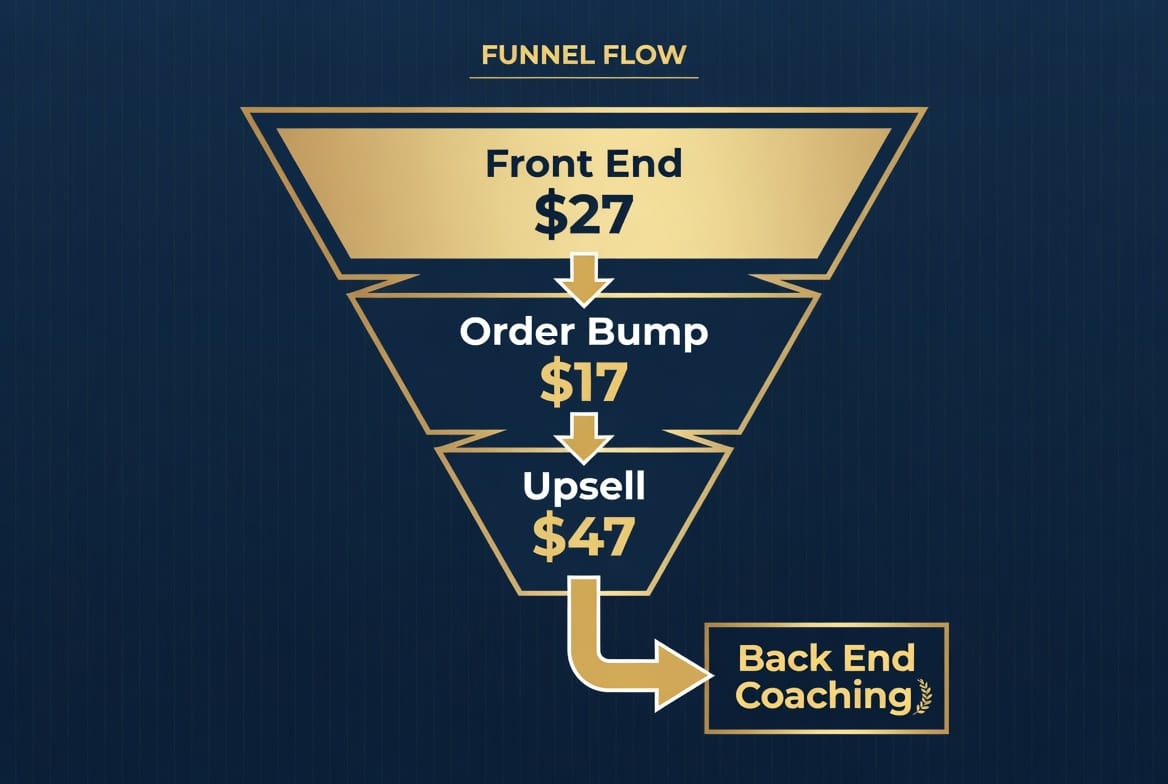
He created a $27 front-end product. One specific problem, one clear solution, one simple checkout page.
On that checkout page he added an order bump: a complementary resource priced at $17. No new page, no new decision required. Just a checkbox before the purchase goes through. It converted at 31 percent, meaning roughly 3 out of every 10 buyers added it before completing their purchase.
Behind the initial purchase he added a single upsell: a deeper implementation training priced at $47. It converted at 22 percent.
Now let's run the math.
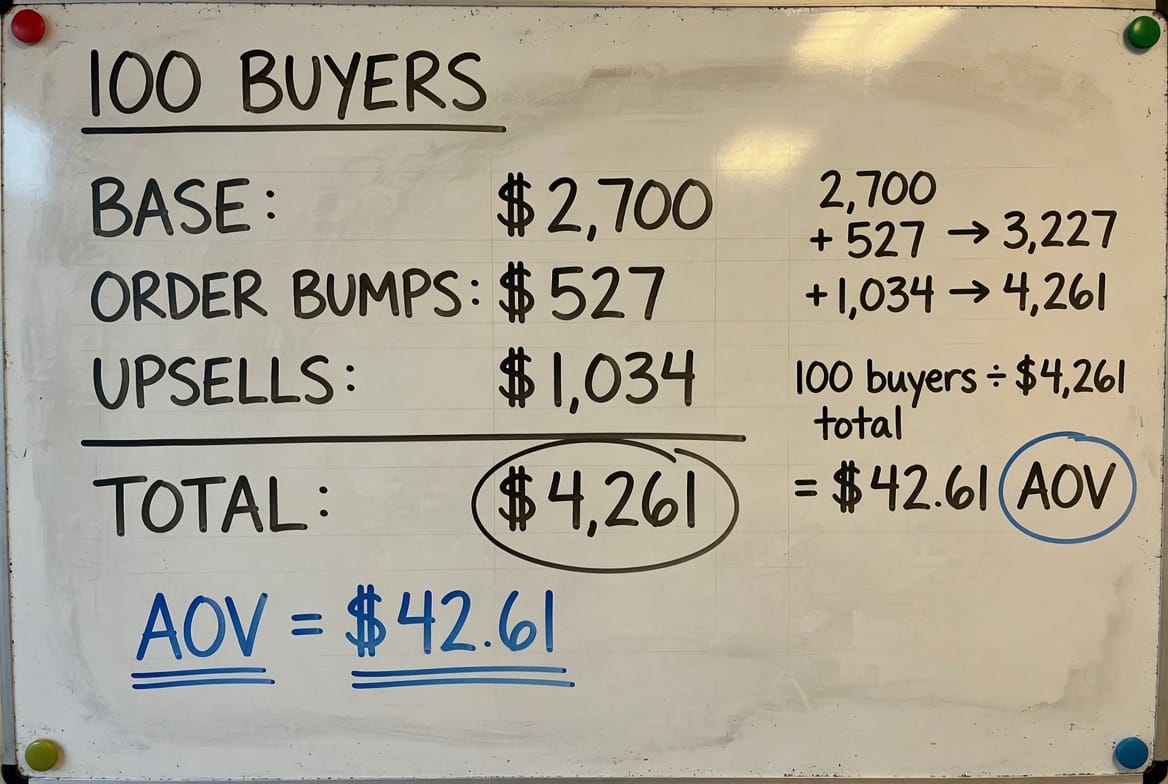
Every 100 people who buy the $27 front-end product generate $2,700 in base revenue.
Of those 100 buyers, 31 add the $17 order bump. That's an additional $527.
Of those 100 buyers, 22 take the $47 upsell. That's an additional $1,034.
Total revenue from 100 buyers: $4,261.
Average order value: $42.61.
Marcus was running Meta ads at a cost per acquisition of $31. His front end was generating $42.61 per buyer. He was making $11.61 on every customer before his back end coaching program ever came into the picture.
That's not a loss he was hoping the back end would cover. That's a front end that was already profitable on its own.
What the Order Bump Actually Does
Most people underestimate the order bump.
It's the single highest-leverage element in the entire funnel. No extra traffic required. No extra ad spend. No new page to build. You're just giving someone who has already decided to buy the option to add something complementary before they complete their purchase.
The psychology is straightforward. The moment someone enters their credit card, their buying resistance drops to its lowest point. They've already made the decision. The order bump isn't asking them to make a new decision, it's asking them to enhance the one they already made.
A well-constructed order bump in the coaching and course creator space typically converts between 25 and 40 percent. At those numbers, it can add $8 to $15 to your average order value without touching anything else in the funnel.
That difference alone can be the gap between a campaign that loses money and one that breaks even. Or between breaking even and being profitable.
What the Upsell Does to the Back End
The upsell has a different job than the order bump.
The order bump optimizes the front end. The upsell bridges the front end to the back end.
A buyer who takes your upsell has now made two purchases in the same session. They've demonstrated twice that they're willing to spend money on solutions in your space. That person is dramatically more likely to buy your higher-ticket offer than someone who only purchased the front-end product.
In Marcus's case, the 22 percent of buyers who took his $47 upsell were three times more likely to eventually book a discovery call for his $2,000 coaching program than buyers who skipped it.
The upsell didn't just add revenue on the front end. It identified his best prospects and pre-qualified them for the back end automatically.
The Break-Even Point and Why It Matters
A lot of coaches set a goal of making their ads profitable. That's the right instinct but the wrong target to start with.
Break-even is actually the goal in the early stages.
When your AOV equals your CPA, you're acquiring buyers for free. Every customer costs you nothing net. Every email you send to that buyer list, every back-end offer you make, every upsell you introduce later, that's all revenue from customers who cost you nothing to acquire.
That's what infinite scale actually looks like. Not profit on the front end, but a front end that costs you nothing while filling your list with buyers.
Marcus hit break-even in his third week of running ads. From that point forward, every buyer who came through the funnel was essentially free. His back-end coaching program closed four new clients in the following 30 days from that buyer list.
At $2,000 each, that's $8,000 in back-end revenue from a paid traffic campaign that cost him nothing net to run.
The One Number to Watch Every Day
Once your funnel is running, there's one number that tells you everything you need to know.
ROAS. Return on ad spend.
Take the total revenue your funnel generated. Divide it by what you spent on ads. That's your ROAS.
A ROAS of 1.0 means you're breaking even. Every dollar you spend on ads comes back as a dollar in revenue. Your buyers are free.
A ROAS above 1.0 means your front end is profitable. You're making money before the back end touches it.
A ROAS below 1.0 means you're losing money on the front end and need to either reduce your CPA, increase your AOV, or both.
The levers for increasing AOV are the order bump and the upsell. The lever for reducing CPA is the ad creative and the landing page conversion rate. You don't need to touch all of them at once. Usually improving one is enough to flip the math.

Why This Changes the Way You Think About Ads
Most coaches treat paid traffic as an expense.
You put money in and hope enough comes back out to justify it. Every campaign feels like a gamble. Every loss feels personal.
When your funnel is structured correctly, paid traffic stops being an expense and becomes a buying machine. You put money in and buyers come out. The front end covers the cost. The back end is profit.
That mindset shift is what separates coaches who scale from coaches who stay stuck running the same organic content hamster wheel hoping something eventually converts.
The math isn't complicated. A $27 product, a $17 order bump, a $47 upsell, and a clear back-end offer. Those four things, structured correctly, are enough to build a self-funding buyer acquisition machine in almost any coaching niche.
Marcus went from two failed ad campaigns and a belief that ads didn't work for him, to a front-end funnel generating $11 per buyer in net profit before his coaching program ever entered the conversation.
The ads didn't change. The math did.