The Math of Pre-Qualified Calls Versus Discovery Call Roulette
David Chen kept a spreadsheet for two years tracking every discovery call he took from cold outreach.
Not because he's unusually analytical. Because something felt wrong and he couldn't identify what it was.
He logged the source of every lead, the outcome of every call, and the revenue generated from every client he closed. Two years of data. 340 calls total.
When he finally sat down and ran the numbers properly, the picture was uncomfortable.
His close rate was 11.2 percent. That meant 302 of those 340 calls had produced nothing. 302 hours, conservatively, of preparation, conversation, and follow-up invested in people who never became clients.
His average client value was $4,800. His 38 closed clients had generated $182,400 over two years. On the surface that looked reasonable.
Then he calculated the cost.
340 hours of discovery calls. Roughly the same again in preparation, follow-up, and the cold outreach activity that had filled the pipeline in the first place. He had spent somewhere in the region of 600 to 700 hours over two years generating $182,400 in revenue.
He was effectively billing himself at $260 to $300 an hour for his sales process. Which sounds decent until you realize that most of those hours were spent in conversations that were never going to produce anything.
The spreadsheet told him he didn't have a sales problem. He had a math problem. And the math problem had a structural solution.
The Discovery Call Roulette Model
The cold outreach discovery call model is essentially a numbers game with a fixed and fairly low probability of success at each spin.
You send outreach. Some people respond. Some of those people book calls. Some of those calls close. The ratios at each stage determine your overall efficiency and your revenue ceiling.
For most consultants and agency owners running cold outreach, the math looks roughly like this.
A hundred cold outreach messages produce somewhere between five and fifteen responses depending on the quality of the targeting and the messaging. Those responses produce three to eight discovery calls after the inevitable no-shows and reschedules. Those calls close at somewhere between 10 and 20 percent.
So a hundred cold outreach messages, which might take four to six hours to research and send properly, produces somewhere between zero and two clients. Usually one, on a good week.
The math isn't terrible. But there's a ceiling built into it. To get more clients you have to send more outreach. More outreach requires more time. Time is finite. The model doesn't scale without you scaling with it.
David had hit that ceiling. He was sending as much outreach as he could manage alongside doing actual client work. His revenue was stuck because his time was stuck.

What the Math Looks Like With Pre-Qualified Calls
The front-end funnel model runs on completely different math.
Instead of starting with outreach and hoping the right people respond, you start with a paid traffic campaign that brings buyers directly into a structured system. The buyers self-qualify by paying. The email sequence warms them up. The ones who are genuinely interested in a deeper engagement book calls.
The numbers at each stage look like this for David's current funnel.
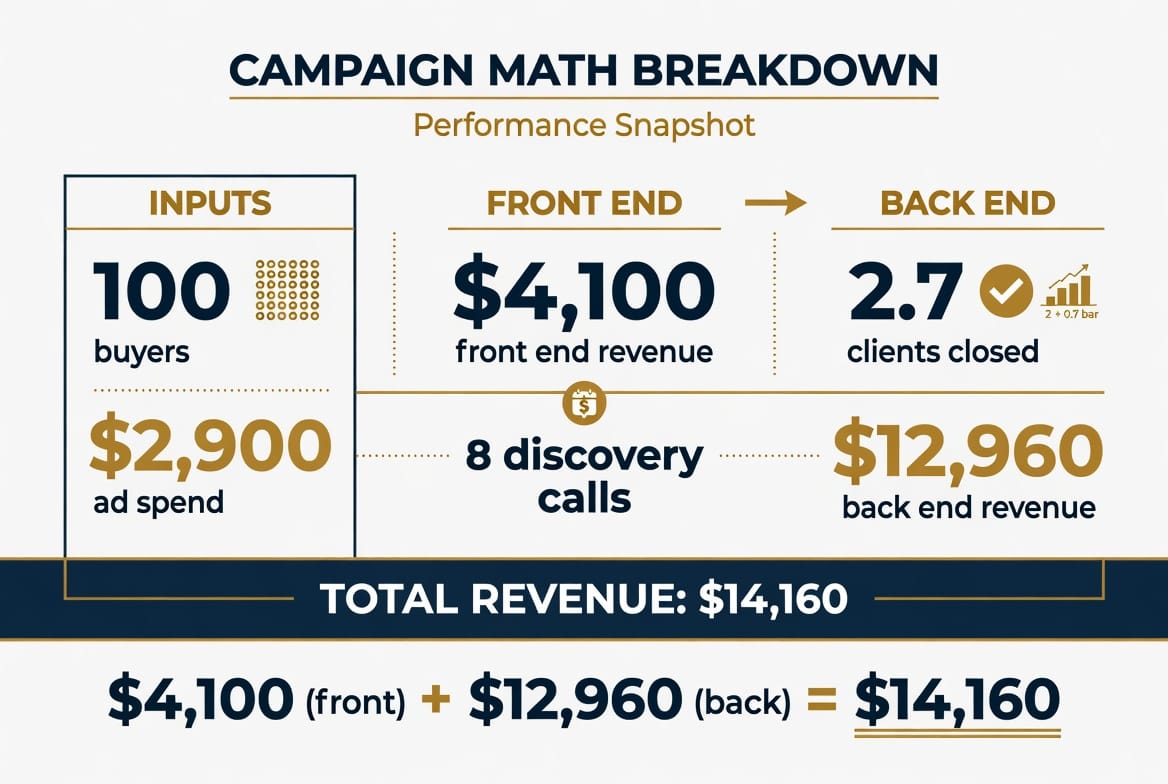
His front-end product converts cold traffic at 3.4 percent. His ad spend produces buyers at an average cost of $29 each. His average order value with the order bump and upsell sits at $41. His front end is profitable before his back end enters the picture.
Of those buyers, roughly 8 percent book a discovery call after going through his Bridge email sequence. That means for every 100 buyers he acquires, about 8 book calls.
Of those 8 calls, he closes 34 percent. That's 2.7 clients per 100 buyers.
His average client value is $4,800. 2.7 clients generates $12,960 in back-end revenue from every 100 buyers who come through the funnel.
His front-end revenue from those same 100 buyers is approximately $4,100, which covers the $2,900 in ad spend that acquired them with $1,200 left over.
Total return from 100 buyers: $14,160. Total ad spend: $2,900. And unlike the cold outreach model, the discovery calls he's taking from those 8 buyers are closing at 34 percent instead of 11 percent.
The Time Math Is Even More Dramatic
Revenue math tells part of the story. Time math tells the rest.
In his cold outreach days David was spending roughly 15 hours a week on lead generation and discovery calls. Ten hours on outreach activity and call preparation, five hours on the calls themselves. That 15 hours was generating somewhere around $3,500 to $4,000 a month in new client revenue on average.
With the front-end funnel running, his weekly time investment in lead generation is about 20 minutes checking his ad dashboard and ROAS numbers. His discovery calls have dropped from eight to ten a week to two to three. His close rate has tripled.
He's spending roughly 3 hours a week on sales-related activity instead of 15. He's generating more revenue from it.
The 12 hours he recovered every week went back into billable work and into building the business. At his billing rate that's roughly $3,600 a week in recovered capacity. Over a year that's close to $187,000 in time that was previously being consumed by a lead generation model that required constant manual effort to sustain.
That number, $187,000 in recovered time value annually, is larger than the direct revenue improvement from the funnel itself in year one.
The real cost of the cold outreach model was never fully visible in the revenue numbers. It was hiding in the time.
The Compounding Difference
Here's the part that doesn't show up in a single month's comparison.
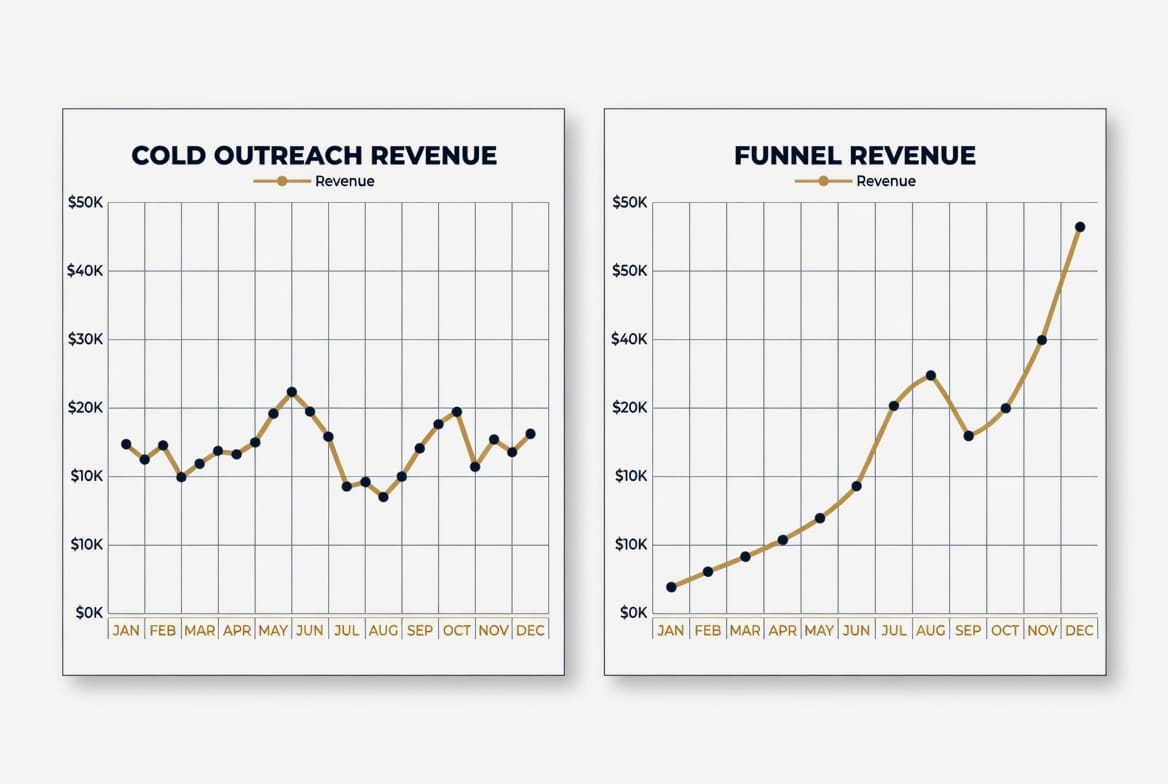
The cold outreach model doesn't compound. Every week you start from scratch. The effort you put into outreach last week doesn't reduce the effort required this week. Your close rate doesn't improve because you've been doing it longer. The leads don't get better because you've sent a thousand messages before.
The front-end funnel model compounds aggressively.
Every buyer who comes through the funnel adds to the list. The list grows every day the funnel runs. The back-end revenue it generates grows as the list grows. The buyers from month one are still on the list in month six. Some of them will buy something else. Some of them will refer someone. Some of them will eventually upgrade to a higher tier of service.
David's buyer list has been growing for eleven months. The buyers he acquired in month one have generated an average of $340 each in total revenue including their initial front-end purchase and any back-end purchases or referrals. His cost to acquire each of them was $29.
A $29 investment that has returned $340 eleven months later. That's not a marketing cost. That's an asset.
What David's Calendar Looks Like Now
The practical day-to-day reality of running the funnel model versus the cold outreach model is worth describing concretely.
In his cold outreach days David's Wednesdays looked like the one described at the start of this series. Four calls, zero clients, four hours of his time and energy invested in conversations that went nowhere. He dreaded his calendar and kept it anyway because there was no alternative.
His Wednesdays now typically involve one or two discovery calls with people who have already bought from him, already gone through his content, and already made a preliminary decision that they want to work together. The calls are shorter. The conversations are better.
The close rate is three times higher.
The rest of Wednesday is available for client work, content creation, or simply not working if he doesn't feel like it.
That last part is not trivial. The cold outreach model had colonized his time so thoroughly that stepping away felt irresponsible. The funnel model generates pipeline whether he's working or not. The leads don't stop coming because he took an afternoon off.
That relationship with your own time and your own calendar is one of the less-talked-about benefits of the model shift. And for someone who had spent years dreading his own schedule, it was one of the most significant changes of all.
The Only Question Worth Asking
If you're running cold outreach right now and your calendar looks anything like David's did, there's really only one question worth sitting with.
How much of your time and energy is being consumed by a lead generation model that selects for the wrong people, requires constant manual effort to sustain, and doesn't compound no matter how long you run it?
And what would your business look like if that time and energy was being returned to you while the pipeline filled itself with people who had already decided to trust you before they ever got on your calendar?