What Happens to Your Revenue When You Replace the Weekly Webinar With a Funnel
Marcus Thompson ran his first front-end funnel test on a Tuesday in October.
He spent $90 on ads that day. By Thursday morning, before he would normally have even started promoting his weekly webinar, he had 11 new buyers on his list.
He hadn't written an email. Hadn't posted on social media. Hadn't spent 90 minutes on camera.
He'd woken up, checked his phone, and found 11 people who had paid him money while he slept.
That was the moment the model clicked for him. Not the theory of it. Not the math on a whiteboard. The actual experience of revenue happening without a performance.
If you've been running a webinar business for any length of time, you know how different that feels. The webinar model conditions you to think of revenue as something you generate through effort. You show up, you perform, you close. Revenue is the output of your activity.
A front-end funnel flips that entirely. Revenue becomes something the system generates while you decide how you want to spend your time.
Here's what that transition actually looks like in practice.
The First 30 Days
The first 30 days of running a front-end funnel alongside a webinar business tend to follow a predictable pattern.
Week one is setup and launch. You're building the product page, the checkout, the order bump, the upsell, and the thank you page. If you already have a product or can repurpose existing content, this goes faster than most people expect. Marcus had a $27 product live in four days using content he'd already created for his webinar audience.
Week two is the first data. You're running ads, watching the numbers, and resisting the urge to change everything before you have enough information. This is the hardest week psychologically. The webinar brain wants to intervene. The funnel brain has to learn to wait for data.
By week three, the picture starts to clarify. You can see your cost per acquisition, your average order value, and whether the math is working. Marcus's funnel hit break-even in day 19. His AOV was $43. His CPA was $38. He was acquiring buyers at a net cost of $5 each.
Week four is when most people have their version of the Tuesday morning moment. The funnel has been running long enough that you wake up to revenue that happened without you. It's a small amount at first. But the feeling is completely different from anything the webinar model produces.

What Happens to Webinar Revenue During the Transition
This is the question most webinar-based coaches are afraid to ask out loud.
If I shift focus to building a funnel, will my webinar revenue drop while I'm doing it?
The honest answer is: maybe, temporarily, and it's worth it.
Building the front-end funnel takes time and attention in the first few weeks. If you're also trying to run your weekly webinar at full capacity during that period, something usually gives. Most coaches find it easier to run the webinar every other week during the build phase rather than trying to do both at full speed simultaneously.
The temporary dip in webinar revenue during the build phase is almost always recovered within 60 days as the funnel starts generating consistent buyer flow. And unlike webinar revenue, funnel revenue doesn't require you to maintain the same weekly effort level to sustain it.
Marcus ran his webinar every other week for the first six weeks of his funnel build. His monthly revenue dropped from $9,500 to $7,200 during that period. By month three, his combined funnel and webinar revenue was $16,800. By month five it was $22,000, with the funnel generating $11,000 of that on autopilot.
The temporary dip cost him roughly $4,600 over six weeks. The upside was a business that no longer required him to perform every Thursday to survive.
The Revenue Profile Changes Completely
Here's something that doesn't get talked about enough when coaches consider making this transition.
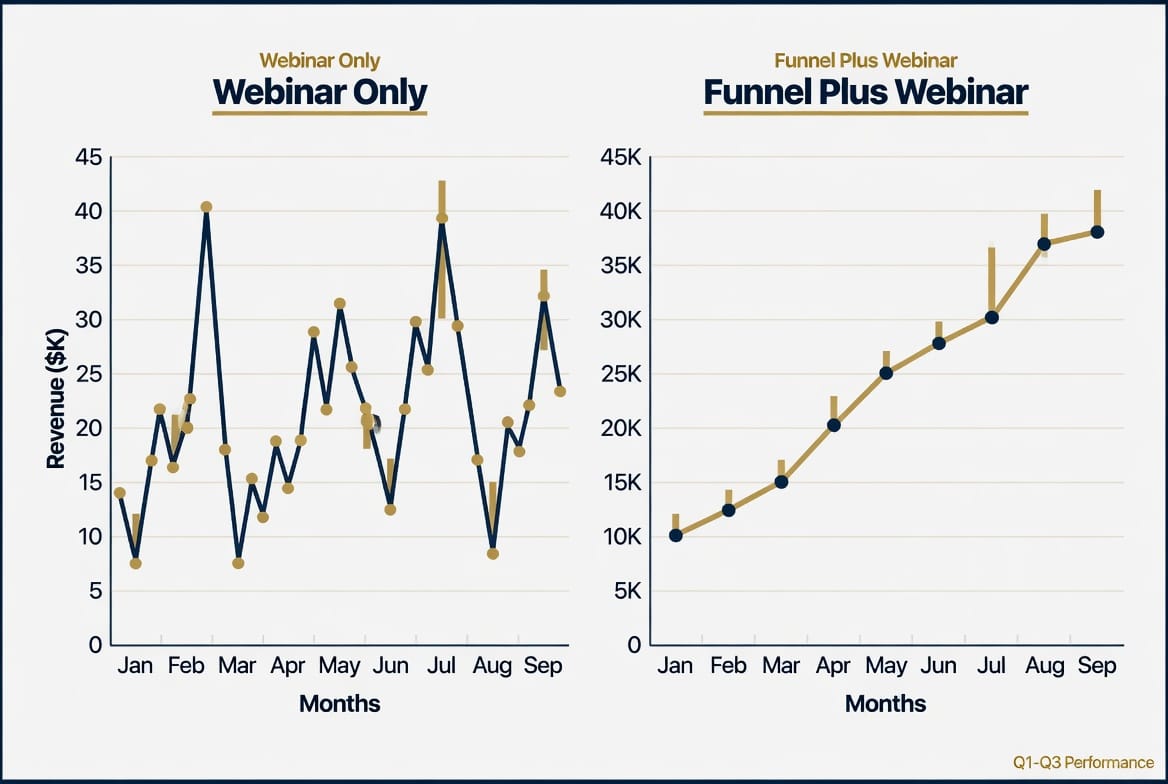
The webinar model produces spiky, unpredictable revenue. Good week, bad week, good week, disaster week. The variance is high and the stress that comes with it is constant.
A front-end funnel produces flatter, more predictable revenue. It's not as exciting as a great webinar week. But it doesn't have the terrifying lows either.
When you combine both, something interesting happens. The funnel creates a baseline that smooths out the spikes. Your worst month with a funnel running is significantly better than your worst month without one, because the funnel keeps generating buyers even when the webinar underperforms.
Marcus described his revenue before the funnel as "a heart monitor with terrifying drops." After adding the funnel he described it as "a slow escalator with occasional jumps when the webinar fires."
The escalator analogy is useful. The funnel moves you forward consistently. The webinar can accelerate that movement when you choose to run it. But the escalator doesn't stop when you step off it.
What the Buyer List Does to Your Webinar
Here's the part most coaches don't anticipate.
When you have a front-end funnel feeding your list with buyers, your webinar gets better.
Not because your slides improved or your close got sharper. Because the people watching your webinar are different.
A webinar audience built from free registrations contains a lot of people who are there for the content and have no intention of buying. They'll consume your 90 minutes, take notes, and unsubscribe from the follow-up sequence. You've learned to factor them in as a cost of doing business.
A webinar audience that includes buyers from your front-end funnel contains people who have already proven they spend money on solutions to their problems. They show up differently. They ask different questions. They're closer to the sale before you even start presenting.
Marcus noticed his webinar close rate climb from 8 percent to 14 percent in the three months after he started running his front-end funnel. He hadn't changed a single slide. The audience composition had changed and the numbers followed.
That's a 75 percent improvement in close rate from a change he made completely outside the webinar itself.
The Back End Starts Working Differently Too
The other change that catches most coaches off guard is what happens to their high-ticket back end once the funnel is running.
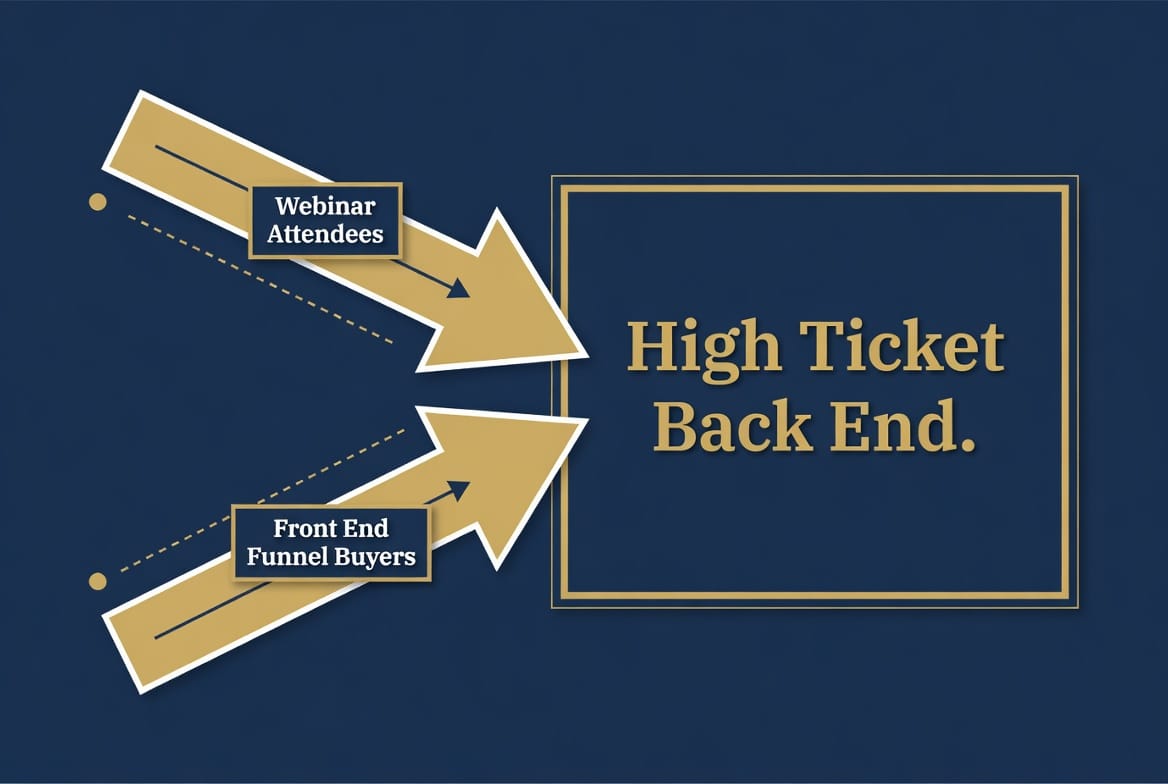
In a pure webinar model, your high-ticket program gets filled primarily by webinar attendees who convert on the call to action at the end. The pipeline is entirely dependent on webinar traffic.
When a front-end funnel is running, you have a second pipeline feeding your back end continuously. Buyers who came in through the funnel, went through the Bridge email sequence, and decided they want to go deeper. These are warm, pre-qualified prospects who have already bought from you once and consumed enough of your content to know they want more.
They book discovery calls at a higher rate than cold webinar attendees. They close at a higher rate. And they show up to those calls already sold on you as a person, which changes the entire dynamic of the conversation.
Marcus added three new coaching clients in month two purely from his funnel's Bridge email sequence. None of them had attended a webinar. They had bought his $27 product, gone through five emails, and decided to book a call.
Three clients at $2,000 each is $6,000 in back-end revenue from a pipeline that didn't exist two months earlier.
The Compounding Effect Over Time
The webinar model doesn't compound. Every week you start from zero. The effort you put in last Thursday doesn't make this Thursday easier.
A front-end funnel compounds.
Every buyer who comes through the funnel becomes a potential back-end client. Every back-end client is a potential testimonial, a referral source, a repeat buyer. The list of buyers you build over six months is worth dramatically more than the list you built over the same period using free lead magnets, and it keeps paying dividends long after the ad that acquired them has stopped running.
Marcus's funnel has been running for eleven months. The buyers he acquired in month one are still on his list. Several of them have bought multiple back-end offers. Two referred friends who became coaching clients. The $27 they paid to get onto his list has compounded into thousands of dollars in lifetime value.
None of that compounding was possible in the webinar-only model where revenue was entirely dependent on this week's performance.
What Comes Next
You now understand what the transition looks like in practice, how revenue changes during and after the shift, and why the funnel makes everything else in your business work better.
The next question is the one that stops most coaches from actually making the move: what does the math look like, and how do you make sure the funnel covers its own costs so you're not just trading webinar losses for ad spend losses?