What is a Sales Funnel? And How To Create One That Actually Makes Money
If you've spent any time in the online business world you've heard the term sales funnel thrown around constantly.
Everyone has one. Everyone says you need one. Half the people using the term can't fully explain what it means and a significant portion of the people who can explain it are running funnels that lose money every month and don't know why.
This article is going to clear all of that up.
What a sales funnel actually is, why most of them don't work, what separates the ones that make money from the ones that drain it, and what the math looks like when a funnel is built correctly.
By the end you'll have a clearer picture of this concept than most people who have been in online business for years.
The Simple Version
A sales funnel is the path a stranger takes from first encountering your business to eventually paying you money.
That's it. Nothing more complicated than that.
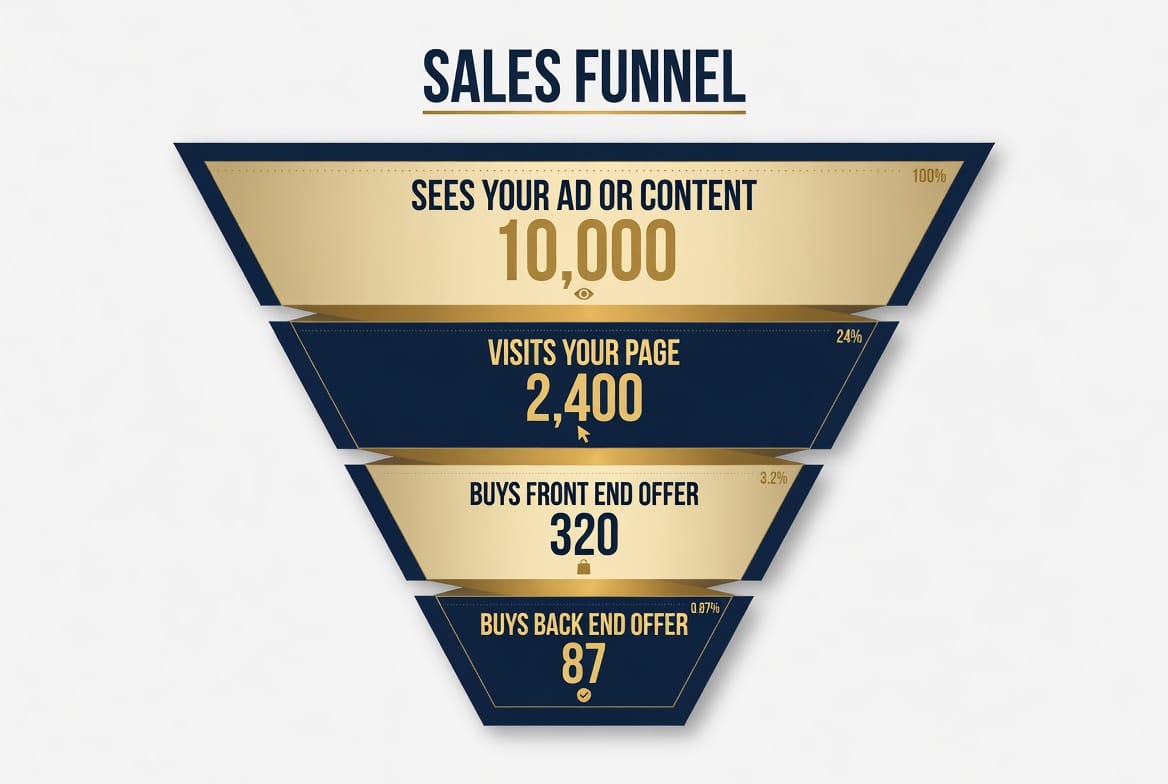
The reason it's called a funnel is because the number of people at each stage gets smaller as you move through it. A large number of people might see your ad or your content. A smaller number will click through to your page. A smaller number still will buy your entry-level offer. An even smaller number will eventually buy your higher-ticket program.
Wide at the top, narrow at the bottom. A funnel.
Every business that sells anything has a funnel whether they've deliberately built one or not. The question isn't whether you have a funnel. It's whether your funnel is designed well enough to make money.
Most aren't.
The Free Funnel Most People Start With
The most common funnel in the coaching and course creator space looks like this.
You create a free lead magnet. A guide, a checklist, a video training. You promote it through ads or organic content. People opt in and land on your email list. You send them a nurture sequence. At some point you make an offer. Some of them buy.
This is the free funnel model and it's the default starting point for most online businesses.
It works. Sort of.
The problem is the economics. When someone opts in to a free lead magnet they give you exactly one piece of information about themselves: they like free things. That tells you almost nothing about whether they'll ever spend money.
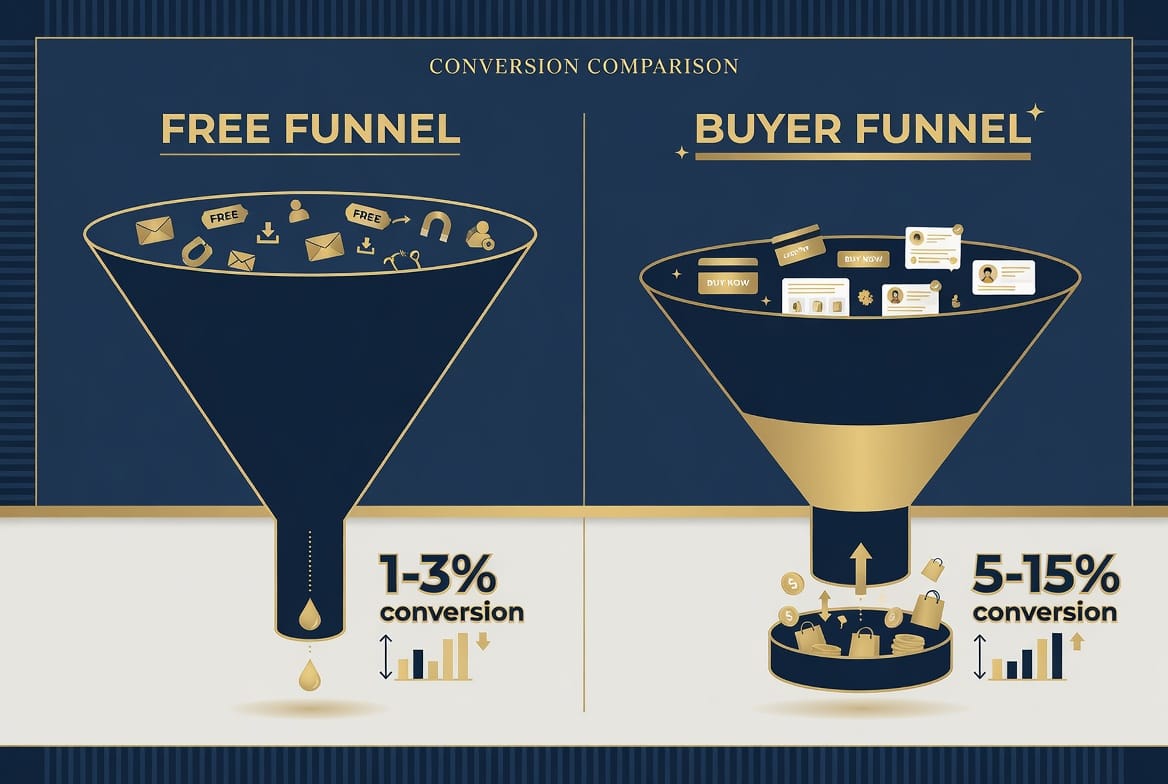
The typical free list in the coaching space converts to paid offers at somewhere between 1 and 3 percent. That means 97 to 99 out of every 100 people who joined your list for free will never buy anything.
You're paying your email platform to store those people. You're spending time creating content to keep them engaged. You're running ads to acquire more of them. And the vast majority will consume everything you give them for free and disappear the moment you ask them to pay.
The free funnel isn't broken. But it's expensive to run and slow to scale. For every thousand free subscribers you need 10 to 30 buyers to justify the cost of having them on your list. Getting to those numbers without a much larger following takes longer than most people expect and costs more than most people plan for.
The Funnel That Actually Pays for Itself
There's a different type of funnel that solves the economics problem from day one.
Instead of a free lead magnet at the top, it starts with a low-ticket product. Something priced between $7 and $47 that solves one specific, immediate problem your ideal customer is already trying to solve right now.
The person who clicks the ad and lands on that page isn't opting in for something free. They're making a buying decision. A small one, but a real one.
That single change transforms the economics of the entire funnel.
Instead of paying to acquire leads who may or may not ever buy, you're paying to acquire buyers. People who have already proven, with their credit card, that they are the kind of person who spends money on solutions to their problems.
Those people behave completely differently on your email list. They open more emails. They engage more deeply. They buy follow-up offers at dramatically higher rates. And they do all of this because of something that happened before they ever received their first email from you: they paid you money.
Sarah Mitchell is a life and mindset coach who switched from the free funnel model to the low-ticket funnel model in early 2024. She had 19,000 free subscribers who were generating about $4,200 a month. Six months into running her low-ticket funnel she had added 800 buyers to her list. Those 800 buyers were generating more revenue than her 19,000 free subscribers ever had.
The funnel was smaller by every traditional metric. It was producing more by every financial one.
The Three Parts Every Profitable Funnel Needs
A funnel that consistently makes money has three parts working together.
The first is the front end. This is what the traffic hits first. In the free funnel model it's the opt-in page. In the profitable funnel model it's the low-ticket product page. The front end has one job: convert the right people from visitors into buyers at a price point the math can support.
The second is the value stack. This is what happens immediately after someone decides to buy. An order bump on the checkout page, a complementary add-on priced at $17 to $27 that converts somewhere between 25 and 40 percent of buyers. An upsell page immediately after purchase, a deeper or broader version of what they just bought, priced between $37 and $97. These two elements are what push the average order value from $27 to $40 or $47, which is often the difference between a campaign that loses money and one that pays for itself.
The third is the back end. This is where the real revenue lives. Your coaching program, your group program, your higher-ticket course. The back end is what the front-end buyers eventually move toward after going through your post-purchase email sequence. It's not the thing you lead with. It's the thing the front end makes possible by building a list of buyers who are already warm by the time they see it.
All three parts are necessary. A funnel with a great front end but no value stack will lose money on paid traffic. A funnel with a great value stack but no back end will plateau. A funnel with a great back end but no structured front end will be entirely dependent on launches and live events to generate revenue.
The Math That Tells You Whether It's Working
There's a single equation that determines whether a funnel is viable before you spend a dollar on traffic.
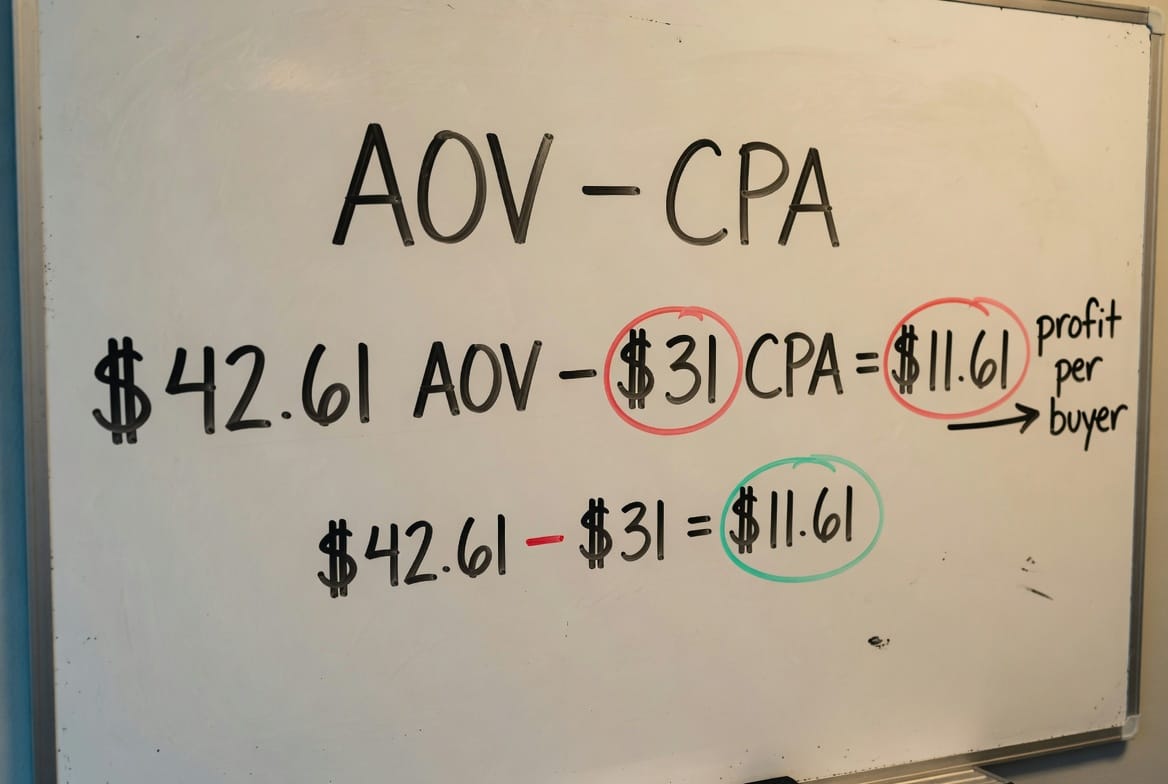
Average Order Value minus Cost Per Acquisition.
Your AOV is what the average buyer spends going through your funnel including the front-end product, the order bump if they take it, and the upsell if they take it.
Your CPA is what you spend on ads to acquire one buyer.
If your AOV is above your CPA your front end is profitable. Your ads are paying for themselves before your back end ever enters the picture. You can scale.
If your AOV is below your CPA you're losing money on every buyer you acquire and relying on your back end to save the campaign. Sometimes it does. Most of the time it doesn't.
Marcus Thompson is a business coach who restructured his funnel around this equation. His front-end product was $27. His order bump was $17 converting at 31 percent. His upsell was $47 converting at 22 percent. His average order value came out at $42.61. His cost per acquisition on Meta ads was $31.
His front end was generating $11.61 per buyer before his coaching program ever came into the picture.
That's what a profitable funnel looks like in practice. Not massive margins. Not overnight riches. A front end that covers the cost of the traffic and delivers a buyer to the back end at zero net cost.
When that math is working you can spend more on ads without losing money. When you spend more you get more buyers. When you get more buyers the back end compounds. The business grows without requiring a live performance every week to sustain it.
Why Most Funnels Fail Before They Have a Chance to Work
The most common reason a funnel fails has nothing to do with the ads or the targeting or the copy.
It has to do with the math never being viable in the first place.
Sending paid traffic to a free lead magnet means your AOV is zero. Your CPA is whatever you're paying per lead. The equation looks like this: zero minus $8 equals negative $8 per lead. You're losing $8 on every person who enters your funnel with no mechanism on the front end to recover any of it.
The only way that math ever works is if your back end converts extraordinarily well and does so quickly enough that the front-end losses don't exhaust your budget before you see a return.
For most coaches and course creators running on real budgets with real constraints, that never happens. The campaign runs for two or three weeks, the money runs out, and the conclusion is that ads don't work for their business.
Ads worked fine. The funnel structure was the problem.
The second most common reason funnels fail is that the offer hasn't been validated before significant money is spent on traffic. Most course creators build first and validate second. They spend months creating a product, launch it to cold traffic, and find out the demand wasn't as strong as they thought after the investment has already been made.
The fix is a five-day validation test before the full build. A simple version of the offer run to a small paid traffic test to confirm real strangers will pay real money for this specific solution at this specific price point. If it converts, you build. If it doesn't, you've bought information for a few hundred dollars instead of months of your life.
What a Funnel Looks Like When All of It Is Working
Priya Sharma spent four months building a course that made nine sales in its launch.
Eight months later the same course was generating consistent monthly revenue without a launch. Not because she had rewritten the content or redesigned the sales page or gotten better at marketing.
Because she had built the right front end, positioned the course correctly as the back end behind it, and let the funnel do what funnels do when they're built correctly.
Her buyer list was growing every day from paid traffic. Her front-end funnel was covering its own costs. Her existing course was converting at 22 percent to front-end buyers who arrived at it already warm, already trusting, and already predisposed to say yes to the fuller version of her work.
The course that had felt like a failure was generating more monthly revenue than her original launch had produced in total. From a funnel that ran while she slept, while she worked with clients, while she had a Tuesday afternoon free for the first time in years.
That's what a sales funnel looks like when it's built correctly. Not a complicated system requiring technical expertise. Not an expensive experiment requiring a large budget to test. A structured path that brings the right people in, covers the cost of finding them, and moves them naturally toward the offers that deliver the most value.
The complete system behind building that kind of funnel, including how to structure the offer, how to make the math work from day one, and how to set up and scale the ad campaign without it consuming your life, is what Get Paid to Get Leads covers.