Why Cold Outreach Fills Your Calendar With People Who Were Never Going to Hire You
David Chen closed his laptop at 6:47pm on a Wednesday and sat quietly for a moment.
He had been on discovery calls for four hours straight. Four different people. Four different conversations about their business challenges, their goals, their frustrations with their current situation.
Zero new clients.
The first call was with someone who had seen his LinkedIn content and was "just exploring options." The second was a referral from a former colleague who had described David's services in a way that bore almost no resemblance to what he actually did. The third was a small business owner with a genuine problem and a budget of $500, roughly a tenth of what David charged. The fourth had been promising right up until the moment the prospect mentioned they needed to "run it by their partner" and disappeared.
Four hours. Four calls. Nothing to show for it except a growing sense that he was doing something fundamentally wrong.
David had been running his consulting business for three years. He was good at what he did. His clients got results. His referrals were genuine. But the pipeline that was supposed to feed the business, a combination of LinkedIn outreach, cold email, and content marketing, kept producing the same result: a calendar full of calls with people who were never seriously going to hire him.
He wasn't bad at sales. He was talking to the wrong people.
How Cold Outreach Selects for the Wrong Prospect
The core problem with cold outreach as a primary lead generation strategy isn't the effort required, though that's considerable.
It's what the outreach selects for.
When you send a cold LinkedIn message or a cold email to someone, the people who respond are a self-selected group. And the selection criteria has almost nothing to do with whether they're actually in the market for what you sell.
Some respond out of politeness. Some respond because they're curious. Some respond because they're early in a research process that won't result in a purchase for six to twelve months. Some respond because they have a genuine problem but no real budget to solve it. Some respond because they enjoy talking about their business challenges with anyone willing to listen for free.
The one thing most of them have in common is that they haven't yet made a decision to invest in a solution. They're browsers, not buyers. And the cold outreach process has no filter for separating browsers from buyers before they land on your calendar.
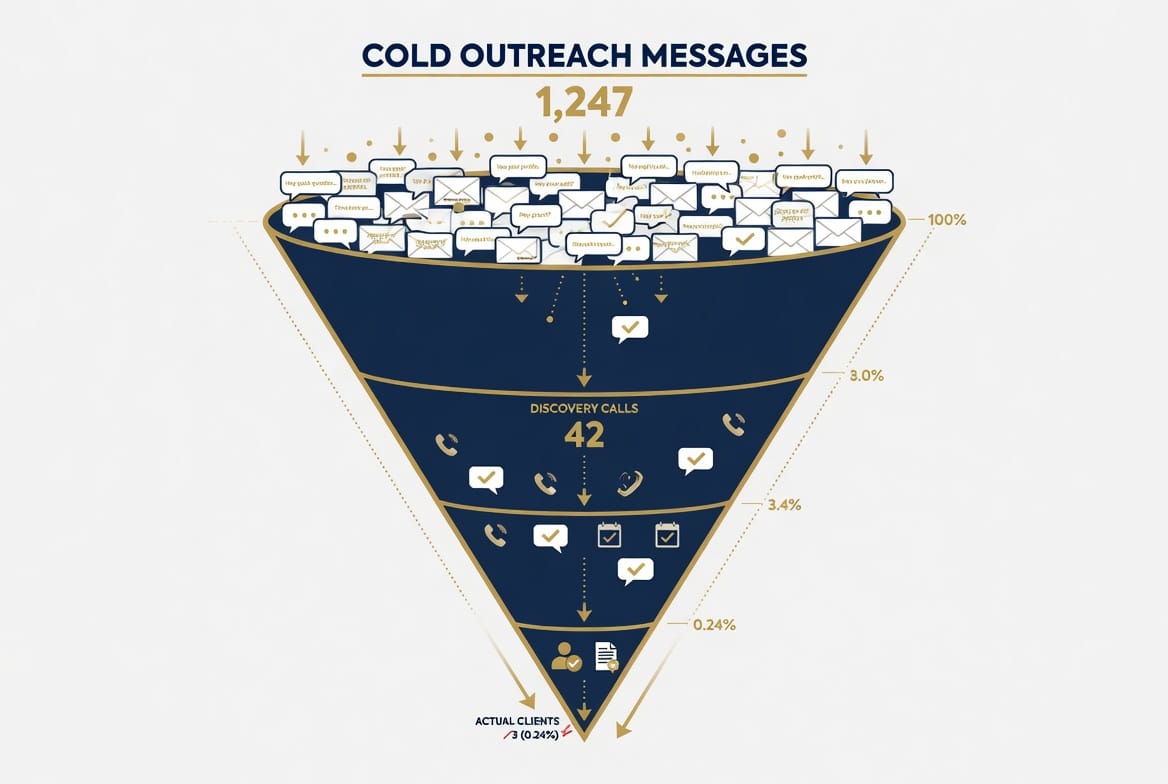
David's close rate on discovery calls from cold outreach was running at about 11 percent. That meant roughly nine out of every ten calls he was taking were with people who were never going to hire him. He was paying for those calls with his most limited resource: his time.
The Hidden Cost of the Unqualified Call
Most consultants and agency owners think about unqualified discovery calls as a nuisance. An inevitable cost of doing business. Something to minimize through better qualifying questions on the booking form.
The real cost is larger than that.
Every unqualified call costs you an hour you could have spent doing billable work, creating content, building systems, or having a conversation with someone who was actually going to hire you. At David's billing rate, an hour of his time was worth roughly $300. Four unqualified calls a week was $1,200 in opportunity cost, every week, 52 weeks a year.
That's over $60,000 a year in time spent talking to people who were never going to become clients.
There's also a subtler cost that's harder to quantify.
Unqualified calls are demoralizing in a specific way. You show up to each one with some level of hope. Maybe this one is the one. You invest genuine attention and energy into understanding their situation. You build a small amount of rapport. And then they reveal that they have no budget, or they were just curious, or they need to think about it and you never hear from them again.
Do that four times a week for three years and the cumulative psychological toll is real. David described it as "a low-grade exhaustion that made me dread my own calendar."
That's not a sales problem. That's a lead quality problem. And better sales training doesn't fix a lead quality problem.
Why Better Qualifying Questions Don't Fix It
The standard advice for dealing with unqualified discovery calls is to add more qualifying questions to the booking form.
What's your budget? What's your timeline? How long have you been dealing with this problem? Are you the decision maker?
David had done this. He had a seven-question booking form that was supposed to filter out people who weren't a serious fit.
It didn't work. Not because the questions were bad. Because people answer qualifying questions strategically. They know you won't book the call if they say they have no budget, so they put a number that sounds reasonable. They know you won't take the call if they say they're just exploring, so they frame their situation as more urgent than it is.
The qualifying form filters for people who can answer qualifying questions convincingly. It doesn't filter for buyers.
There's only one filter that reliably identifies a buyer before they ever get on your calendar.
A prior purchase.
When someone has already paid you money, even a small amount, they have demonstrated something that no qualifying question can replicate. They have shown you, with their actual behavior rather than their self-reported intentions, that they are the kind of person who spends money on solutions to their problems.
That behavioral signal changes everything about the quality of the conversation that follows.
What the Calendar Looks Like When the Filter Is a Purchase
David's calendar today looks almost nothing like the one that was draining him three years ago.
The calls he takes now are predominantly with people who came through his front-end funnel. They paid $27 for a specific resource, went through a post-purchase email sequence over the following week, and then booked a call because the sequence made it clear that working with David directly was the obvious next step for someone who wanted to go further.
These are not cold prospects who responded to an outreach message out of curiosity. These are people who have already bought from him, already consumed his content, and already decided that his approach to their problem is the right one. They're booking the call to discuss details, not to evaluate whether he's worth talking to.
His close rate on these calls is 34 percent. Three times his cold outreach number.
The calls are shorter. They move faster. The trust is already established before he says a word. The prospect often opens the call by saying some version of "I've already gone through your material and I know I want to work with you, I just have a few questions."
That's a completely different version of a discovery call. And it comes entirely from a different quality of prospect arriving through a different door.

The Qualification That Happens Before the Call
What David built wasn't just a front-end product. It was a pre-qualification system that does the filtering work before anyone gets near his calendar.
The process is straightforward from the prospect's perspective. They encounter his content or his ad. They see a specific offer that addresses a problem they're already trying to solve. They pay a small amount to access it. They receive the product and go through a short email sequence. If the sequence resonates and they want to go further, there's a clear invitation to book a call.
Every step in that process filters.
The decision to pay, even $27, filters out browsers who were never going to buy. The consumption of the product filters out people who aren't genuinely engaged with the problem. The email sequence filters out people who aren't interested in a deeper relationship. The booking process filters out people who aren't serious about taking action.
By the time someone gets on David's calendar through this process, they have passed through four natural filters. Each one was self-selected. Nobody was pressured through any of them. The people who make it through are there because they genuinely want to be there.
That's not a better qualifying form. That's a fundamentally different architecture for how prospects enter your world.
What This Means for the Cold Outreach You're Already Doing
David didn't stop cold outreach overnight. He wound it down gradually as the front-end funnel ramped up and the quality difference between the two types of calls became impossible to ignore.
If you're running cold outreach right now and it's producing some results, you don't necessarily need to stop immediately. But it's worth being honest about what it's costing you in time and psychological energy relative to what it's producing in closed clients.
And it's worth understanding that there's a version of your calendar that looks nothing like the one you're managing right now. One where the people showing up have already decided to trust you before the call starts. Where the close rate is high enough that each call feels like a worthwhile investment of your time rather than a roll of the dice.
That version of the calendar comes from a different lead generation architecture. One built around a front-end offer that pre-qualifies prospects automatically rather than a booking form that asks them to qualify themselves.
How that architecture works, what the math looks like, and how to build it in a way that makes the numbers work from day one...