Why Most Course Launches Fail and What It Has Nothing to Do With Your Content
Priya Sharma spent four months building her course.
Not four months of casual, whenever-I-feel-like-it work. Four months of early mornings before her kids woke up, late nights after they went to bed, and every spare hour she could carve out of a life that didn't have many spare hours to offer.
She recorded 14 modules. She built the workbooks. She designed the slides. She wrote the sales page. She planned the launch sequence, the email campaign, the social media push. She did everything the courses and coaches and podcasts had told her to do.
Launch day came. She sent the emails. She posted the content. She answered every comment and replied to every DM.
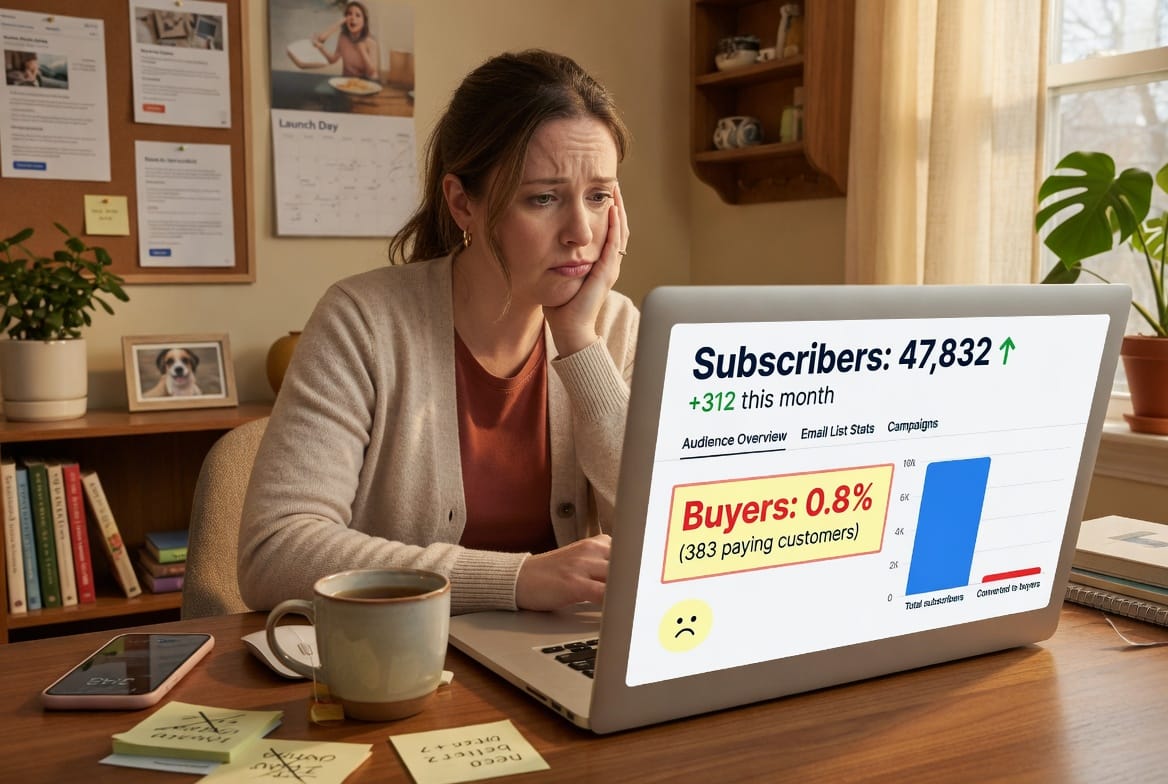
She made nine sales.
Nine sales at $197 each. $1,773 in revenue from four months of work and the most sustained creative effort she had put into anything since leaving her corporate job two years earlier.
She sat with that number for a long time.
The content was good. She knew it was good because the nine people who bought it told her it was good. Her audience had been engaged throughout the launch. The emails had decent open rates. The sales page had traffic.
None of that explained the gap between what she had built and what the market had returned for it.
Here's what actually explained it. And it had nothing to do with the quality of what she created.
The Trust Gap Nobody Talks About
There's a specific problem that sits at the heart of almost every underperforming course launch and it almost never gets named directly.
Cold traffic won't pay $197 to someone they met ten minutes ago.
That sounds obvious when you say it out loud. But most course launches are structured in a way that ignores it completely.
Priya had spent four months building a course and roughly three weeks promoting it. The people she was promoting it to fell into two categories. Her existing audience, who knew her to varying degrees, and cold traffic she was driving to the launch through ads and content.
The existing audience converted reasonably well relative to their size. The cold traffic converted almost not at all.
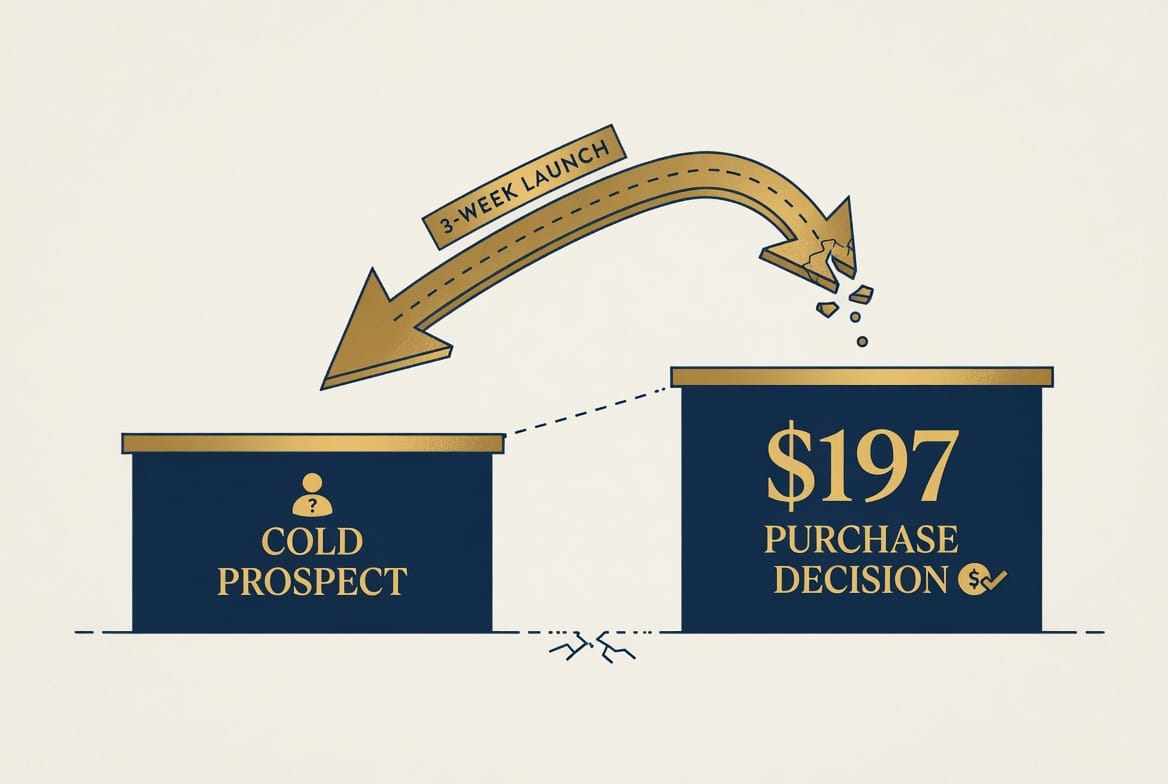
The problem wasn't the offer. It wasn't the price. It wasn't the sales page copy. It was the distance between where those cold prospects were when they first encountered her and where they needed to be to hand over $197 with confidence.
That distance is the trust gap. And a three-week launch sequence, no matter how well executed, isn't enough to close it for someone who has never heard of you before.
The launch model assumes that if you show the right people a compelling enough offer with enough social proof and enough urgency, they'll buy. For warm audiences who already know and trust you, that assumption is roughly correct. For cold traffic encountering you for the first time during a launch window, it almost never is.
What the Launch Model Gets Right and Wrong
The launch model isn't broken. It works extremely well under specific conditions.
It works when you have a large warm audience that has been consuming your content for months or years and already trusts you. It works when you have an existing buyer list of people who have already paid you for something before. It works when you have strong affiliate partners who can bring their own warm audiences to your offer.
What it doesn't work well for is turning cold strangers into $197 buyers in a compressed timeframe.
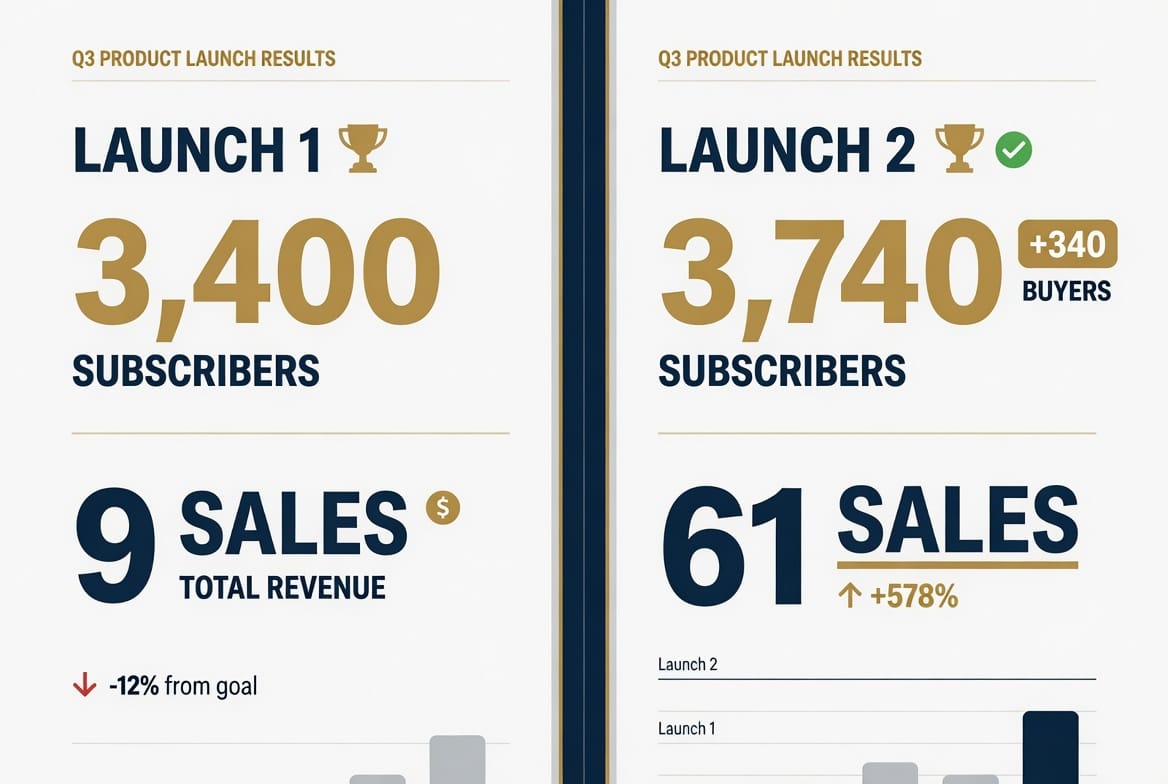
Priya's audience was real but relatively small. Around 3,400 email subscribers and a social following of similar size, most of whom had been on her list for less than a year. Not cold strangers, but not deeply warm either. People who had downloaded a free lead magnet, opened some emails, and maybe watched a few videos.
The launch model asked those people to go from mild familiarity to a $197 purchase decision in three weeks. For most of them, that was too far too fast.
It also asked her cold traffic, the people seeing her for the first time through paid ads during the launch window, to make the same leap. Almost none of them did. The ads spent money and produced awareness. They didn't produce buyers.
The launch model had optimized for the wrong thing. It had optimized for reach and visibility during a compressed window rather than for building the kind of trust that produces purchase decisions from people who don't already know you well.
The Invisible Problem With Free Lead Magnets Before a Launch
Here's something Priya hadn't considered when she was building her pre-launch audience.
The free lead magnet she had used to build her list of 3,400 subscribers had selected for the wrong type of person from day one.
Her subscribers had opted in for a free guide. They had proven one thing about themselves: they liked free things. They had not proven that they would pay for solutions to their problems. They had not demonstrated any willingness to open their wallets for anything she offered.
When the launch came and the ask shifted from "here's a free thing" to "here's a $197 course," a significant portion of that list experienced a version of whiplash. The relationship had been built entirely around free content. The sudden presence of a price tag felt like a change in the terms of the relationship rather than a natural next step.
The nine people who bought were the exceptions. The people who had been warm enough and trusting enough and aligned enough with the offer to make the jump. The remaining 3,391 people on her list were not in that place.
Not because the course was wrong. Because the relationship that had been built with them through free content wasn't the kind of relationship that produces buyers at the moment of the ask.
What Priya's Nine Buyers Actually Revealed
The nine sales from Priya's launch weren't just disappointing. They were useful data if she looked at them correctly.
She did something smart in the weeks after the launch. She talked to every single one of her nine buyers. She asked them what had moved them from interested to paying. She asked what had almost stopped them. She asked what they were hoping to get from the course.
What she found was consistent across almost all nine of them.
They had been on her list longer than average. Most had been following her for six months or more. Several had read almost everything she had published. Two had previously hired her for small one-off projects. All of them described a level of familiarity and trust that had built over time rather than during the launch window.
The launch hadn't converted them. The previous months of relationship building had converted them. The launch had just provided the vehicle.
That told her something important. The problem wasn't the course. The problem wasn't her ability to build trust or deliver value. The problem was that the model she had been using to build her audience had produced very few people who were at the trust level her nine buyers had reached.
She had 3,400 subscribers and roughly 9 of them were at the level of trust required to buy a $197 course from her. The other 3,391 would eventually get there, or they wouldn't, on a timeline she couldn't control or accelerate through a launch sequence.
What she needed was a different way of building the audience. One that brought in people who were already at a higher baseline of trust because they had already made a purchasing decision before they ever encountered her $197 course.
The Model That Closes the Trust Gap Before the Launch
The thing Priya discovered after her launch is that the trust gap isn't something you close during a launch.
You close it before one.
When your audience includes people who have already bought something from you, even a $27 product, the relationship they bring to the next offer is fundamentally different. They've already made a positive buying decision about you. They've already experienced your content in a paid context. They've already crossed the line from subscriber to customer.
Those people convert on a $197 course at dramatically higher rates than free subscribers who have never paid for anything.
Priya's second launch, eight months after the first one, was to a much smaller total audience but one that included 340 buyers from her front-end funnel sitting alongside her free subscribers. Those 340 buyers had come in through a $27 product she had launched in the months between the two launches.
Her second launch generated 61 sales. Nearly seven times the first launch from a total audience that was only marginally larger.
The course hadn't changed. The price hadn't changed. The launch sequence hadn't changed dramatically.
The audience had changed. Specifically, the 340 buyers in it had changed everything about the conversion math.
What This Means If You've Already Been Through a Disappointing Launch
If your last launch underperformed, the instinct is to look for what went wrong with the launch itself.
The copy. The timing. The price point. The bonuses. The urgency. The webinar strategy.
Those things matter at the margin. But if your launch underperformed significantly, the problem almost certainly isn't in the launch mechanics. It's in the composition of the audience the launch was running to.
Specifically, whether that audience contained enough buyers, people who had already crossed the line from subscriber to customer with you, to produce the conversion rates a successful launch requires.
The good news is that problem is completely solvable. And solving it doesn't require starting over or throwing away the course you already built.
What it requires is a front-end funnel that builds a buyer list in the months before your next launch so that when the launch comes, the audience it runs to is fundamentally different from the one that produced nine sales.
How to build that funnel, how to use it to validate your next offer before you spend months creating it, and how to structure your existing course as the natural back end of the system, is what the rest of this series covers.