Why Most Side-Hustle Ad Campaigns Lose Money Before They Ever Have a Chance to Work
Jennifer Walsh had been building her coaching business on the side for fourteen months.
She had a full-time job. A mortgage. Two kids. She was carving out evenings and early mornings to build something she believed in, and doing it carefully because every dollar she put into the business was a dollar she had personally earned somewhere else first.
She was not the kind of person who threw money around carelessly.
Which made it all the more painful when her first Facebook ad campaign cost her $600 and returned nothing.
She had done the research. Watched the tutorials. Set up the targeting carefully. Written the copy herself. She had done everything the way the courses told her to do it.
Six hundred dollars gone. Four leads. Zero sales.
She tried again three months later with a tighter budget, a different audience, and a reworked ad. Four hundred dollars. Three leads. Zero sales.
After that she put the ad account away and went back to organic content. Told herself ads weren't for her yet. That she'd try again when the business was bigger and she could afford to lose the money.
Here's what nobody told her: the campaigns didn't fail because of the ads. They failed because of what was sitting behind them.
The Part of the Equation Most People Never See
When Jennifer ran those two campaigns, she was doing what most coaches and course creators do when they first try paid traffic.
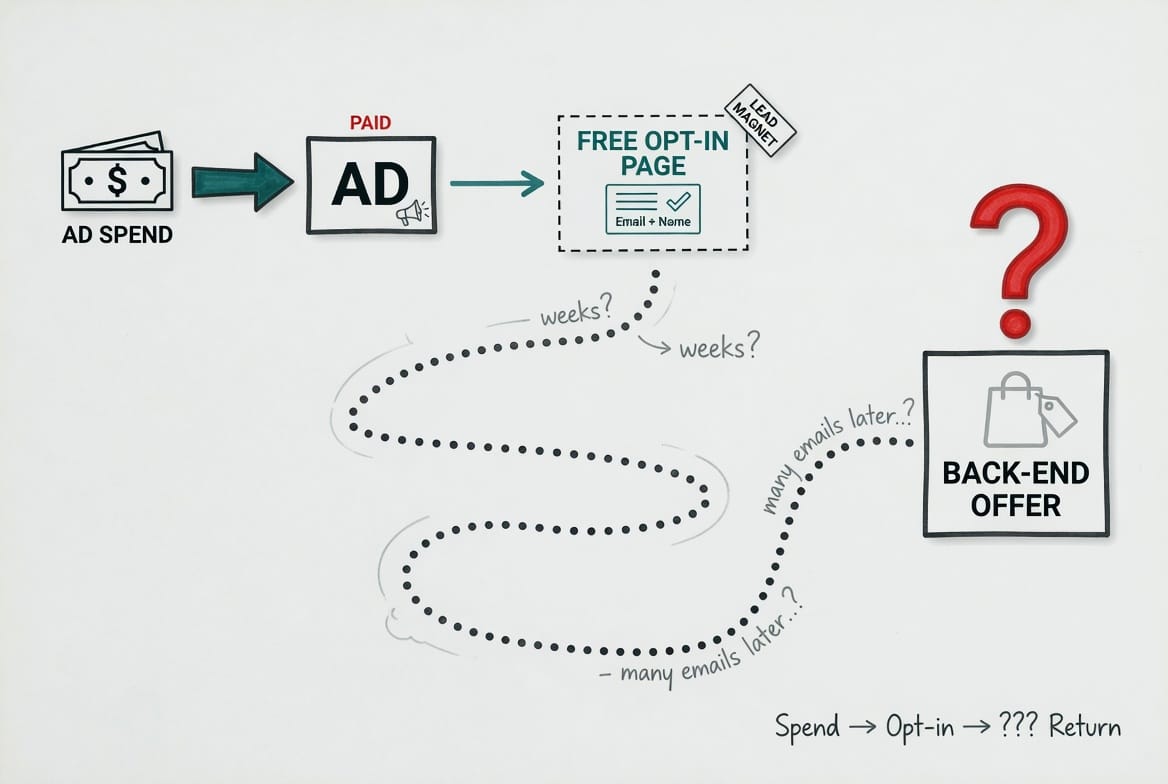
She was sending cold traffic to a free lead magnet.
A checklist. An opt-in page. No friction, no price tag, just a free download in exchange for an email address.
The logic seems sound. Get people onto your list. Nurture them. Eventually sell them something. The leads are cheap. The barrier to entry is low. What's not to like?
Here's what's not to like.
Every dollar Jennifer spent on those campaigns stayed spent. There was no mechanism on the front end to recover any of it. She was paying $8, $10, $12 per lead and getting back exactly zero dollars per lead on the front end. The only way those campaigns could ever be profitable was if her back-end offer converted well enough over the following weeks and months to justify the upfront loss.
It didn't. It rarely does.
Not because Jennifer's offer was bad. Not because her nurture sequence was weak. Because the math of the model is fundamentally broken before a single ad is written.
Sending paid traffic to a free lead magnet is a bet. You're betting that the back end will eventually produce enough revenue to cover what you spent acquiring those leads. For a one-person business running on a personal budget without the cash reserves to absorb months of front-end losses while waiting for the back end to catch up, that bet almost always loses.
Why the Side-Hustle Budget Makes This Worse
There's something specific about running a side-hustle business that makes the free lead magnet model even more punishing than it is for full-time entrepreneurs.
When you have a day job and a family and a mortgage and you're building something on the side, every dollar you put into the business carries a weight that it doesn't carry for someone whose entire livelihood depends on making the business work.
Paradoxically that weight makes you more cautious in exactly the ways that prevent the model from working.
You set smaller budgets. You pull campaigns earlier. You second-guess creative that the data says is performing. You make conservative decisions because the downside is personal and immediate in a way it isn't for someone running the business full time with investors or savings to burn through.
Jennifer pulled her second campaign after ten days. The data was actually trending in the right direction. Another week might have produced a different result. But $400 with nothing to show for it yet felt like too much to keep running, so she stopped.
The free lead magnet model requires patience and cash reserves to give it enough time to work. Most side-hustle business owners have neither. The model is almost perfectly misaligned with the financial reality of the person trying to use it.
The Fear That Keeps People Stuck on Organic
After two failed campaigns Jennifer spent the next eight months on organic content.
She posted consistently. She built her audience slowly. She made some sales. It was working, just not fast enough and not predictably enough to ever feel like she was actually building toward something she could count on.
The problem with organic content as a primary growth strategy for a side-hustle business is that it trades money for time. And time is exactly what Jennifer didn't have.
She was already stretched thin between her job, her family, and the hours she was carving out to build the business. Adding a daily content requirement on top of that wasn't sustainable. Some weeks she posted consistently. Other weeks life happened and the business stalled.
The organic strategy also didn't solve the core problem. It was still producing free leads. People who followed her, consumed her content, and occasionally bought something. Not buyers coming in systematically through a structure designed to cover its own costs.
She wasn't stuck because she lacked talent or work ethic or marketing knowledge. She was stuck because the model she was using was the wrong model for her specific situation. A person building a business on the side, with limited time and limited budget, needs a system that generates buyers, covers its own costs, and doesn't require daily manual effort to sustain.

What Changes When the Structure Is Right
Jennifer's business started to look different when she stopped trying to fix the free lead magnet model and replaced it with a different structure entirely.
The change wasn't about better ads or better targeting or better copy. It was about building a front end that generated revenue from the traffic instead of just collecting email addresses from it.
A low-ticket product that covered the cost of acquiring each buyer. An order bump and upsell that pushed the average transaction value high enough to make the math work on cold traffic. A post-purchase sequence that moved buyers toward her back-end coaching offer without requiring her to manually follow up with each one.
The first time her funnel ran for a full week and the front-end revenue covered the ad spend, something shifted for her.
Not just financially. Psychologically.
The fear of running ads had always been rooted in the same place: the knowledge that every dollar going in might not come back. When the structure is right and the math is working, that fear loses its grip. You're not gambling anymore. You're running a system.
Within 60 days of launching her restructured funnel Jennifer's ad campaigns were breaking even on the front end. Her buyer list was growing every day without her having to post content to sustain it. She was booking discovery calls from people who had already bought from her and already trusted her before they ever got on a call.
She was still working her day job. But for the first time the path from where she was to where she wanted to be had a clear shape to it.
The Thing Worth Understanding Before You Spend Another Dollar on Ads
If you've tried paid traffic before and lost money, the instinct is to conclude that ads don't work for your business.
That conclusion is almost certainly wrong.
What didn't work was the structure sitting behind the ads. The free lead magnet model that has no mechanism for recovering the cost of the traffic on the front end. The model that requires patience and cash reserves that most side-hustle business owners simply don't have.
The question worth asking before you run another campaign isn't how do I get better at ads. It's whether the funnel behind the ads is structured to cover its own costs from the moment someone clicks.
When the answer to that question is yes, ads stop being a source of anxiety and start being a growth lever you can actually use.
How to know whether your specific offer can support that structure, and how to validate the math before you spend a dollar finding out...