Why Your Free Lead Magnet Is Filling Your List With People Who Will Never Buy
In 2012, I had an email list of 300,000 people.
Not cold names. Not dead accounts. Active, cleaned weekly, real subscribers who were opening emails and clicking links.
I looked at the revenue numbers and something felt off. So I did something most marketers would never do. I shut off every free lead magnet for six months and watched what happened.
Then I cut everyone on the list who had never bought anything.
The list went from 300,000 people down to 50,000. And revenue went up.
If you've ever wondered why your open rates look decent but your sales don't match, or why you keep adding subscribers but your income stays flat, what I'm about to walk you through is probably the reason.
The One Thing a Free Opt-In Actually Tells You
When someone downloads your free lead magnet, they're giving you exactly one piece of information about themselves: they like free things.
That's it. Nothing else.
You don't know if they'll ever spend money. You don't know if they value what you do. You don't know if they're someone who acts on information or someone who collects it and moves on.
Most of them are collectors.
They're on 30 other lists. They grabbed your PDF the same way they grabbed the last seven PDFs from the last seven coaches they followed. They'll open your emails occasionally, click when something looks interesting, and buy almost never.
Meanwhile, you're paying to keep them on your list every single month.
Platform fees. Automation tools. The time you spend writing emails and building sequences to try to convert people who decided on day one that they weren't going to pay for anything.
The problem started before they ever got on your list. The free opt-in selected for the wrong person from the beginning.
What Happens When Someone Pays You $27
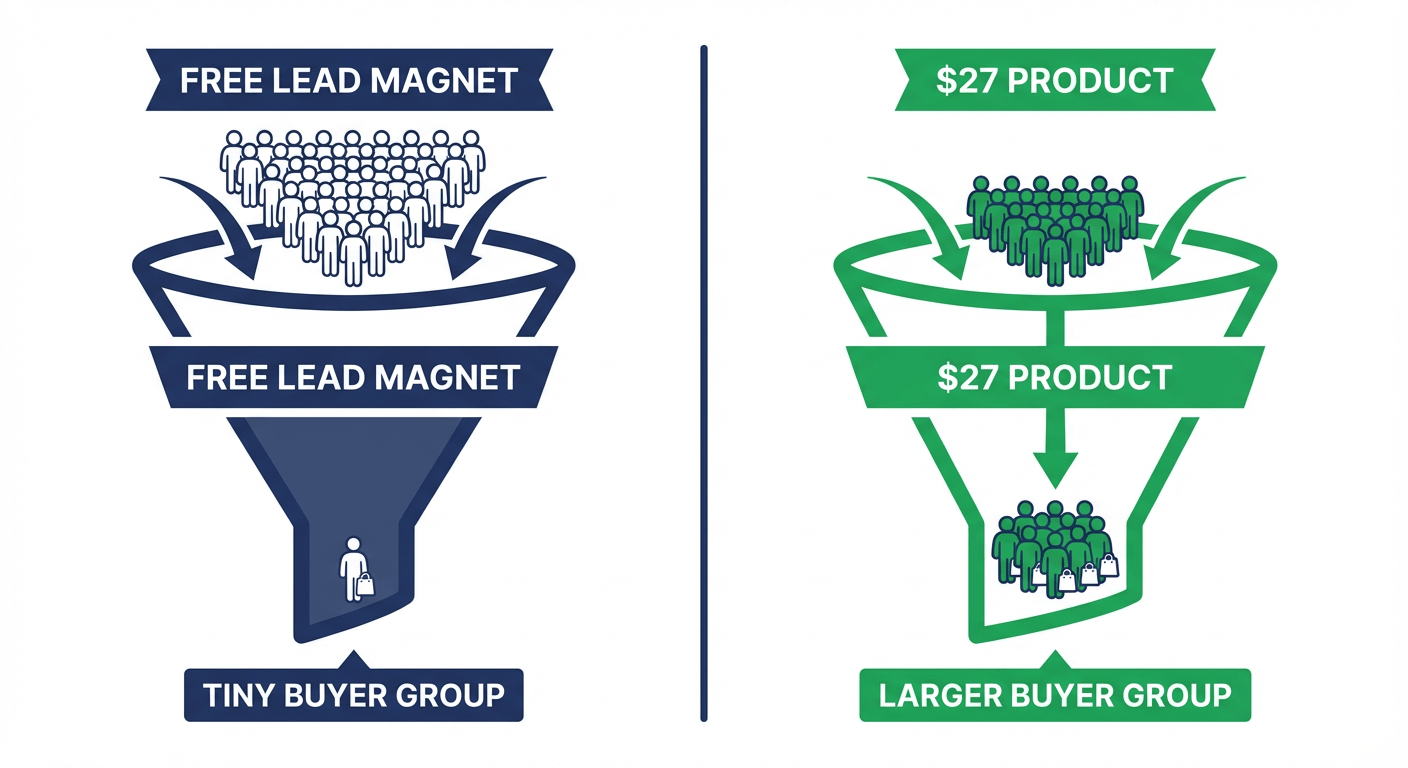
A person who pays you $27 is telling you something completely different than a person who downloaded your freebie.
They've made a buying decision. They crossed the line from consumer to customer. And that line matters more than almost anything else in your business.
Buyers buy again. Freebie seekers collect freebies.
I've seen lists of 5,000 buyers outperform lists of 80,000 free leads in raw revenue. Not because there's some magic formula at work. Because buyers are a self-selected group of people who have already proven they'll open their wallet when something is worth it to them.
When you build your list with buyers from the start, you're not just getting better leads. You're changing the entire character of your audience. Your emails get more responses. Your offers get more traction. Your launches stop feeling like you're pulling teeth.
Everything gets easier when the people on your list are actually buyers.
The Math That Most Coaches Get Backwards
Here's where most coaches and course creators get tripped up.
They hear "low-ticket product" and assume it means they're making less money. They think charging $27 instead of giving something away for free is somehow limiting them.
It's the opposite.
The goal of a low-ticket front-end product is not to make a profit on that one transaction. The goal is to acquire a buyer at a cost that paid traffic can sustain, and then sell that buyer into higher-ticket offers on the back end where your real margin lives.
Here's what that looks like in practice.
Say your front-end product sells for $27. Your cost to acquire a customer through ads is $20. You're getting paid $7 for every buyer you add to your list. That's not a huge margin, but you're not losing money either. Every single customer is free, or close to it.
Now that person is on your list as a proven buyer. They see your $97 product. Your $297 program. Your high-ticket offer. They're already ten times more likely to buy those than a free subscriber would be.
Run that math across even a modest back-end and the front-end product stops being a revenue source. It becomes a customer acquisition machine that pays for itself.
That's the entire model. And it works for coaches, consultants, course creators, and agency owners, regardless of niche.
Why This Feels Counterintuitive at First
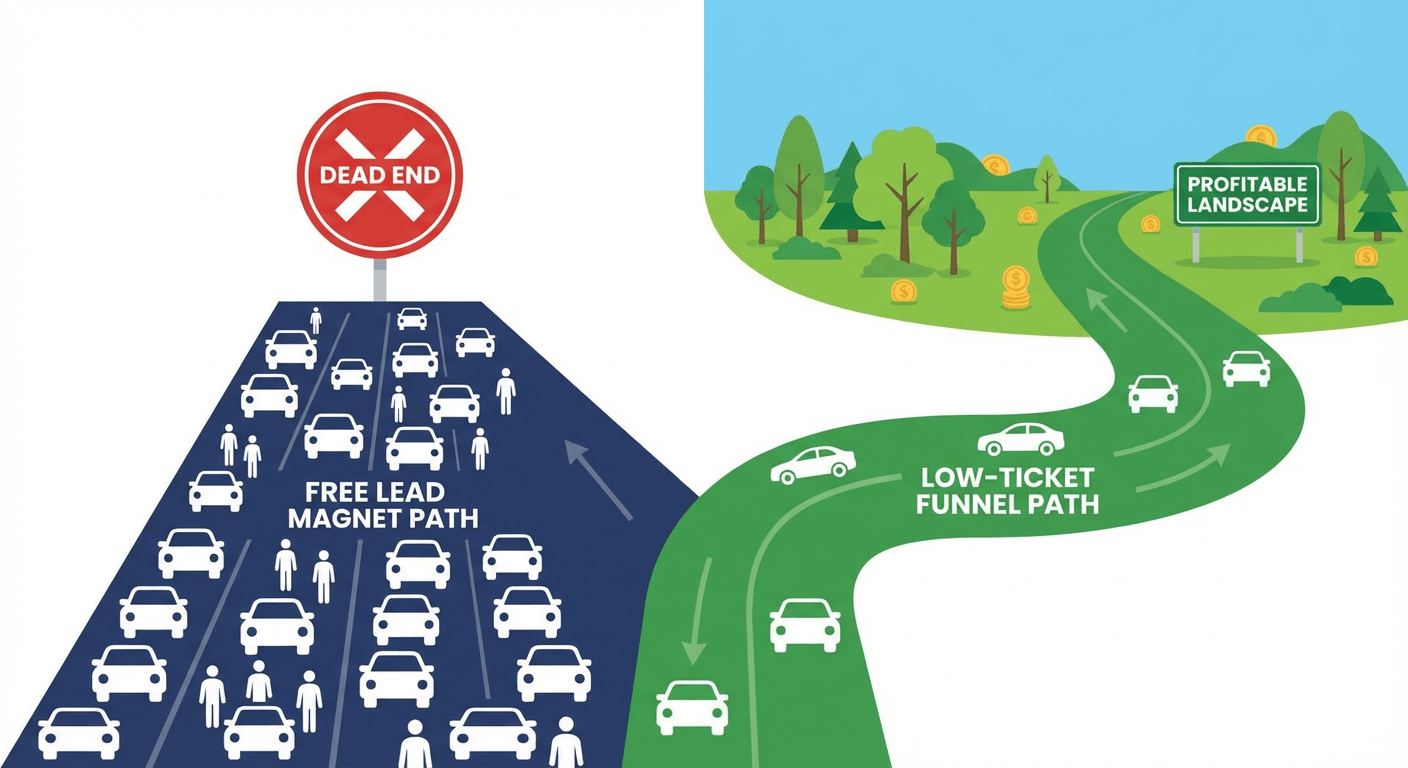
The reason most people resist this model is that the numbers look scarier up front.
A free lead magnet might pull 500 opt-ins a month. A $27 product on paid traffic might pull 80 buyers. On paper, 500 looks better than 80.
But 500 people who never buy anything are not an asset. They're an expense.
Those 80 buyers, on the other hand, are people you can build a real business around. They're people who will respond to your emails, engage with your content, and buy your next offer if it's the right fit for them.
The other thing that holds people back is the belief that they need to give something away for free to prove their value before anyone will pay them. That belief comes from a misunderstanding of what a low-ticket product actually does.
A $27 product that solves one specific problem demonstrates your value better than any freebie ever could. Because the person who buys it and gets a result trusts you with the next, bigger problem. A freebie collector trusts nobody. That's how they ended up on 30 lists.
The One Change That Shifts Everything
You don't need to overhaul your whole business to test this.
Pick one specific problem your ideal client is already trying to solve. Not a broad topic. Not a library of content. One problem, one solution, one product priced somewhere between $7 and $47.
Put it on a simple page. Drive traffic to it. Track how much it costs you to get a buyer versus how much that buyer is worth to you over time.
When that math starts working, you stop paying for leads. Your list builds itself. And every person who comes in is already a customer, not a stranger you're hoping to convert someday.
That shift, from free list building to buyer list building, is the single biggest lever most coaches and course creators are leaving untouched right now.
If you want the complete framework for building this kind of funnel, including the offer structure, the order flow, the upsell stack, and how to make paid traffic work from day one, that's exactly what Get Paid to Get Leads lays out step by step.
Grab it here - https://www.growthclubhub.com/get-paid-to-get-leads