Why Your Webinar Business Stops Making Money the Moment You Stop Showing Up
Three years ago, Marcus Thompson was doing everything right.
He had a webinar that converted. A solid offer. A growing audience. He was pulling in $8,000 to $12,000 a month coaching small business owners on marketing strategy. By every visible measure, the business was working.
Then he got sick for two weeks.
Not hospitalized. Not seriously ill. Just sick enough that he couldn't run his weekly webinar for two Thursdays in a row.
Revenue dropped by 60 percent.
He hadn't taken a vacation in 14 months. He'd been on camera every single Thursday, driving traffic to the same registration page, running the same 90-minute presentation, making the same offer. Every week without fail.
And the moment he stopped, so did the income.
That's when he realized something that changed how he thought about his business entirely. He hadn't built a business. He'd built a job that required him to perform on camera every week just to keep the lights on.
If you're running a webinar-based business right now, there's a good chance you already know exactly what that feels like.
The Webinar Model Works. Until It Doesn't.
To be clear: webinars work. They convert well. They build trust fast. They can take a cold prospect from curious to buyer in 90 minutes better than almost any other format.
The problem isn't the webinar. The problem is what happens when the webinar is the only thing generating revenue.
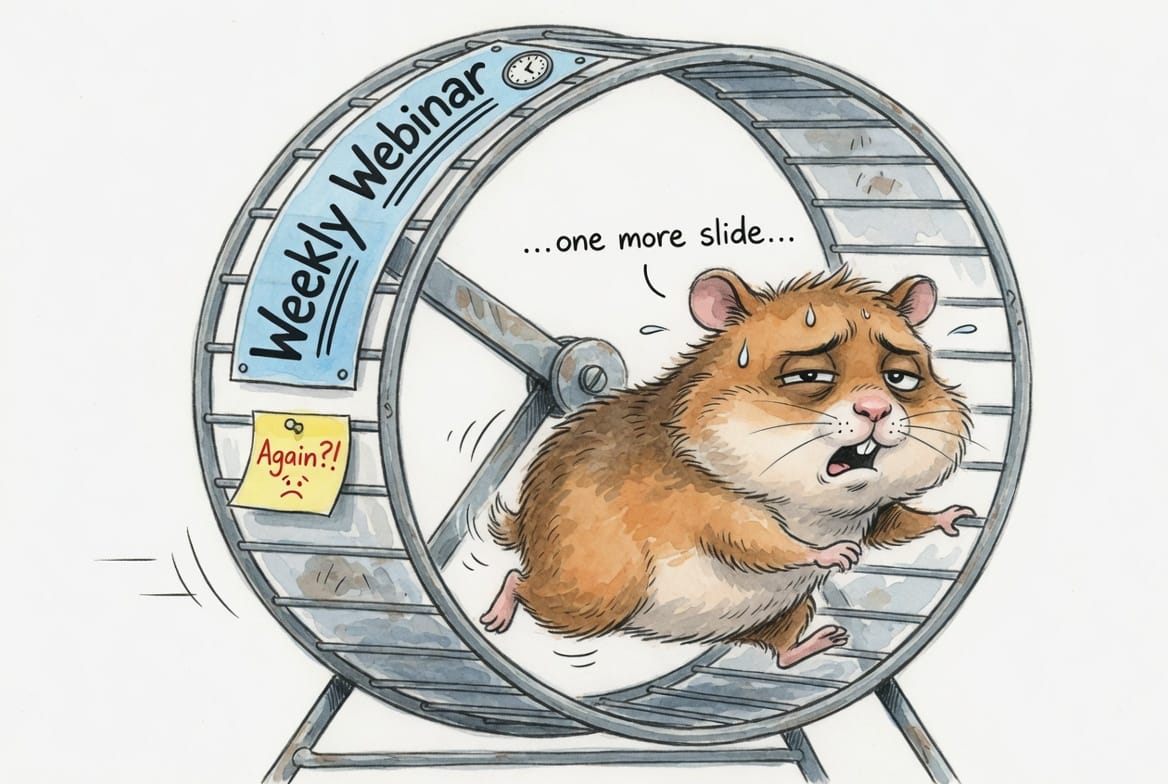
When your business is built around a live weekly event, you've created a model with a very specific and very serious structural flaw. The business has no memory. Every week starts at zero. Every week requires you to fill a room, show up, deliver, and close. If any one of those things doesn't happen, the revenue doesn't happen.
Miss a week and your pipeline stalls. Take a vacation and your income takes a vacation with you. Get sick, deal with a family emergency, or simply burn out from 18 months of showing up every Thursday, and the business stops like someone pulled a plug.
That's not freedom. That's a performance contract with no days off.
Why Most Webinar Businesses Are One Bad Month Away From a Crisis
Here's the math most webinar-based coaches don't look at closely enough.
Your revenue in any given month is a direct function of how many people showed up to your webinar that month and how well you closed them. That's it. There are no other inputs.
Which means your revenue is entirely dependent on:
Your ability to drive registration traffic every single week
Your ability to show up and deliver every single week
Your close rate staying consistent every single week
Your market not getting fatigued from seeing the same offer repeatedly
Every one of those variables is fragile. Ad costs go up. Organic reach drops. You have an off week on camera. Your audience starts to feel like they've heard this presentation before.
Any one of those things can cut your revenue in half with no warning.
Marcus had been running the same webinar for 14 months when he got sick. What he discovered when he came back wasn't just that two missed weeks had hurt his income. It was that his registration rates had been quietly declining for months because the same audience kept seeing the same promotion. He'd been working harder just to maintain the same result.
The treadmill had been speeding up without him noticing.
The Difference Between a Business and a Performance
There's a useful way to think about this.
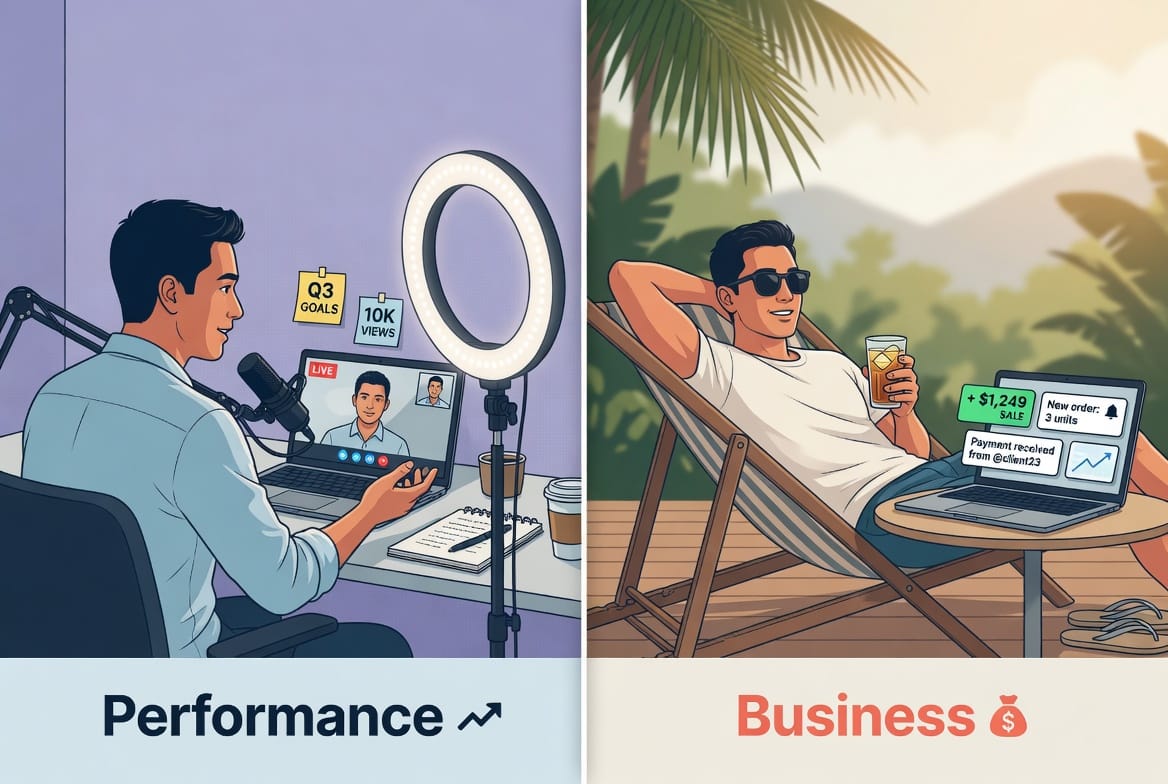
A performance requires you to show up. A business runs whether you do or not.
A musician who only makes money when they're on stage has a performance. A musician who makes money from recordings, licensing, and streaming has a business. The recordings keep generating revenue while the musician sleeps.
Your webinar is a performance. It generates revenue while you're on stage and stops when you walk off.
A front-end funnel is a recording. It runs traffic, converts buyers, and generates revenue around the clock whether you're at your desk or not.
The goal isn't to eliminate the webinar. Marcus still runs webinars. They're a powerful sales tool and he's good at them. The goal is to make the webinar optional, not mandatory. To have a system generating buyers and revenue automatically so that the webinar becomes a way to accelerate growth rather than the only thing keeping the business alive.
That's a completely different relationship with your own business.
What the Treadmill Costs You Beyond the Money
The financial fragility is the obvious problem. But there's another cost that's harder to measure and in some ways more damaging.
When your revenue requires a live performance every week, you can never fully step away. Even when you're not on camera, you're thinking about the next webinar. Preparing the promotion. Worrying about registration numbers. Checking whether the ads are performing.
The mental overhead is constant.
Coaches who run this model often describe a specific kind of exhaustion that isn't just physical. It's the exhaustion of knowing that the moment you stop thinking about the business, the business stops working. There's no coasting. There's no quiet week. There's no version of this where you go on vacation and come back to find revenue waiting for you.
Marcus described it this way: "I felt like I was always one missed week away from having to explain to my wife why we couldn't pay the mortgage."
That's not a cash flow problem. That's a structural problem. And no amount of better webinar copy or higher-converting slides fixes it.
The Question Worth Asking
If you ran your webinar business exactly as you're running it now, but you stopped showing up for 30 days, what would happen to your revenue?
If the honest answer is "it would drop significantly or disappear entirely," you're not running a business. You're running a very demanding freelance gig with a weekly performance requirement.
That's worth sitting with for a moment.
The good news is the fix doesn't require you to throw out everything you've built. Your audience is real. Your offer works. Your webinar converts. Those are valuable assets. The issue is that right now they're all dependent on your physical presence to function.
What needs to change is the infrastructure sitting underneath them.

What a Different Model Looks Like
Imagine your business had a front-end funnel running paid traffic 24 hours a day to a low-ticket product. Every day, buyers are coming in automatically. Every buyer goes through a post-purchase sequence that introduces your coaching program. Some of them book calls. Some of those calls close.
Your webinar still exists. When you run it, it accelerates everything. New buyers come in faster, your list grows quicker, your back end fills up more rapidly. But when you don't run it, the business doesn't stop. It keeps moving at a baseline pace that doesn't require you to perform.
That's the model Marcus rebuilt his business around after his two-week illness.
He didn't scrap the webinar. He built a front-end funnel that ran independently of it. Within four months, his baseline monthly revenue from the automated funnel alone covered his core expenses. The webinar became upside, not survival.
He took his first real vacation in two years. Checked his phone on day three. The funnel had generated 34 new buyers while he was on a beach.
That's what a business looks like.
How the front-end funnel works, what it costs to run, and how to make the math work from day one....